
High Demand Associate Degrees in Healthcare Beyond Nursing
High demand associate degrees in healthcare beyond nursing offer fast paths to stable careers. Call (877)-218-7081 for guidance.

By Janet Wilson
Healthcare is one of the fastest-growing industries in the United States, and nursing often dominates the conversation when students consider associate-level credentials. Yet the operating room, the diagnostic lab, and the billing office all depend on skilled professionals who never wear a nursing pin. According to the Bureau of Labor Statistics, several allied health occupations requiring only a two-year degree are projected to add tens of thousands of jobs by the early 2030s, driven by an aging population, expanding outpatient care, and stricter documentation requirements. For students who want a direct patient-care or technical role without committing to a four-year degree or a nursing curriculum, these pathways offer a faster route to employment, lower tuition costs, and strong starting salaries. This guide breaks down the most in-demand options, what each program covers, and how to choose the right fit for your career goals.
Why Allied Health Associate Degrees Are Booming
The demand curve for allied health professionals is not a temporary spike; it is a structural shift. Roughly 10,000 baby boomers turn 65 every day, and older adults consume a disproportionate share of diagnostic imaging, surgical procedures, and rehabilitation services. At the same time, hospitals and clinics are under pressure to control costs, which means they increasingly rely on two-year trained technologists and technicians rather than requiring every role to hold a bachelor's or master's degree. This creates a sweet spot for associate degree holders who can perform specialized tasks under the supervision of physicians or senior clinicians.
Another driver is technology adoption. Electronic health records, minimally invasive surgery, and advanced imaging equipment all require trained operators. Employers cannot simply promote front-desk staff into these roles; they need graduates from accredited programs who have logged clinical hours and passed national certification exams. That credential barrier keeps wages stable and reduces the risk of oversaturation that affects some other associate-level fields.
Finally, the financial equation matters. An associate degree in an allied health field typically costs a fraction of a bachelor's degree, and many programs can be completed in 18 to 24 months. For career changers and working adults, that shorter runway means less time out of the workforce and faster entry into a role with benefits. If you are weighing several two-year options, our breakdown of the most lucrative associate degrees and career outcomes puts the salary and growth numbers side by side.
Top High Demand Associate Degrees in Healthcare Beyond Nursing
The following programs consistently appear on employer shortage lists and state workforce projections. Each one combines classroom instruction with supervised clinical experience, and each leads to a certification or license that employers recognize nationwide. Salaries vary by region and setting, but the figures below reflect typical entry-level ranges for full-time positions.
- Radiologic Technology: Median pay near $70,000; projected growth around 6 percent through 2033.
- Respiratory Therapy: Median pay near $74,000; growth driven by chronic respiratory conditions and aging patients.
- Diagnostic Medical Sonography: Median pay near $84,000; one of the highest-paying two-year health credentials.
- Dental Hygiene: Median pay near $87,000; strong demand in private practices and public health clinics.
- Health Information Management: Median pay near $62,000; growth tied to coding accuracy and data privacy rules.
These roles share several advantages. They are less physically demanding than bedside nursing over a full career, they often offer predictable schedules, and they allow specialization without returning to school for a graduate degree. The trade-off is that most require state licensure or national certification, so you must choose an accredited program and pass an exam before you can work. Accreditation matters enormously here; graduating from an unaccredited program can disqualify you from certification entirely.
Radiologic Technology and Sonography
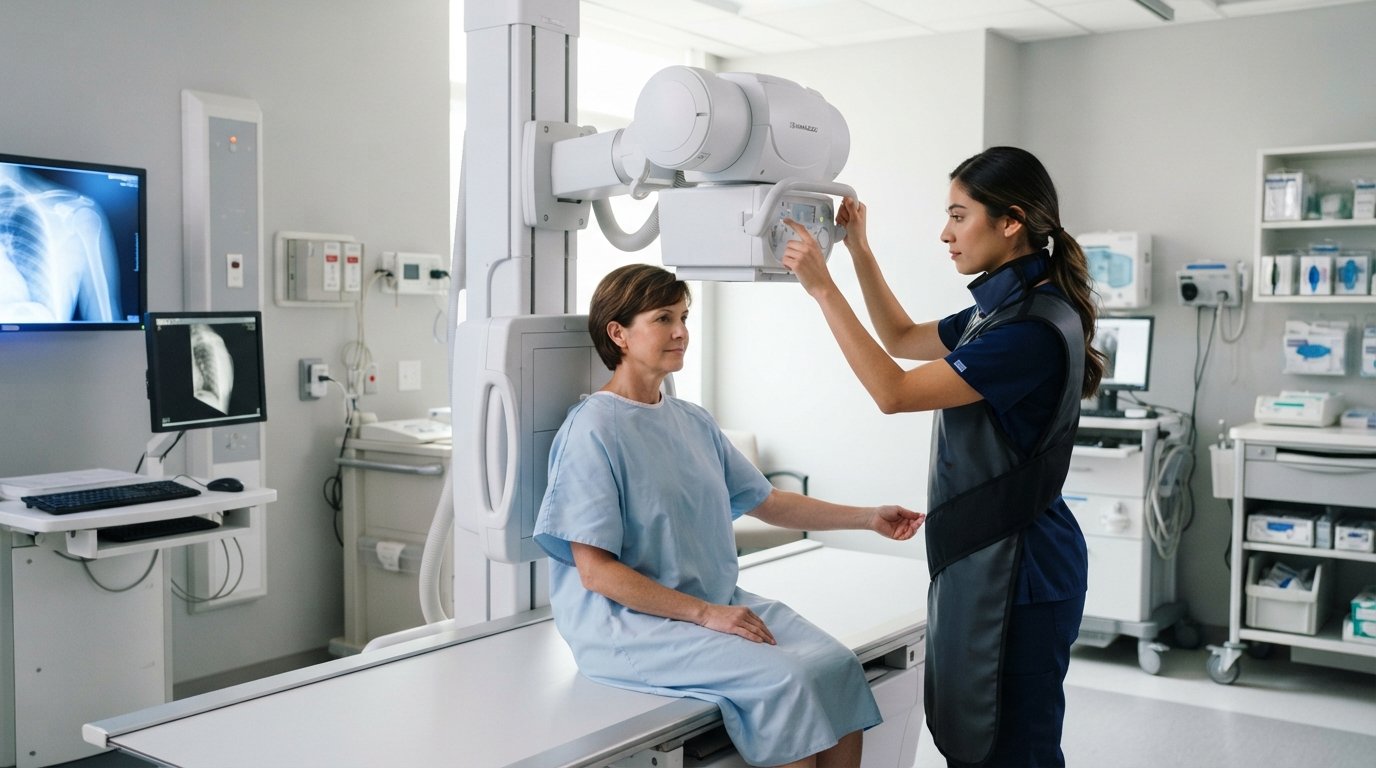
Radiologic technologists operate X-ray machines, CT scanners, and MRI equipment. The work is technical and detail-oriented: you position patients, adjust equipment settings, and ensure images are clear enough for a radiologist to interpret. Sonographers use high-frequency sound waves to create images of organs, blood vessels, and developing fetuses, and they often work in obstetrics, cardiology, or vascular labs. Both fields require strong spatial reasoning and comfort with technology.
Programs typically run 21 to 24 months and include coursework in anatomy, radiation physics, patient care, and image evaluation. Clinical rotations take place in hospitals and imaging centers, where students log a required number of procedures before sitting for the American Registry of Radiologic Technologists exam or a sonography credential. Because equipment is expensive, these programs sometimes have limited seats, so applying early is wise.
Respiratory Therapy and Dental Hygiene
Respiratory therapists help patients with asthma, COPD, sleep apnea, and post-surgical breathing difficulties. They manage ventilators, administer inhaled medications, and monitor oxygen levels. During public health crises, respiratory therapists are among the most critical staff in the hospital, which has raised the profile of the profession and boosted demand for graduates.
Dental hygienists clean teeth, take X-rays, apply sealants, and educate patients on oral health. The role offers a rare combination of clinical skill and patient interaction, with most hygienists working in private dental offices on predictable schedules. Both respiratory therapy and dental hygiene programs require clinical hours and national board exams, and both have seen steady wage growth as employers compete for licensed candidates.
Health Information Management and Medical Billing
Not every high-demand healthcare role involves direct patient contact. Health information management professionals manage patient records, assign medical codes for billing, and ensure compliance with privacy regulations such as HIPAA. As healthcare reimbursement becomes more complex and data-driven, employers need people who understand both clinical terminology and information systems.
An associate degree in health information management or medical billing and coding typically covers anatomy, medical terminology, coding systems (ICD-10 and CPT), reimbursement methods, and health law. Graduates often pursue certification through AHIMA or AAPC, which signals competence to employers and can increase starting pay. Many of these roles can be performed remotely, making them attractive to caregivers, military spouses, and people who prefer limited patient interaction.
Growth in this field is tied to the shift from paper to electronic records and the ongoing need for accurate billing. Hospitals lose revenue when claims are coded incorrectly, so skilled coders are not a luxury; they are a financial necessity. That dynamic keeps demand stable even when other parts of the healthcare system slow down.
How to Choose the Right Program
Selecting a program is not simply a matter of finding the nearest campus. Accreditation, clinical placement relationships, and pass rates on certification exams vary widely, and those factors directly affect your ability to get hired. Before you apply, gather data on each program's outcomes and compare them honestly.
- Verify programmatic accreditation for your specific field, not just regional accreditation for the school.
- Ask about clinical placement sites and whether students are guaranteed a rotation slot.
- Review first-time pass rates on national certification exams for the past three years.
- Calculate total cost, including fees, uniforms, background checks, and exam fees.
- Confirm that the program offers job placement support or employer partnerships.
Cost deserves special attention because financial aid packages differ dramatically between schools. A community college program may cost a few thousand dollars per year, while a private institution can charge three or four times that amount for the same credential. The salary after graduation is similar in both cases, so the cheaper accredited option often delivers a better return on investment. Families navigating these decisions can find practical guidance on financial aid and college planning at CollegeAndTuition, a resource focused on affordability and informed decision-making.
Career Outlook and Advancement
One concern students raise about associate degrees is the ceiling on advancement. In allied health, that ceiling is higher than many people assume. Radiologic technologists can cross-train into MRI, CT, or mammography, each of which carries a pay premium. Respiratory therapists can specialize in neonatal or critical care. Dental hygienists can move into public health, education, or practice management. Health information professionals can earn additional certifications in coding auditing or privacy compliance.
Some workers eventually return for a bachelor's degree to move into management, teaching, or sales roles with equipment manufacturers. But that step is optional, not mandatory. The associate degree alone provides a stable, benefits-eligible career with clear pathways for wage growth through specialization and experience. In a labor market where many bachelor's degree holders struggle to find work aligned with their majors, that reliability is a genuine advantage.
Demand also varies by geography. Rural hospitals and clinics often struggle more than urban systems to fill technologist roles, which can mean signing bonuses and relocation assistance for new graduates. If you are willing to work in an underserved area for a few years, you may accelerate your earnings and gain experience faster than you would in a saturated metro market.
Taking the Next Step
If you are ready to move from interest to enrollment, start by narrowing your list to two or three fields that match your strengths and lifestyle preferences. Someone who enjoys hands-on technical work may thrive in radiologic technology, while someone who prefers analysis and detail may prefer health information management. Once you have a shortlist, request information from accredited programs, compare their costs and outcomes, and apply to more than one to keep your options open. The demand for these roles is real, the training is achievable in under two years, and the payoff is a career that helps people without requiring the grueling schedule or emotional load that often accompanies nursing. With careful research and a clear plan, an allied health associate degree can be one of the smartest educational investments you make.