
Game Design Certificate in Under 12 Weeks at Clover Park
The Game and Interactive Media Design Certificate, less than 12 weeks In-person at Clover Park Technical College, builds a portfolio fast. See costs, careers, and aid.

What if you could start building a career in video game design before the next college quarter even begins? For students in Washington State, that possibility is closer than you might think. Clover Park Technical College offers a Game and Interactive Media Design Certificate, less than 12 weeks In-person at Clover Park Technical College, giving you a fast, hands-on path into one of the most creative industries in the world. This isn't a survey course or a passive online module; it is an intensive, face-to-face program designed to get you creating playable experiences and marketable assets in a single academic term.
The appeal is obvious. Traditional degree programs can take years and cost tens of thousands of dollars before you ever touch a professional-grade game engine. A short certificate flips that model. You get immediate exposure to industry tools, direct feedback from instructors, and a portfolio you can show to employers or use to launch your own projects. For career changers, recent high school graduates, and working adults who need a fast credential, this kind of program is a practical entry point. And because it is in-person, you benefit from real-time collaboration, access to campus labs, and the kind of spontaneous problem-solving that happens when creative people share a room.
This article breaks down what the certificate covers, who it is for, how to fit it into your schedule, and how to pay for it. We will also look at the career paths it can open and how it fits into a larger educational strategy. If you have been looking for a low-risk way to test your interest in game development, this program deserves a close look. For those weighing broader funding options, our guide on how to use federal aid for college degrees and certificates explains the steps to apply for financial support that can cover short-term training like this.
What the Game and Interactive Media Design Certificate Covers
The Game and Interactive Media Design Certificate, less than 12 weeks In-person at Clover Park Technical College, is built around the core competencies that entry-level game design roles demand. You will not spend weeks on theory before touching software. The curriculum is project-based from day one, meaning you learn by making things: simple prototypes, interactive scenes, character assets, and small playable levels. The goal is to give you a working vocabulary in design, art, and programming logic so you can communicate effectively with specialists in each area.
Students can expect to work with industry-standard tools. While specific software may vary by cohort, typical programs in this space cover game engines such as Unity or Unreal, 2D and 3D art pipelines, basic scripting, and level design principles. You will also touch on the softer side of game development: playtesting, iteration, and giving and receiving critique. These are the skills that separate hobbyists from professionals. A game designer must be able to explain why a mechanic works, not just that it feels right.
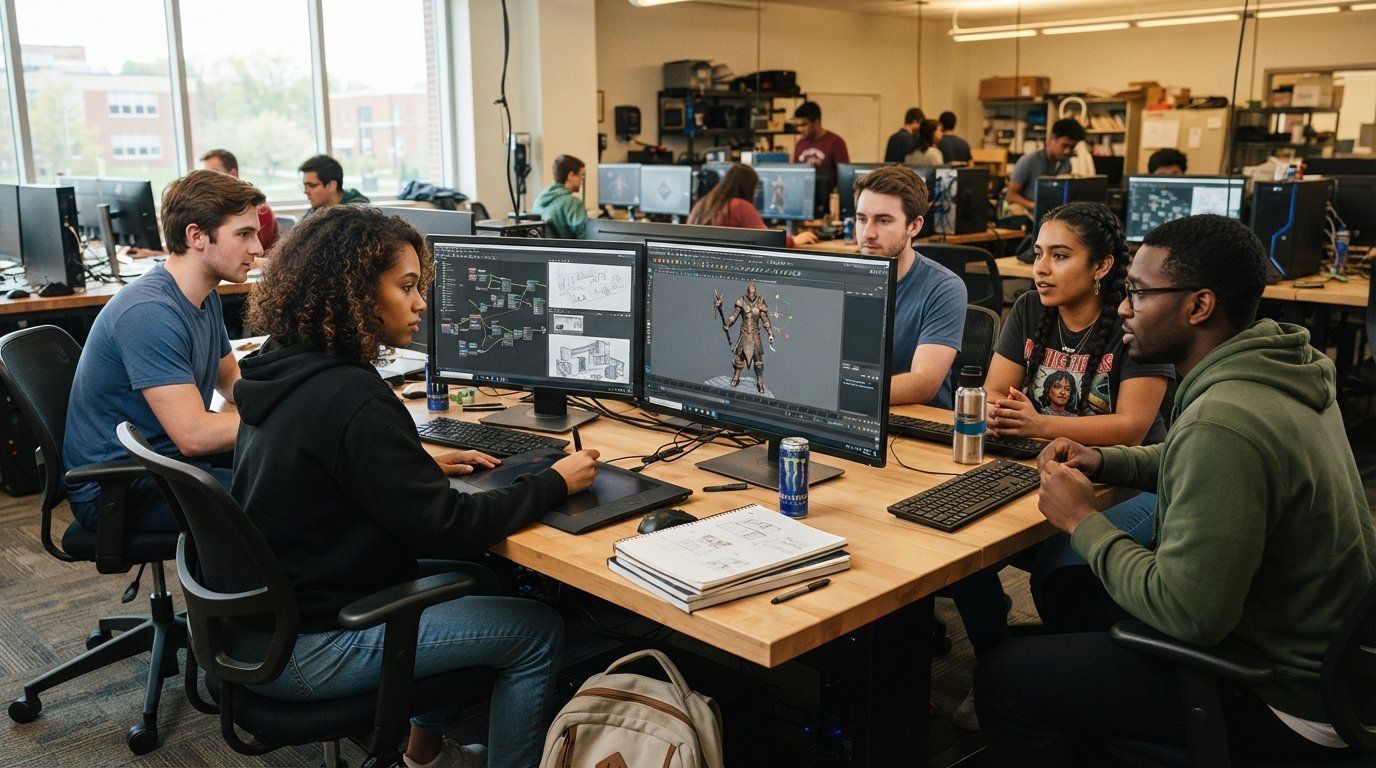
The in-person format is a major advantage here. Game development is collaborative, and learning to work in a shared studio environment mirrors how real studios operate. You will debug problems together, watch instructors demonstrate techniques in real time, and build a network of peers who may become future collaborators. The compressed timeline means you need to be focused, but it also means you finish with a concentrated body of work rather than scattered assignments from a semester-long course.
Here is a closer look at the kinds of skills and topics the certificate is designed to develop:
- Game engine fundamentals, including scene setup, asset import, and basic scripting for interaction.
- 2D and 3D asset creation, covering modeling, texturing, and animation basics for game contexts.
- Level design and environmental storytelling, with attention to player guidance and pacing.
- Playtesting and iterative design, including how to gather feedback and improve a prototype.
- Portfolio development, so you leave with finished pieces that demonstrate your abilities to employers or clients.
These skills map directly to entry-level roles such as junior game designer, QA tester, level design assistant, or indie developer. They also provide a foundation for further study if you decide to pursue an associate or bachelor's degree in game design, interactive media, or computer science. The certificate is not a replacement for a full degree, but it is a powerful first step that can help you decide whether this field is the right fit before committing to a longer program.
Who This Short Certificate Is For
The Game and Interactive Media Design Certificate, less than 12 weeks In-person at Clover Park Technical College, is designed for a broad range of learners. It is not limited to teenagers who have been modding games since middle school. The program attracts career changers who want to move into a creative technical field, working adults who need a fast credential to qualify for a new role, and veterans who are translating military experience into civilian careers. It also serves students who are not yet ready to commit to a two-year or four-year degree but want to explore game design in a structured, supportive environment.
If you are a parent helping a recent high school graduate find a direction, this certificate can be a low-cost way to test aptitude and interest. If you are a working adult with a full-time job, the compressed schedule may actually be easier to manage than a traditional semester, because the commitment is intense but short. You are not signing up for years of evening classes; you are signing up for a focused sprint. That matters for people who need to see a return on their time quickly.
It is also a strong option for people who learn best by doing. If you have struggled with lecture-heavy courses or abstract theory, the hands-on, project-driven nature of this program may suit you better. The in-person setting provides accountability and immediate help when you get stuck. You will not be alone with a confusing tutorial at midnight; you will have an instructor and classmates who can troubleshoot with you. For students who thrive in collaborative environments, that is a significant advantage.
There are also considerations for people who are weighing this certificate against a full degree. A certificate is not the same as a bachelor's degree, and some employers, particularly larger studios, may prefer or require a degree for certain roles. However, the game industry is famously portfolio-driven. A strong, focused portfolio can sometimes matter more than a credential, especially for indie studios, mobile game companies, and interactive media agencies. This certificate helps you build that portfolio fast. If you later decide to pursue a degree, the credits and experience can help you choose a program with more confidence. You can explore sponsored programs in technology and design through CollegeDegree.Education's online programs by field to compare longer-term options side by side.
How the In-Person Format and Timeline Work
The phrase less than 12 weeks is not marketing fluff; it is a structural feature of the program. Most certificate cohorts are designed to be completed in a single academic term, often around 10 to 11 weeks depending on scheduling and holidays. That means you need to be ready to commit significant time each week. In-person programs typically meet several days per week, with additional lab time for project work. The exact schedule varies, so you should confirm current meeting times with the college, but the general expectation is that this is a full-time or near-full-time commitment for the duration.
Because the program is in-person, you will need to plan for transportation, parking, and time on campus. Clover Park Technical College is located in Lakewood, Washington, with access to public transit and campus parking. The campus environment gives you access to computer labs, software licenses, and equipment that might be expensive to purchase on your own. This is a real cost savings, especially for students who do not own a powerful gaming PC or drawing tablet. The in-person requirement also means you cannot phone it in; you are expected to show up, participate, and collaborate.
Here is a practical way to think about the timeline and what you need to prepare:
- Confirm the next cohort start date and meeting schedule with the college, since these can change by term.
- Plan your transportation and daily routine, including how you will handle meals and any work or family obligations during the program.
- Check whether you need to purchase any supplies, such as a sketchbook or external storage drive, and whether software is provided on campus.
- Set up a dedicated space at home for homework and project work, even though the instruction is in-person.
- Arrange your finances, including financial aid, payment plans, or workforce funding, before the first day of class.
The compressed format is intense, but it is also efficient. You are not spreading a few concepts over months; you are immersed in them. Many students find that this intensity helps them retain skills better than a slower-paced course. The key is to treat the program like a job for those weeks. If you can clear your schedule and focus, you will get more out of it. If you cannot, you may want to wait for a term when you can commit fully.
It is also worth noting that short certificates can stack. Some students complete this program and then continue into an associate degree or a more advanced certificate. Others use it to land an entry-level job and then pursue further training while working. The certificate is a starting point, not a ceiling. The skills you learn are foundational, and the portfolio you build can be expanded over time.
Cost, Financial Aid, and Return on Investment
Cost is often the deciding factor for students considering a short certificate. While exact tuition figures change and should be confirmed with the college, certificate programs are generally far less expensive than full degree programs. You are paying for a focused set of credits, not years of general education requirements. For many students, this makes the program accessible without taking on significant debt. It also makes it easier to justify as a career exploration step; if you discover that game design is not for you, you have not lost years of time or tens of thousands of dollars.
Financial aid may be available for eligible students. Federal aid, state workforce programs, and institutional scholarships can sometimes be applied to certificate programs, but the rules vary. You should complete the FAFSA and speak with the college's financial aid office to understand what you qualify for. Veterans should also check their GI Bill benefits, as some certificate programs are approved for VA funding. For a step-by-step overview of the federal aid process, see our guide on using federal aid for degrees and certificates. It covers the FAFSA, types of aid, and how to compare offers.
Return on investment is another important consideration. Game design salaries vary widely based on role, location, and experience. Entry-level positions may start modestly, but experienced designers, technical artists, and specialized developers can earn significantly more. The certificate alone does not guarantee a high salary, but it can shorten the time it takes to get your first paid role. It also gives you a realistic sense of the industry before you invest in a longer degree. That information is valuable, even if you ultimately decide to pursue a different path.
For students who want to compare costs and outcomes across different schools and programs, CollegeDegree.Education offers a matching service that connects prospective students with accredited colleges and universities. You can explore sponsored programs, request information, and compare options without pressure. It is a useful way to see how a short certificate fits into the broader landscape of game design and interactive media education. You can also use general career resources to research job duties and typical training paths; for example, Careers.org provides occupation profiles that explain what different roles involve and how people typically prepare for them.
Career Paths and Next Steps After the Certificate
Graduates of the Game and Interactive Media Design Certificate, less than 12 weeks In-person at Clover Park Technical College, leave with a portfolio and a set of practical skills. The most direct career paths include junior game designer, quality assurance tester, level design assistant, and indie game developer. Some graduates also find work in adjacent fields such as interactive media, educational technology, simulation design, and web-based interactive experiences. The skills are transferable because they revolve around user experience, visual communication, and technical problem-solving.
It is important to be realistic about the job market. The game industry is competitive, and many entry-level roles require demonstrated experience. Your portfolio is your strongest asset. During the program, you should aim to complete at least one polished project that you can show to employers. That might be a small playable level, a character asset pack, or a prototype that demonstrates a specific mechanic. Quality matters more than quantity. A single well-executed project is more persuasive than a dozen unfinished experiments.
Networking also matters. The in-person format gives you access to instructors who may have industry connections, as well as classmates who could become collaborators or referrals. Take advantage of office hours, ask questions, and stay in touch with your cohort after the program ends. Many opportunities in creative fields come through people you know. Attend local game development meetups, participate in game jams, and keep building things. The certificate is a launchpad, not a finish line.
If you decide to continue your education, the certificate can serve as a stepping stone. You might pursue an associate degree in game design, a bachelor's degree in interactive media, or a related field such as computer science or graphic design. Some colleges accept certificate credits toward a degree, so ask about articulation agreements. You can also explore online degree programs if you need more flexibility, especially if you are working while studying. The key is to keep building on what you have started.
Finally, consider the broader trajectory of the interactive media industry. Games are not the only application; interactive design is used in healthcare training, education, architecture, and marketing. A certificate in game and interactive media design can open doors to these adjacent fields, where the same skills, such as user engagement, storytelling, and technical implementation, are highly valued. That versatility is one of the strongest arguments for this kind of short, focused training.
If you are ready to move quickly, build real skills, and test your fit for a creative technical career, the Game and Interactive Media Design Certificate, less than 12 weeks In-person at Clover Park Technical College, is worth investigating. Confirm the next start date, speak with financial aid, and prepare to treat those weeks like a launch window. Short programs work best when you show up ready to work, and the results can be surprisingly fast.