
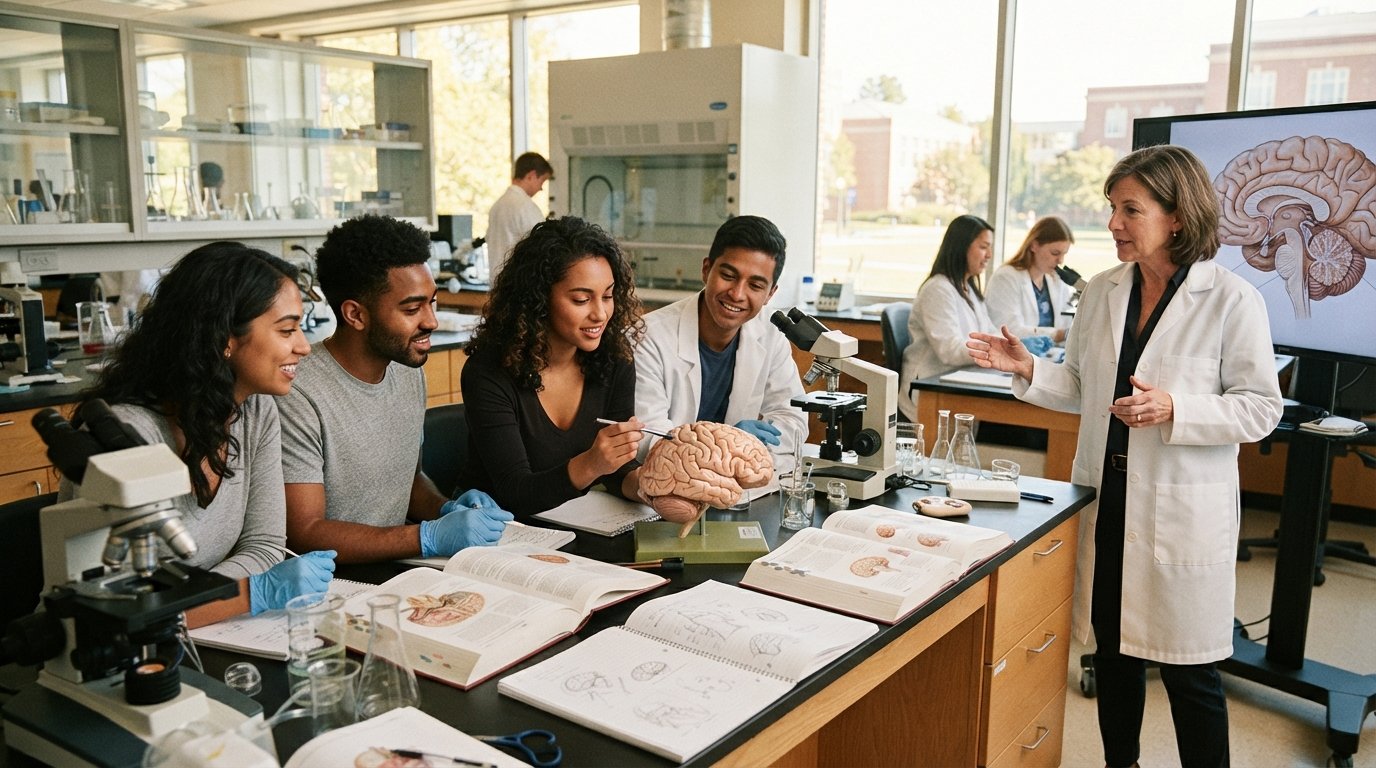
Creighton Neuroscience Bachelor's: 4-Year In-Person Guide
Creighton's in-person Neuroscience Bachelor's degree spans four years with hands-on labs and strong pre-health advising, preparing you for medical school or research careers.

By Mia Roberts
A Neuroscience Bachelor's degree, usually 4 years In-person at Creighton University, offers a rigorous, hands-on foundation in one of the fastest-growing scientific fields. If you are fascinated by the brain, behavior, and the biological roots of consciousness, this program could be your launching pad into medical school, research, or a range of health and science careers. Creighton University, a private Jesuit institution in Omaha, Nebraska, blends a strong liberal arts core with cutting-edge neuroscience coursework, giving students both depth and perspective. In this guide, we break down the curriculum, admission steps, costs, career outcomes, and campus experience so you can decide if this in-person pathway fits your goals.
Why Pursue a Neuroscience Bachelor's Degree at Creighton University?
Neuroscience sits at the intersection of biology, psychology, chemistry, and philosophy. A bachelor's degree in this field trains you to think across disciplines, analyze complex data, and communicate scientific ideas clearly. Creighton's program stands out because it is embedded in a university known for health sciences, ethics, and service. The in-person format, spanning four years, allows for face-to-face mentorship, lab access, and a tight-knit learning community. Unlike online options, this residential experience provides daily interaction with faculty who are active researchers and clinicians.
Creighton's location in Omaha also gives students access to major medical centers, including CHI Health Creighton University Medical Center and the Boys Town National Research Hospital. These partnerships create volunteer, internship, and research opportunities that are hard to replicate online. The university's Jesuit mission emphasizes caring for the whole person (cura personalis), which shapes how neuroscience is taught here: not just as a technical discipline but as a way to understand and serve human flourishing.
For students who thrive in structured, immersive environments, the in-person format is a major advantage. You will attend lectures, labs, and seminars on campus, collaborate with peers on group projects, and build relationships with professors who can write strong letters of recommendation for graduate school. The four-year timeline also allows for summer research fellowships, study abroad experiences, and clinical shadowing that deepen your resume.
Program Structure and Curriculum: What to Expect Over Four Years
The Neuroscience Bachelor's degree at Creighton is typically completed in four years of full-time, in-person study. The curriculum blends foundational science courses with specialized neuroscience electives and a liberal arts core. Expect to take biology, general chemistry, organic chemistry, physics, and calculus in your first two years, alongside introductory psychology and neuroscience. Upper-division coursework dives into neurobiology, cognitive neuroscience, neuroanatomy, and research methods. Many students also complete a senior capstone or independent research project.
Because Creighton is a Jesuit university, you will also take courses in philosophy, theology, ethics, and the humanities. These are not just requirements to check off; they enrich your understanding of neuroethics, consciousness, and the social dimensions of brain science. The program is designed to be completed in person, with labs and seminars that rely on hands-on learning. There is no accelerated online track for this specific degree, so plan for a traditional four-year residential experience.
Here is a sample progression to give you a sense of the four-year arc:
- Year 1: General biology, general chemistry, introductory psychology, composition, and theology or philosophy.
- Year 2: Organic chemistry, physics, statistics, neuroscience foundations, and ethics.
- Year 3: Neurobiology, cognitive neuroscience, research methods, and elective courses in areas like psychopharmacology or developmental neuroscience.
- Year 4: Advanced electives, senior seminar or capstone research, and internship or clinical shadowing.
This structure ensures you build a strong scientific base before specializing. The in-person format means you can seek help during office hours, join study groups, and use campus resources like the Creighton University Health Sciences Library. If you are also considering other science or engineering paths, you might explore what a civil engineering bachelor's degree involves to compare program structures and career outcomes.
Admission Requirements and Application Steps
Admission to Creighton's Neuroscience program is competitive but holistic. The university looks for students with strong high school backgrounds in science and math, but also values demonstrated curiosity, service, and leadership. You will apply through the Common Application or Creighton's own application. Typical requirements include official high school transcripts, letters of recommendation, a personal essay, and standardized test scores (ACT or SAT, though test-optional policies may apply). International students may need to submit TOEFL or IELTS scores.
To strengthen your application, take advanced science courses in high school, such as AP Biology, AP Chemistry, and AP Psychology. Participate in science clubs, research competitions, or volunteer work in healthcare settings. Creighton values its Jesuit mission, so experiences that show a commitment to service and ethics can set you apart. The application process usually opens in the summer before your senior year, with early action and regular decision deadlines in the fall and winter.
Here is a step-by-step timeline to keep you organized:
- Research the program and visit campus (in person or virtually) during your junior year.
- Prepare for and take the ACT or SAT by the spring of your junior year.
- Request letters of recommendation from science teachers and mentors.
- Write your personal essay and complete the application by the early action deadline (often November 1).
- Submit financial aid forms (FAFSA and CSS Profile) as early as possible.
After submitting, you may be invited for an interview or asked for additional materials. Creighton's admissions team communicates clearly about timelines, and the in-person campus visit can help you confirm your fit. If you are exploring multiple science pathways, you can use resources like Careers.org to learn about the day-to-day realities of various science and healthcare occupations, which can help you refine your choice.
Tuition, Financial Aid, and Affordability
As a private university, Creighton has a higher sticker price than public institutions, but generous financial aid often brings the net cost down significantly. For the 2025-2026 academic year, undergraduate tuition is approximately $47,000, plus fees, room, and board. However, the university awards merit scholarships, need-based grants, and federal aid. Nebraska residents may also qualify for state grants. It is important to file the FAFSA early and explore external scholarships from scientific societies and community organizations.
Because the program is in-person for four years, you should budget for housing and meal plans, especially if you live on campus. Many students offset costs through part-time jobs, research assistantships, or resident advisor positions. Creighton's financial aid office provides personalized counseling, and the university is committed to making education accessible. Compared to online degrees, the in-person experience includes lab fees and activity fees, but also offers facilities and services that support your success.
To manage costs, consider these strategies:
- Apply for merit scholarships through Creighton and external organizations.
- File the FAFSA by the priority deadline to maximize need-based aid.
- Look into federal work-study positions on campus.
- Explore tuition payment plans to spread costs over the semester.
Keep in mind that financial aid packages can vary, and it is wise to compare net costs rather than sticker prices. If affordability is a top concern, you might also consider online or in-state options, but for students set on Creighton's in-person neuroscience program, the investment can pay off through strong career outcomes and alumni networks.
Career Paths and Graduate School Options
A bachelor's degree in neuroscience opens doors to a variety of careers and advanced study. Many graduates pursue medical school, dental school, or physician assistant programs. Others go into research, working as lab technicians or research coordinators in academic or pharmaceutical settings. The degree also prepares you for roles in clinical psychology, physical therapy, occupational therapy, and speech-language pathology, though additional graduate training is required. Some students enter industry directly, taking positions in biotechnology, health informatics, or science communication.
Creighton's pre-health advising is strong, with dedicated advisors who help you plan coursework, secure shadowing experiences, and prepare for entrance exams. The university's alumni network in healthcare is extensive, and the in-person format allows you to build relationships with professors who can connect you to opportunities. If you are considering a career in a different branch of science or engineering, you might also look at civil engineering degree pathways to compare how technical degrees translate into infrastructure and design careers.
For students interested in graduate school, the four-year in-person program provides ample time to engage in research. You can join a faculty lab as early as your sophomore year, present at conferences, and co-author papers. These experiences are crucial for competitive PhD or MD-PhD applications. The senior capstone further demonstrates your ability to design and execute a research project.
Common career paths include:
- Medical doctor or surgeon: requires medical school and residency.
- Research scientist: often requires a PhD or master's degree.
- Physician assistant: requires a master's program and licensure.
- Clinical psychologist: requires a doctoral degree in psychology.
- Biotechnology or pharmaceutical industry: entry-level roles with a bachelor's, advancement with graduate study.
Salaries vary widely by path. For example, medical scientists with a PhD earn a median of around $100,000, while physician assistants earn over $120,000. Research technicians with a bachelor's typically start around $45,000 to $55,000. These figures underscore the value of graduate study for higher earnings, but a bachelor's in neuroscience is a versatile stepping stone.
Campus Life and the In-Person Advantage
Creighton's campus is located in midtown Omaha, a vibrant area with restaurants, parks, and cultural attractions. The in-person format means you are part of a residential community, with access to clubs, intramural sports, and service organizations. Neuroscience students often join the Neuroscience Club, participate in brain awareness outreach, or volunteer at local health fairs. The university's commitment to service is woven into campus life, and many students participate in service trips or local outreach.
The in-person advantage extends beyond social life. You will have face-to-face access to faculty mentors, use advanced lab equipment, and attend seminars by visiting scientists. The library and academic support centers are staffed with people who know you by name. For students who learn best in collaborative, structured environments, this can make a significant difference in academic performance and satisfaction. The four-year timeline also allows you to build lasting friendships and professional networks.
Omaha itself offers a low cost of living compared to other major cities, and the campus is close to medical facilities, making it easy to arrange shadowing or volunteer shifts. The city has a growing tech and healthcare sector, which provides internship opportunities. Whether you are studying late in the library or cheering on the Bluejays at a basketball game, the in-person experience at Creighton is designed to shape you as a whole person.
Is This Program Right for You?
Choosing a Neuroscience Bachelor's degree, usually 4 years In-person at Creighton University, is a commitment to a rigorous, immersive education. It suits students who want a strong foundation in science, a supportive community, and a values-driven approach to learning. If you prefer flexibility or need to work full-time, an online program might be a better fit. But if you crave hands-on lab work, close mentorship, and a campus culture that emphasizes service and ethics, Creighton's program is worth serious consideration.
To make your decision, visit campus, talk to current students, and review the curriculum in detail. Consider your long-term goals: are you aiming for medical school, research, or another health profession? Creighton's pre-health advising and research opportunities can help you get there. Also weigh the cost and financial aid package carefully. The in-person format is a significant investment, but the return can be substantial in terms of career preparation and personal growth.
As you explore options, use tools that connect you with accredited programs and financial aid information. CollegeDegree.Education's matching service can help you compare neuroscience and related science degrees, and you can request information from schools without obligation. For a broader look at how different science and engineering degrees translate into careers, you might also explore civil engineering pathways. Ultimately, the best program is the one that aligns with your learning style, budget, and professional aspirations.
Pursuing a Neuroscience Bachelor's degree at Creighton University is more than earning a credential; it is an opportunity to study the brain within a community that values ethics, service, and scientific rigor. If the in-person, four-year experience matches your goals, this program could be the foundation for a meaningful career in science and healthcare.