
Auto Mechanics Certificate at Cowley County Community College
The automotive mechanics certificate at Cowley County Community College can get you shop-ready in under two years with hands-on training and local job prospects.

By Alex Jordan
A high school senior who has spent weekends rebuilding a small block engine. A career changer tired of desk work and ready to pick up a wrench. A working adult who wants to move from oil changes to diagnostics without spending four years on a degree. All three share a practical question: is there a fast, hands-on path into the automotive trade that does not require a bachelor's degree? For many students in south-central Kansas, the answer is the Automobile/Automotive Mechanics Technology/Technician Certificate, 1 year to less than 2 years In-person at Cowley County Community College. This credential is short, skills-focused, and built around the tools and systems that modern shops actually use.
What makes this certificate worth a closer look is its format. It is an in-person program, which matters in a field where your hands, not a textbook, do most of the learning. Students work directly on vehicles, diagnostic equipment, and shop machinery under the guidance of instructors who have spent time in the industry. The 1 year to less than 2 years timeframe puts the credential within reach of people who cannot pause their lives for a traditional degree, while still delivering enough depth to prepare for entry-level technician roles.
This guide walks through what the program covers, who it is designed for, how to enroll, what it costs, and what kinds of jobs graduates typically pursue. It also explains how a certificate like this fits into the broader landscape of career and technical education, and how to compare it against other training options so you can make a confident decision.
What the Automotive Mechanics Technology Certificate Covers
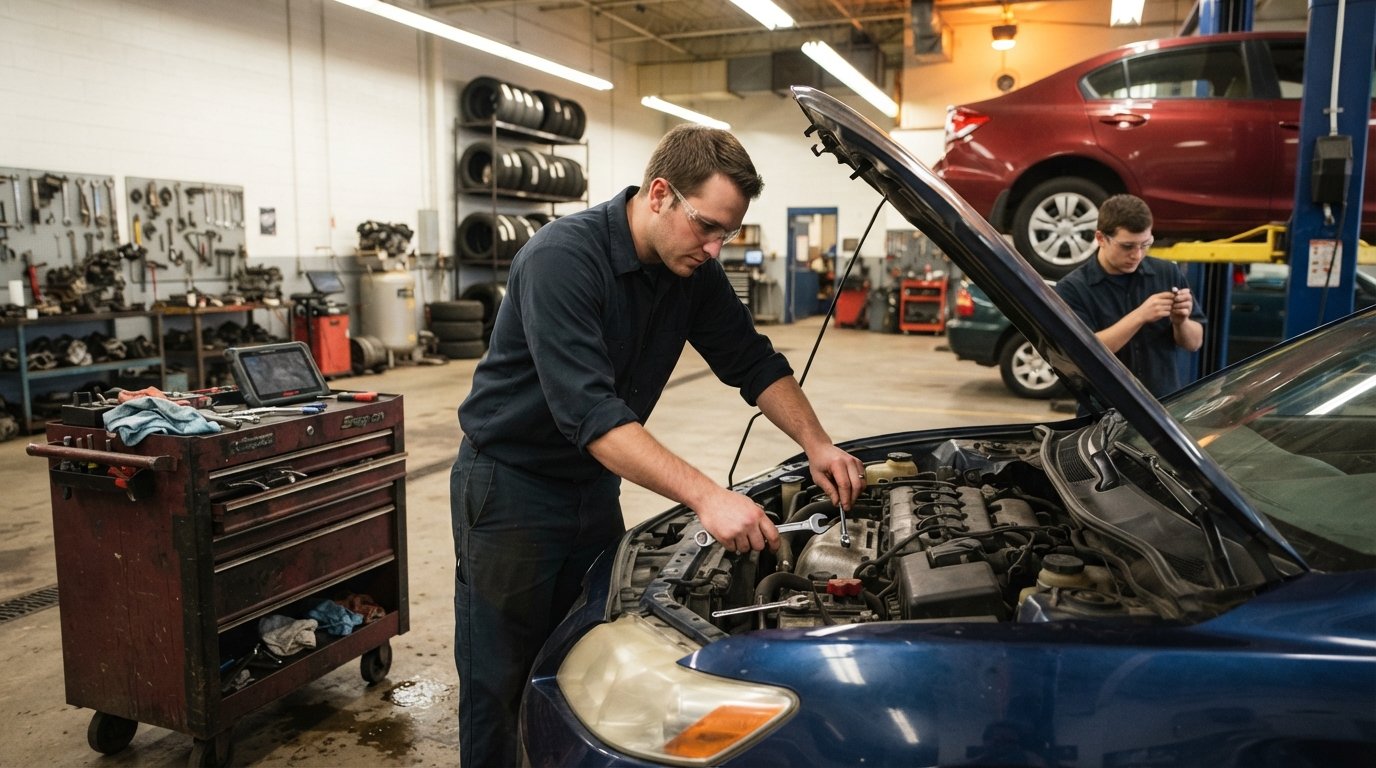
The Automobile/Automotive Mechanics Technology/Technician Certificate, 1 year to less than 2 years In-person at Cowley County Community College is built around the core competencies that every entry-level technician needs. Coursework typically blends classroom instruction with substantial lab time, so students learn the theory behind a system and then immediately apply it on real vehicles. Expect to spend time under hoods, on lifts, and at diagnostic computers, not just in seats.
Subject matter generally spans the major vehicle systems. Engine repair and performance, automatic and manual transmissions, brake systems, steering and suspension, electrical and electronic systems, heating and air conditioning, and engine performance and diagnostics are common building blocks. Many programs also introduce shop safety, tool use, service writing, and customer communication, because technicians do not work in isolation. They explain problems to service advisors, document repairs, and sometimes talk directly with customers.
One of the practical advantages of an in-person format is access to equipment that is hard to replicate at home. Students work with scan tools, digital multimeters, alignment machines, and brake lathes, and they learn how to interpret the data those tools produce. Modern vehicles are computers on wheels, and employers increasingly expect technicians to be comfortable with electronics, sensors, and network diagnostics. A well-structured certificate program reflects that reality.
Because the program runs between one and two years, it can pack a lot into a short window. Students who enter with some prior experience, such as high school auto shop or hobbyist wrenching, often move faster on hands-on tasks and can use lab time to deepen diagnostic skills. Beginners should expect an intensive pace, but the structure is designed to bring newcomers up to speed.
Who This Program Is Designed For
Career and technical programs like this one serve a wide range of students, and the automotive certificate is no exception. The common thread is a preference for hands-on learning and a desire to enter the workforce without a long detour through a four-year degree. That said, different students arrive with different goals, and it helps to see where you fit.
- Recent high school graduates who want a direct path into employment and are not ready to commit to a bachelor's program.
- Career changers moving from office, retail, or service jobs into a skilled trade with clear advancement potential.
- Working adults who need a credential they can complete in under two years while balancing jobs and family responsibilities.
- Military veterans using education benefits to build a civilian career in a hands-on field.
- Hobbyists and DIYers who want formal training to turn a passion into paid work.
It is worth noting that the program is not limited to people who already know their way around a toolbox. Instructors typically assume no prior professional experience and build from fundamentals. What matters more is reliability, attention to safety, and a willingness to ask questions when a diagnosis does not add up. Automotive work rewards patience and systematic thinking as much as mechanical aptitude.
Students who are unsure whether a certificate or a degree is the better fit should consider their timeline and goals. A certificate gets you into the workforce quickly and lets you earn while you learn. An associate degree takes longer but can open doors to advanced roles, management, or specialized niches. Many technicians start with a certificate and later return for additional credentials as their careers evolve.
Admissions, Enrollment, and What to Expect
Community college admissions for career and technical programs are generally straightforward, but automotive programs can have specific steps because of lab capacity and safety requirements. The exact process varies by institution, so always confirm details with the college, but the general sequence tends to look like this.
- Apply to the college. Complete the general admissions application, which usually includes providing identification and high school transcripts or equivalent documentation.
- Complete placement or readiness steps. Some programs use placement tests or advising conversations to confirm readiness for college-level coursework.
- Meet with an advisor. An academic advisor or program coordinator can explain cohort start dates, course sequencing, and any prerequisites.
- Register for classes and secure funding. This includes applying for financial aid, setting up a payment plan, or using employer or veteran benefits.
- Prepare for lab requirements. Safety glasses, closed-toe boots, and basic tools may be required, and some programs provide a tool list before the first day.
Because the program is in-person and lab-based, seats can be limited. Prospective students should apply early and stay in contact with the program coordinator, especially if they need specific start dates to align with work or family schedules. It also helps to ask about course load per term, since certificate programs often front-load foundational courses before moving into advanced diagnostics.
Financial aid is a common concern, and it deserves attention before classes begin. Certificate programs at accredited community colleges often qualify for federal student aid, scholarships, and workforce development grants. Veterans should check their GI Bill benefits, and working adults should ask employers about tuition assistance. For a broader look at how certificate and degree pathways compare, including funding strategies, see this guide to certificate program planning. The same principles apply across trades: understand total cost, confirm accreditation, and map the credential to specific jobs.
Cost, Financial Aid, and Return on Investment
Cost is one of the strongest arguments for a certificate over a longer degree. Community college tuition is typically far lower than four-year institutions, and a program that runs one to two years keeps total expenses contained. That said, students should budget beyond tuition. Tools, safety gear, textbooks, and transportation to and from an in-person campus all add up, and some programs require students to supply their own basic tool set.
Financial aid options for certificate seekers include federal Pell Grants, state workforce grants, institutional scholarships, and employer tuition assistance. Many community colleges also participate in work-study or apprenticeship-style arrangements with local dealerships and independent shops. These partnerships can offset costs and provide a direct pipeline to employment after graduation. Students should speak with the financial aid office early to understand what they qualify for and whether the program is eligible for specific aid programs.
Return on investment depends on the local job market and the student's willingness to keep learning. Entry-level technicians typically start at modest wages, but compensation rises with certifications, specialization, and experience. Technicians who master diagnostics, hybrid and electric vehicle systems, or diesel equipment often command higher pay. Over time, some move into service advising, shop management, or independent ownership. The certificate is a starting point, not a ceiling, and continuing education is part of the job.
Career Outcomes and Job Outlook for Automotive Technicians
Automotive technicians remain in demand because vehicles keep getting more complex and the workforce is aging. Shops report difficulty filling positions, especially for technicians who can handle diagnostics and electronics. The U.S. Bureau of Labor Statistics projects steady demand for automotive service technicians and mechanics over the coming decade, with openings driven by both growth and replacement of retiring workers.
Graduates of an automotive mechanics technology certificate typically pursue roles such as:
- Entry-level automotive service technician at dealerships, independent shops, or chain service centers.
- Quick lube and maintenance technician, often as a stepping stone to more advanced work.
- Tire and brake specialist, building foundational skills in high-volume service environments.
- Apprentice technician in a manufacturer or dealership training program.
- Fleet maintenance assistant for delivery companies, municipalities, or rental agencies.
Advancement usually comes through a combination of hands-on experience and industry certifications. The National Institute for Automotive Service Excellence (ASE) offers credentials in specific systems, and many employers pay for or reimburse certification exams. Dealerships often run their own training academies, and some technicians eventually specialize in areas like transmissions, air conditioning, or electric vehicle service. For students who want to explore the broader world of career planning and how credentials translate into wages and advancement, Careers.org offers occupation profiles and training pathway overviews that can help clarify next steps.
Geographic location matters as well. Urban and suburban areas with dense car ownership tend to have more shops and dealerships, which means more entry-level openings. Rural areas may have fewer positions but less competition. Students should look at local hiring trends and consider whether they are willing to relocate or commute for the right opportunity.
In-Person Learning and Why It Matters in This Trade
Online education has transformed many fields, but automotive mechanics is not one of them. The Automobile/Automotive Mechanics Technology/Technician Certificate, 1 year to less than 2 years In-person at Cowley County Community College reflects a simple reality: you cannot learn to diagnose a misfire or replace a transmission by watching videos. Hands-on repetition builds the muscle memory and judgment that employers expect.
In-person programs also replicate the shop environment. Students learn to work safely around lifts, power tools, and high-voltage systems. They practice communicating with peers and instructors, asking for help, and documenting work. These soft skills matter on the job, where technicians collaborate with service advisors, parts departments, and customers. A lab setting also exposes students to the pace and pressure of real service work, which helps ease the transition to employment.
For students who live at a distance, commuting to an in-person program is a real consideration. Some choose to relocate temporarily or arrange carpooling with classmates. Others use the program as a reason to move closer to employment opportunities after graduation. It is worth calculating transportation costs and time commitments before enrolling, since attendance and punctuality are part of professional training.
How to Decide If This Certificate Is Right for You
Choosing a training program is a personal decision, and the right answer depends on your goals, resources, and learning style. A few practical questions can help narrow the field. Do you want to start working quickly, or are you interested in a longer academic path that might lead to management or engineering? Are you able to attend in-person classes consistently, and do you have reliable transportation? What does the local job market look like for entry-level technicians, and are there employers who partner with the program?
It also helps to compare programs on specifics rather than general reputation. Ask about lab hours, instructor credentials, tool requirements, certification exam pass rates, and job placement support. Visit the campus if possible and talk to current students. A program that feels like a good fit on paper may look different in person, and vice versa.
Finally, keep the long view in mind. The automotive trade rewards curiosity and continuous learning. A certificate is a strong first step, but technicians who keep up with new technology, pursue ASE certifications, and seek out specialized training tend to advance faster. Whether you are fixing your first brake job or preparing for a career change, the right program gives you a foundation to build on.
If you are ready to explore automotive training and want to see how this certificate compares with other career-focused programs, start by contacting the college's admissions office and asking about start dates, costs, and financial aid. A short conversation can clarify whether the Automobile/Automotive Mechanics Technology/Technician Certificate, 1 year to less than 2 years In-person at Cowley County Community College is the right vehicle for your next chapter.