
El Paso Fashion Design Associate's Degree: 2-Year Guide
The Fashion/Apparel Design Associate's degree at El Paso Community College takes about 2 years in person and builds a job-ready portfolio without private art school costs.

By Alex Jordan
El Paso has a quiet but persistent role in the American apparel story: a border city with deep manufacturing roots, a growing independent designer scene, and a community college that trains makers at a fraction of the cost of private art schools. If you have been sketching in margins, altering thrift finds, or wondering whether a creative career is realistic without moving to New York or Los Angeles, the Fashion/Apparel Design Associate's degree, usually 2 years In-person at El Paso Community College offers a practical, affordable, and local entry point. This guide walks through what the program covers, who it suits, how to apply, what it costs in broad terms, and how to turn the credential into work.
Two years sounds short, and it is. That is exactly why the structure matters. A well-built associate's degree in apparel design front-loads hands-on skills (patternmaking, construction, draping, textiles) and pairs them with digital tools and portfolio development so graduates leave with something to show, not just a transcript. El Paso Community College, often shortened to EPCC, has built its offerings around that model, with in-person studio time that is hard to replicate through online videos alone.
What the Fashion/Apparel Design Associate's Degree at El Paso Community College Actually Covers
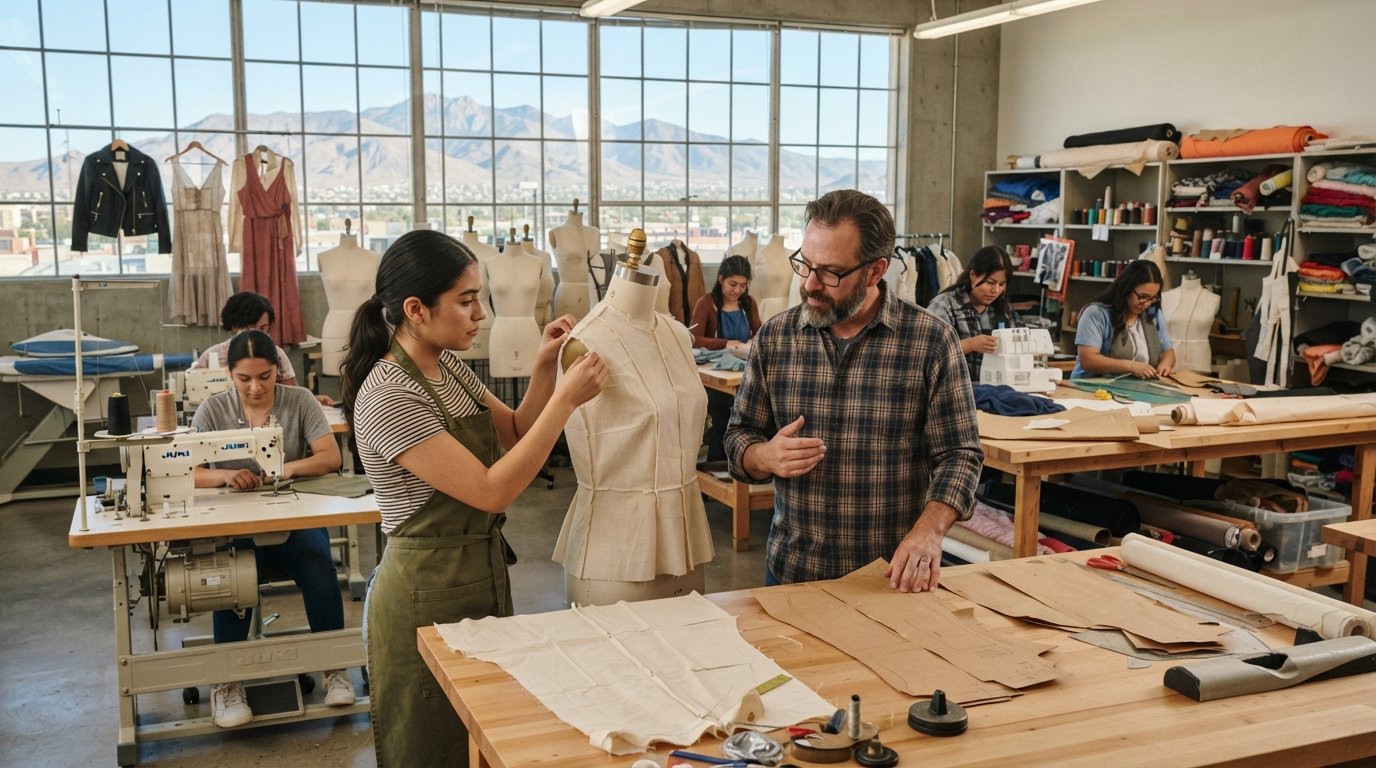
At its core, the degree is a two-year, in-person program, and the in-person part is not a formality. Sewing machines, industrial sergers, dress forms, pressing equipment, and cutting tables are shared tools, and learning to use them safely and efficiently requires supervised repetition. Students typically move through foundational courses in garment construction and patternmaking before advancing to draping, tailoring, and collection development. Along the way, they study textiles (fiber behavior, weave structures, care and durability), fashion history and trend analysis, and the business side of apparel: costing, sourcing basics, and merchandising.
Digital skills are now woven into most apparel programs, and students should expect coursework in computer-aided design, technical sketching, and possibly digital patternmaking software. A technical flat sketch that communicates measurements and construction details to a factory is a different skill from a beautiful illustration, and employers value people who can do both. Most programs also require a portfolio or capstone course where students design and construct a small collection, then present it. That final project is often the single most useful item a graduate carries into an interview.
Because the degree is an associate's, general education requirements (English composition, math, social sciences, and sometimes speech) are built in. These are not filler. Written communication matters when you are drafting spec sheets and emails to suppliers, and basic math matters when you are calculating yield, fabric consumption, and markup. Students who treat gen eds as obstacles tend to struggle later; students who use them as practice for professional communication get more out of the program.
Studio Courses Versus Lecture Courses
Expect roughly half of your week to be studio-based. Studio courses run longer, often two to three hours per session, because setup and cleanup eat time. A construction class might begin with a demonstration, then move into supervised sewing where the instructor circulates and corrects posture, seam allowance, and machine tension. Lecture courses (textiles, history, business) are more traditional but should still connect back to making. If a textiles lecture never touches actual fabric swatches, that is a warning sign.
In-person attendance also builds the habit of working alongside others, which mirrors how design rooms and sample rooms function. You will learn as much from watching a classmate solve a collar problem as from the instructor's demo. That peer learning is difficult to reproduce online, and it is a legitimate reason to choose an in-person program even when online options exist.
Who This Two-Year Degree Is For, and Who Should Look Elsewhere
The strongest candidates for this program share a few traits: they enjoy working with their hands, they are comfortable being corrected repeatedly, and they want to enter the workforce or transfer to a four-year program without taking on heavy debt. The degree suits recent high school graduates, career changers who want a structured reset, working adults who can arrange daytime or evening studio time, and veterans using education benefits. It also suits people who plan to stay in the El Paso region, where the cost of living makes launching a small brand or freelance alteration business more feasible than in coastal fashion hubs.
It is a weaker fit for students who want a purely conceptual design education with heavy emphasis on illustration and trend forecasting, or who expect the program to function as a talent agency. No associate's degree guarantees a design job at a major label. It is also a poor fit for anyone who cannot attend in person regularly, since the format is explicitly on-campus. Students seeking fully online study should compare accredited online degree programs in related fields such as graphic design or fashion merchandising, which sometimes offer more flexible delivery.
One useful framing: this degree is a skills credential, not a status credential. It teaches you to make things well and to document them professionally. What you build with those skills, whether employment, a small business, or a transfer pathway, depends on the effort you put into the portfolio and the relationships you build with instructors and local employers.
A Realistic Look at Cost, Aid, and Return on Investment
Community college tuition is among the lowest in American higher education, and for El Paso residents, district tuition rates make the two-year program dramatically cheaper than a private design school. That said, apparel design carries costs beyond tuition: fabric, muslin, thread, notions, pattern paper, a reliable sewing kit, and possibly a home sewing machine for practice. Students should budget several hundred dollars per semester for materials, more during capstone terms. A used industrial or heavy-duty home machine is often a worthwhile early purchase.
Financial aid works through the standard channels: the FAFSA, state grants, institutional scholarships, and for eligible students, workforce or trade-related funding. Veterans should speak directly with the college's veterans office about benefit coverage for studio courses and materials. Because apparel programs sometimes have lab fees, ask for a full cost breakdown by semester rather than relying on the published per-credit rate alone.
For students comparing total costs across institutions, resources that explain tuition structures and aid options can help frame the decision. Our guide on what an associate degree in medical assisting involves illustrates how two-year credentials in other fields structure costs, clinical hours, and job outcomes, which is a useful comparison point when you are weighing an apparel degree against other associate-level paths. Families mapping out affordability across several program types may also find broader planning tools at CollegeAndTuition helpful for comparing costs and aid scenarios side by side.
Return on investment is best measured in stages. In the short term, the degree qualifies you for entry-level roles: sample room assistant, pattern assistant, production assistant, alterations specialist, costume shop assistant, or retail visual merchandising with a technical edge. In the medium term, graduates who build strong portfolios and learn costing and sourcing can move into assistant designer, technical designer, or small-batch production management roles. Long-term outcomes depend heavily on specialization and location, so research local employers before enrolling and ask the program which companies have hired recent graduates.
How to Apply and What to Prepare Before Day One
Admission to a community college apparel program is generally straightforward: apply to the college, submit transcripts, complete placement steps for English and math, and declare the major. The competitive pressure is low, but the preparation gap is real. Students who arrive able to thread a machine, sew a straight seam, and read a basic pattern have a smoother first semester. If you have never sewn, a short community sewing class or a few supervised projects before enrollment is time well spent.
Here is a practical pre-enrollment sequence that reduces first-semester friction:
- Complete the college application and financial aid forms early, ideally several months before the term starts.
- Meet with an academic advisor to map the two-year sequence, noting which courses are offered only in fall or spring.
- Gather a small portfolio of whatever you have made (garments, sketches, alterations, crafts) to discuss with faculty; it helps with placement and goal setting.
- Budget for tools and materials, and ask the department for a required supply list before buying anything.
- Attend any orientation or open studio sessions to meet instructors and see the equipment.
During the program, treat the portfolio as a running project rather than a senior-year scramble. Photograph finished garments on a dress form with consistent lighting, keep digital copies of technical flats, and write short process notes for each piece. Instructors can only recommend you for opportunities if they can remember your work, and a well-organized portfolio makes that easy.
Career Paths and Transfer Options After Graduation
Graduates leave with a mix of making skills and production knowledge that fits several employment lanes. The most common entry points include sample and pattern rooms, where accuracy and speed matter; small-batch production for local brands; costume shops for theater and film; alterations and tailoring businesses; and retail roles that require technical product knowledge. El Paso's cross-border manufacturing context also creates demand for people who understand garment construction and can communicate with production teams, a niche where bilingual graduates have an advantage.
Self-employment is a legitimate path, especially for graduates who learn costing and marketing alongside construction. Small-batch clothing lines, made-to-measure services, upcycling and repair businesses, and custom cosplay or costume work all draw on the same core skills. The degree does not teach you to run a business by itself, so pair it with short courses or advising on pricing, permits, and online selling.
For students who want a bachelor's degree, transfer agreements matter. Many community college apparel programs align with four-year fashion merchandising, apparel production, or design programs, and completing the associate's first can lower the total cost of the bachelor's substantially. Ask advisors which universities accept the credits, and confirm whether studio courses transfer as studio courses or as electives. Transfer planning should begin in the first semester, not the last.
Finally, consider how this credential fits a longer career plan. A two-year degree is a strong first step, but the apparel industry rewards continuous learning: new software, sustainable materials, and digital sampling tools keep changing the work. Graduates who stay curious and keep updating their portfolios tend to advance faster than those who treat graduation as the finish line.
The Fashion/Apparel Design Associate's degree, usually 2 years In-person at El Paso Community College, is best understood as a launch platform: affordable, hands-on, and grounded in the realities of making clothes. For students who show up, use the studio time, and build a portfolio with intention, it opens doors that a stack of sketches alone never will.