
Dental Assisting Certificate: 12 Weeks to 1 Year
Earn your Dental Assisting/Assistant Certificate in 12 weeks to less than 1 year. Call 8772187081 to find accredited in-person programs near you.

By Lucas Lucas
Finding a fast, affordable path into healthcare can feel overwhelming, especially when you want to start working sooner rather than later. A Dental Assisting/Assistant Certificate, 12 weeks to less than 1 year In-person at Dental Assisting Institute offers one of the quickest routes to a stable, in-demand career. Instead of spending two or more years in a traditional degree program, you can complete focused, hands-on training and enter the workforce with the skills dental practices need every day. This guide explains what the certificate covers, how the timeline works, what to expect from in-person training, and how to decide whether this short program is the right fit for your goals. It also connects you with resources to compare accredited programs and explore financial aid options so you can make a confident, informed decision.
Why a Short Dental Assisting Certificate Makes Sense in 2026
The healthcare field continues to expand, and dental assisting is one of the most accessible entry points. Dental assistants perform a mix of clinical and administrative tasks: preparing treatment rooms, sterilizing instruments, assisting during procedures, taking X-rays (where state rules allow), and helping patients feel at ease. Because dentists rely on trained assistants to keep appointments running smoothly, demand for qualified candidates remains strong across general practices, orthodontic offices, and specialty clinics. A certificate program that runs from 12 weeks to less than a year lets you enter this field without committing to a multi-year degree.
For career changers, working adults, and recent high school graduates, the appeal is obvious. You invest a few months rather than a few years, and you build practical skills that translate directly into day-one job readiness. Many students also appreciate that shorter programs often cost significantly less than associate degrees, reducing the need for heavy student loans. If you are weighing different healthcare roles, it helps to compare this certificate with longer pathways, such as the options covered in our guide on dental assistant certificate programs that take one to two years, so you can see how program length affects cost, depth, and career flexibility.
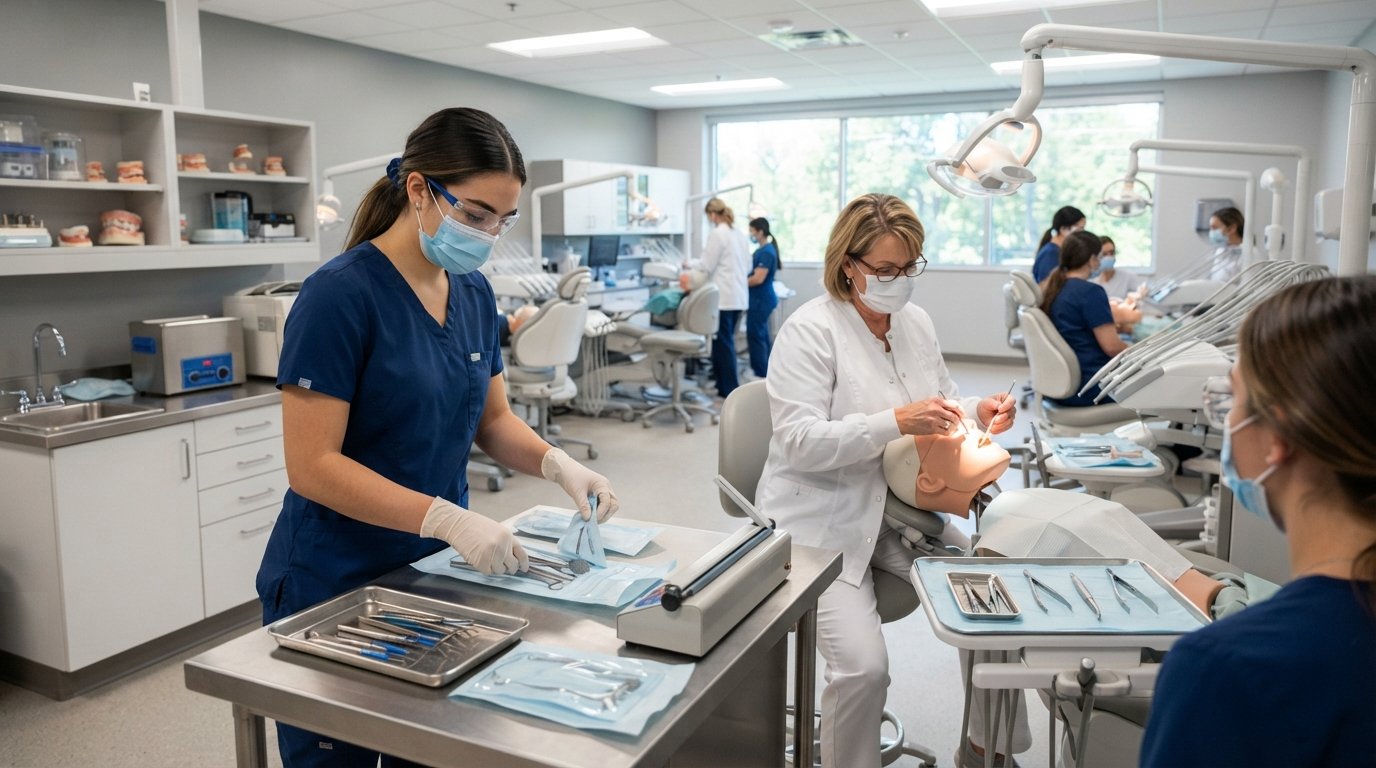
Another advantage is the in-person format. Dental assisting is a tactile profession. You need to practice chairside techniques, learn instrument passing, and understand infection control through repetition. A hands-on program at a dental assisting institute gives you supervised practice in a real or simulated clinical setting, which builds confidence before you ever step into a paid position. That practical training is difficult to replicate fully online, making in-person instruction especially valuable for this field.
What You Learn in 12 Weeks to Less Than 1 Year
Even though the program is short, the curriculum is intensive and designed to cover the core competencies employers expect. Most certificate programs blend classroom instruction with laboratory practice and, in some cases, externships at local dental offices. You will learn terminology, anatomy of the head and neck, infection control protocols, and the legal and ethical responsibilities of a dental assistant. You will also practice patient communication, which is critical because assistants often serve as the main point of contact between the dentist and the person in the chair.
Clinical skills typically include preparing tray setups, mixing dental materials, suctioning during procedures, and taking impressions. Depending on your state, you may also receive training in dental radiography (X-rays), coronal polishing, or sealant application. Programs that prepare you for state-specific certifications often include exam review and practice tests, so you can pursue credentials that expand your job options and earning potential. Administrative training may cover scheduling, billing, and electronic health records, giving you flexibility to work in front-office or back-office roles.
Here is a closer look at the core areas most short certificate programs cover:
- Clinical chairside skills: Instrument identification, four-handed dentistry, suctioning, and patient positioning.
- Infection control and safety: Sterilization, disinfection, personal protective equipment, and OSHA standards.
- Dental radiography: X-ray technique, safety, and image processing (where state regulations permit).
- Patient care and communication: Managing anxiety, explaining procedures, and documenting treatment.
- Administrative support: Scheduling, insurance forms, and basic practice management software.
Because the schedule is compressed, attendance and time management matter. Many programs meet full-time during the day, while others offer evening or weekend cohorts for working adults. You should expect a mix of lectures, hands-on labs, and quizzes or practical exams. The pace is fast, but the payoff is that you can complete your training and start applying for jobs within a few months. Before enrolling, confirm that the program includes enough hands-on hours to satisfy your state's requirements for dental assistants, since licensure and certification rules vary by location.
In-Person Training at a Dental Assisting Institute: What to Expect
Choosing an in-person program at a dedicated dental assisting institute offers several benefits over purely online or community college alternatives. First, the environment is focused. You are surrounded by peers who share the same goal, and instructors are often practicing dental professionals who bring real-world experience into the classroom. Second, equipment and materials are typically up to date, so you train on the same types of chairs, lights, and sterilization units you will encounter in a working practice. Third, the school often has relationships with local dental offices, which can lead to externship placements and job leads after graduation.
Class sizes are usually small, which means more one-on-one feedback as you practice techniques. That matters when you are learning fine motor skills like passing instruments or taking impressions. Instructors can correct your hand position immediately, helping you avoid bad habits that could slow you down later. Many institutes also provide career services, including resume help, interview preparation, and connections to hiring dentists in the area. If you are considering a program, ask about externship requirements, graduation rates, and job placement support before you commit.
It is also wise to verify accreditation. A reputable dental assisting institute should hold accreditation from an agency recognized by the U.S. Department of Education or be approved by the state board that regulates dental assisting. Accreditation matters because it can affect your eligibility for financial aid, your ability to sit for certification exams, and how employers view your credential. If you want to explore broader education options while you research, you can visit DegreesOnline.Education, a resource that helps adult learners discover accredited programs and compare pathways. Just be sure that any dental assisting program you choose is specifically approved for the credential you plan to pursue.
Admission Requirements and How to Enroll
Most dental assisting certificate programs have straightforward admission requirements. You typically need a high school diploma or equivalent, and you may need to pass a background check or provide immunization records because you will be working in a healthcare setting. Some programs require a short interview or an entrance exam to assess basic reading and math skills. Because the training is fast-paced, schools want to ensure you can keep up with the coursework and hands-on practice.
The enrollment process usually follows a predictable sequence. Here is a typical step-by-step path:
- Request information: Contact the institute or use an online matching service to learn about start dates, tuition, and program length.
- Complete the application: Submit your application, transcripts, and any required documents, such as proof of immunizations.
- Interview or entrance assessment: Some schools schedule a conversation or basic skills test to confirm readiness.
- Arrange financial aid: Discuss payment plans, scholarships, or federal aid if the program is accredited and eligible.
- Enroll and attend orientation: Once accepted, you will receive a schedule, supply list, and orientation details before classes begin.
Because start dates can fill quickly, it helps to apply early, especially if you are targeting a specific cohort. If you are also considering longer programs or want to compare costs across different healthcare certificates, take time to review tuition, fees, and living expenses. A short program reduces opportunity cost because you can start earning sooner, but you should still budget for supplies, uniforms, and any certification exam fees. Ask the school for a clear breakdown of all costs before you sign an enrollment agreement.
Career Outlook and Salary for Dental Assistants
Dental assisting offers steady demand and a clear path to advancement. The U.S. Bureau of Labor Statistics projects employment for dental assistants to grow faster than the average for all occupations over the next decade, driven by an aging population and increased focus on oral health. That growth means new graduates often find job opportunities in general dentistry, orthodontics, pediatrics, oral surgery, and public health clinics. Because assistants are needed wherever dentists practice, you can often find work close to home, and some roles offer flexible schedules that fit family or other commitments.
Earnings vary by region, experience, and credentials. Assistants who hold expanded-function certifications, such as radiography or coronal polishing, typically command higher pay because they can perform more procedures. Full-time positions often include benefits like health insurance, paid time off, and retirement plans, though part-time and temporary roles are also common. With experience, you can move into roles such as lead assistant, office manager, or clinical coordinator. Some assistants eventually return to school to become dental hygienists or dentists, using their chairside experience as a foundation for advanced study.
If you want to maximize your employability, focus on building a professional network during your training. Externships are a chance to impress potential employers, and instructors often serve as references. Keep your resume updated with specific skills, such as digital X-ray software, sterilization protocols, and patient communication. A short certificate program gives you the technical foundation, but your attitude, reliability, and willingness to learn will set you apart in a competitive hiring market.
Is This Certificate Right for You?
The Dental Assisting/Assistant Certificate, 12 weeks to less than 1 year In-person at Dental Assisting Institute is an excellent fit for people who want to enter healthcare quickly, enjoy hands-on work, and prefer a structured, face-to-face learning environment. It is less ideal for someone who wants a broad academic degree or who cannot commit to daytime classes and clinical practice. If you thrive in fast-paced settings, like working with people, and want a career with clear demand, this pathway can get you there without years of tuition and debt.
Before you enroll, visit the campus if possible, talk to current students or graduates, and confirm that the program meets your state's requirements for dental assistants. Ask about externship placement, certification exam pass rates, and job placement assistance. Those details will tell you whether the institute truly prepares you for the workplace. With the right program, you can complete your training in a matter of months and step into a role that makes a real difference in patients' lives.
Take the next step by comparing accredited dental assisting programs, checking financial aid options, and speaking with admissions advisors. A short, focused certificate can be the bridge between where you are now and a rewarding career in dental care.