
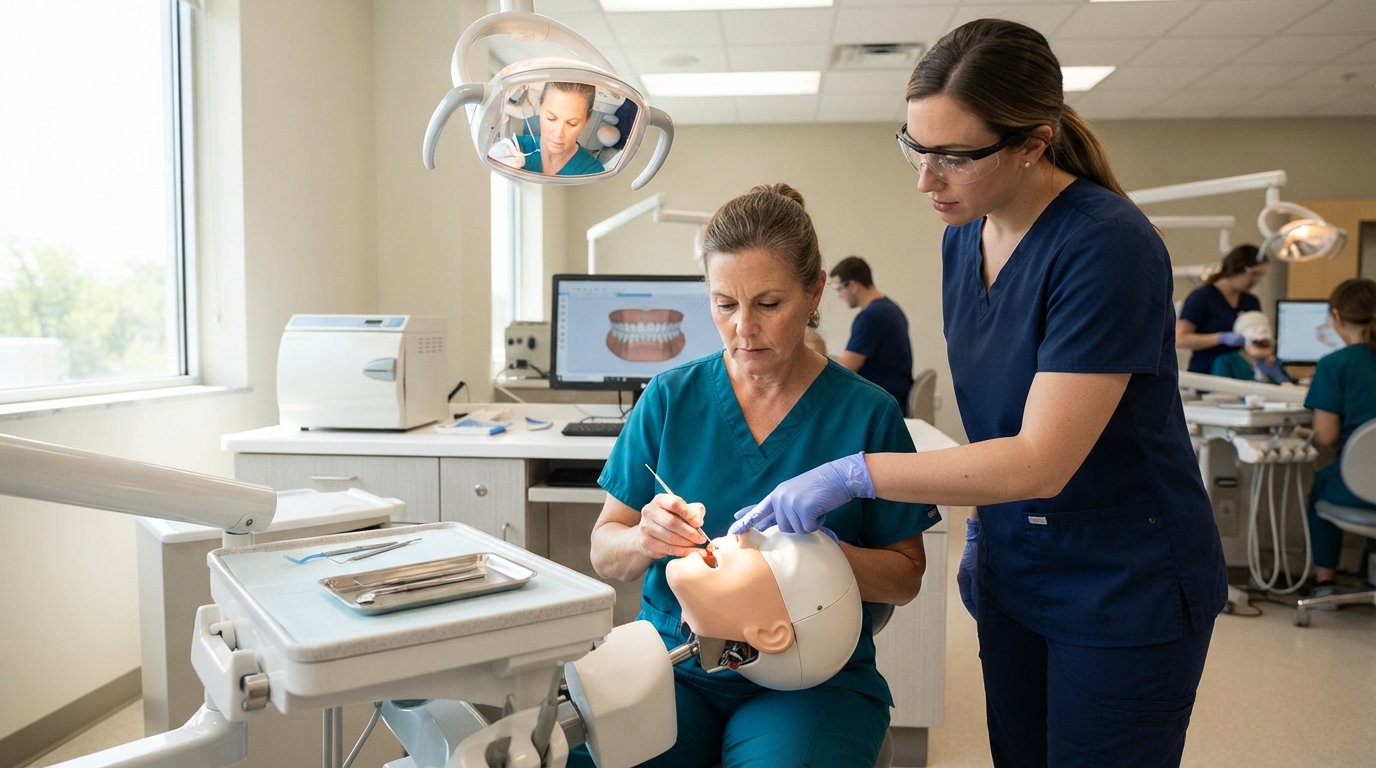
Dental Assistant Certificate: 1 to 2 Year In-Person Program
Earn a Dental Assisting Certificate in 1-2 years in person at BCIT. Gain hands-on skills for a fast-growing healthcare career.
By Scott Thompson
If you are exploring healthcare careers that offer hands-on patient interaction, a strong job outlook, and a relatively short path to entry, becoming a dental assistant is a compelling choice. The Dental Assisting/Assistant Certificate, 1 year to less than 2 years In-person at Burlington County Institute of Technology-Adult Education provides exactly that kind of focused, practical training. This program is designed for adults who want to move quickly from the classroom into a dental office, equipping them with the clinical and administrative skills that employers in New Jersey and beyond are actively seeking. Whether you are starting a new career or looking to formalize skills you already have, this certificate can serve as your gateway to a stable and rewarding profession.
Dental assistants are vital members of the oral healthcare team, performing tasks that range from preparing patients for procedures to sterilizing instruments and managing office records. The role demands a blend of technical precision, empathy, and organizational ability. Because the training is delivered in person at the Burlington County Institute of Technology, you benefit from direct supervision, real-time feedback, and access to dental equipment that mirrors what you will use in a professional setting. This hands-on approach is particularly valuable for a field where tactile skills and procedural confidence are paramount.
Why Choose a Certificate Program of This Duration?
A certificate program spanning one to less than two years strikes a practical balance between depth and speed. Unlike a four-year degree, which involves general education requirements and a longer time commitment, this focused track zeroes in on the competencies you need to become employable quickly. The curriculum at Burlington County Institute of Technology-Adult Education is structured to cover both the science behind dental procedures and the practical techniques you will use every day. You will learn chairside assisting, radiography (taking and processing X-rays), infection control, and patient communication, all within a condensed timeframe that respects your need to enter the workforce efficiently.
Moreover, this duration allows for a more thorough exploration of topics than a shorter, few-week course might offer. You have time to practice skills until they become second nature, to ask questions, and to learn from mistakes in a supportive environment. The in-person format is a distinct advantage here. While online programs offer flexibility, they cannot replicate the experience of physically positioning a patient, handling instruments, or navigating the dynamics of a real dental operatory. At Burlington County Institute of Technology, you will spend substantial hours in labs and clinical simulations, which builds the muscle memory and confidence that employers look for.
For adults balancing work or family responsibilities, the one to two year timeline is often ideal. It is long enough to master the material but short enough to see a relatively quick return on your investment. Many graduates find positions within months of completing the program, and the certificate serves as a meaningful credential that signals to employers that you have received standardized, high-quality training.
What You Will Learn: Curriculum and Skills
The curriculum for the Dental Assisting/Assistant Certificate at Burlington County Institute of Technology-Adult Education is carefully sequenced to build your knowledge from the ground up. In the early months, you will focus on foundational sciences such as dental anatomy, oral pathology, and pharmacology. You will learn the names and functions of teeth, the structure of the jaw, and the common diseases and conditions that affect the oral cavity. This theoretical groundwork is essential because it enables you to anticipate the needs of the dentist and to communicate effectively with patients about their oral health.
As you progress, the emphasis shifts to hands-on clinical skills. You will practice four-handed dentistry, where you assist the dentist by passing instruments, retracting tissues, and managing suction. You will learn to prepare and pass materials like composites and cements, and you will become proficient in taking digital and traditional X-rays, a task that requires certification in many states. Infection control is another critical component; you will master the protocols for sterilizing instruments, disinfecting surfaces, and handling hazardous materials, all of which are essential for patient and staff safety.
Beyond clinical duties, the program also addresses the administrative side of dental practice. You will learn how to schedule appointments, manage patient records, handle billing and insurance claims, and use dental software. This dual focus makes you a more versatile employee, capable of supporting the practice both at the chairside and at the front desk. Many smaller dental offices, in particular, value assistants who can seamlessly switch between these roles.
Key Skills You Will Develop
- Chairside assisting techniques and instrument transfer
- Radiography (taking and processing dental X-rays) with proper safety protocols
- Infection control and sterilization procedures
- Patient communication and comfort management
- Basic office administration, including scheduling and billing
These skills are not just academic; they are directly aligned with the duties that dental assistants perform on a daily basis. By the time you complete the certificate, you will be able to walk into a dental office and contribute from day one, which is a significant advantage during the job search.
Career Paths and Job Outlook
One of the most attractive aspects of earning the Dental Assisting/Assistant Certificate, 1 year to less than 2 years In-person at Burlington County Institute of Technology-Adult Education is the strength of the job market for dental assistants. According to the U.S. Bureau of Labor Statistics, employment of dental assistants is projected to grow much faster than the average for all occupations, driven by ongoing research linking oral health to overall health and by an aging population that requires more dental care. This demand translates into a wide range of employment settings, including private dental practices, community health clinics, specialty offices (like orthodontics or oral surgery), and dental schools.
In addition to traditional dental offices, you might find opportunities in public health settings, where you could help provide care to underserved populations, or in corporate dental chains that offer a different pace and benefits structure. Some dental assistants also choose to specialize further after gaining experience, such as becoming a dental office manager, a dental sales representative, or a dental assistant instructor. The certificate you earn here is often a stepping stone to further education; some assistants go on to pursue additional certifications in areas like expanded functions, which allow them to perform more advanced procedures under the dentist's supervision.
The earning potential is also solid. While salaries vary by location and experience, dental assistants earn a median annual wage that is competitive for a position requiring less than two years of post-secondary training. In New Jersey, where the cost of living is higher, wages tend to be above the national average. Furthermore, many dental practices offer benefits such as health insurance and retirement plans, making this a stable and sustainable career choice.
Why Choose Burlington County Institute of Technology-Adult Education?
Selecting the right training provider is as important as choosing the career itself. Burlington County Institute of Technology (BCIT) has a long-standing reputation for delivering career and technical education that is responsive to local industry needs. The Adult Education division is specifically designed for learners who are balancing other commitments, offering schedules and support services that accommodate working adults. The instructors at BCIT are typically experienced dental professionals who bring real-world insights into the classroom, sharing not just techniques but also the nuances of patient interaction and practice management.
The in-person nature of the program is one of its strongest selling points. You will train in facilities that are equipped with modern dental chairs, X-ray units, and sterilization equipment. This exposure ensures that you are comfortable with the technology and tools used in contemporary practices. Moreover, BCIT often has relationships with local dental offices, which can facilitate externships or job placements after you complete the program. While the school does not guarantee employment, its career services and industry connections can give you a head start in your job search.
Another advantage is the program's structure. The one to two year timeline is not rigidly fixed; it is designed to give you enough time to absorb the material while still allowing you to plan your career transition with confidence. BCIT also provides academic advising and support services to help you navigate any challenges that arise during your studies. For adults who may have been out of a classroom for years, this support can be invaluable.
How to Get Started: Admission and Costs
Getting started in the Dental Assisting/Assistant Certificate program at BCIT-Adult Education involves a straightforward application process. Prospective students typically need a high school diploma or GED, and some programs may require a background check and proof of immunizations, given the healthcare setting. You may also need to complete a basic skills assessment to ensure you are prepared for the coursework. The admissions team at BCIT can provide specific details and guide you through the requirements, so reaching out to them directly is a wise first step.
Financial considerations are important for any adult learner. The cost of the program is significantly lower than that of a two-year associate degree, and because you can enter the workforce sooner, the overall return on investment is favorable. Be sure to explore financial aid options, including federal grants and loans, scholarships, and payment plans. Some employers may also offer tuition reimbursement if you are currently working in a healthcare or administrative role. The financial aid office at BCIT can help you understand what you qualify for and how to apply.
If you are comparing this program with other educational pathways, you might also consider how an associate degree in education could complement your career goals, though that is a different field. For dental assisting specifically, the certificate is the most direct route. However, if you are interested in broader healthcare education, you can explore resources like DegreesOnline.Education to find online degree programs that might suit your needs, should you decide to pursue further education later.
Making the Most of Your Training
Once you are enrolled, your success in the program will depend on your engagement and dedication. Treat every lab session as a rehearsal for your future job. Practice not just the technical skills but also the soft skills, such as greeting patients warmly, explaining procedures in plain language, and working calmly under pressure. These interpersonal abilities are often what set outstanding dental assistants apart, and they are best developed through in-person interaction, which is a core strength of the BCIT program.
Take advantage of any externship opportunities that BCIT offers. An externship allows you to work in a real dental office under the guidance of experienced professionals, giving you a taste of the pace and expectations of the job. It also provides a chance to network and potentially secure a job offer before you even graduate. Many students find that their externship site becomes their first employer, so approach it with professionalism and enthusiasm.
Finally, keep your long-term goals in mind. A certificate is just the beginning. You might decide to pursue further certifications, such as becoming a Registered Dental Assistant or obtaining a specialty credential in orthodontics or pediatric dentistry. The foundation you build at BCIT will support these future ambitions, and the confidence you gain from mastering a field will serve you well throughout your career.
In summary, the Dental Assisting/Assistant Certificate, 1 year to less than 2 years In-person at Burlington County Institute of Technology-Adult Education is more than just a training program; it is a launchpad for a stable and fulfilling healthcare career. With a balanced curriculum, hands-on instruction, and a clear pathway to employment, it represents a smart investment in your future. If you are ready to take the next step toward becoming a dental assistant, this program deserves your serious consideration.