
Art Studies Bachelor's at Albright College: 4-Year Guide
Explore the Art/Art Studies, General Bachelor's degree, usually 4 years In-person at Albright College. Call 8772187081 for guidance on admissions and financial aid.

By Janet Wilson
Choosing an art degree can feel like standing in a gallery with a thousand doors, each one leading somewhere different. For students who want breadth over narrow specialization, the Art/Art Studies, General Bachelor's degree, usually 4 years In-person at Albright College offers a structured yet flexible path. Albright College, located in Reading, Pennsylvania, has built a reputation for interdisciplinary learning, and its general art studies program reflects that philosophy: studio practice, art history, and critical thinking woven together across four years of face-to-face instruction. If you are weighing whether this program fits your goals, the details below will help you compare costs, coursework, career outcomes, and alternatives without the guesswork.
What the Art/Art Studies, General Bachelor's Degree at Albright College Actually Covers
A general art studies degree is not the same as a specialized BFA in painting or graphic design. At Albright, the Art/Art Studies, General Bachelor's degree, usually 4 years In-person, is designed for students who want a broad foundation across multiple media before deciding on a concentration, or who plan to combine art with another field such as communications, education, or business. The curriculum typically moves through foundational drawing and design courses, intermediate studio work in two and three dimensions, art history surveys, and upper-level electives that let you shape your own emphasis.
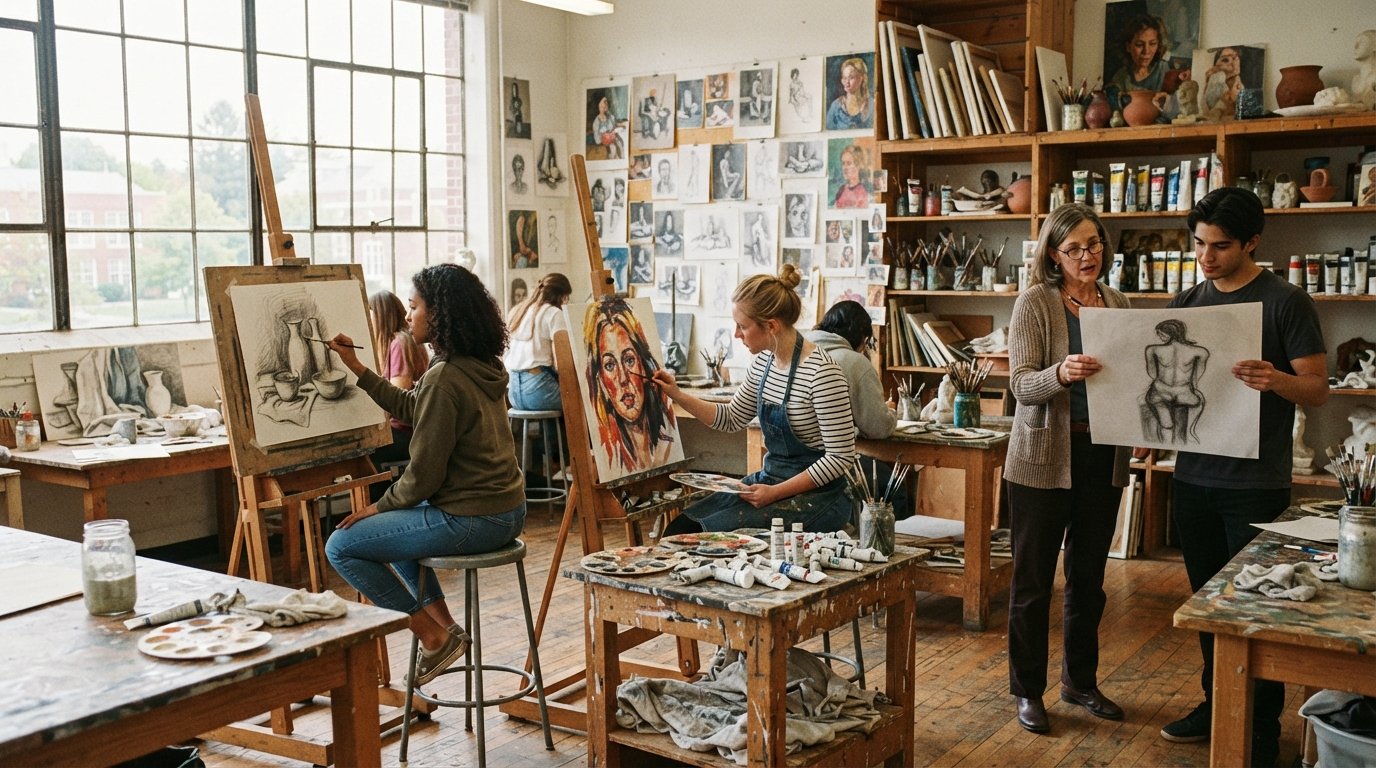
Because the program is in-person, students benefit from daily access to studios, critique sessions, and faculty mentorship that online programs struggle to replicate. The four-year timeline also allows room for internships, study abroad, or a second major without extending graduation. Albright's approach to interdisciplinary studies means you can pair art courses with psychology, digital media, or even neuroscience if your interests lean toward the science of perception. In fact, students curious about how the brain processes visual information often explore resources like our Bachelor of Neuroscience Degree Guide to understand adjacent pathways.
Typical coursework in a general art studies program includes:
- Two-dimensional design and color theory
- Drawing I and II, including figure drawing
- Three-dimensional design and sculpture fundamentals
- Survey of Western art history and global art traditions
- Digital media or photography electives
- Senior capstone or portfolio review
These courses build technical skill, but they also train you to talk about your work, accept critique, and solve visual problems. Those soft skills matter in every art-adjacent career, from museum education to advertising art direction.
Why Four Years In-Person Still Matters in a Digital Age
Online art degrees have grown more common, and they work well for some learners. But a general art studies degree is hands-on by nature. You cannot fully learn how to stretch a canvas, mix pigments, or weld a sculpture through a video lecture. In-person programs provide equipment, safety training, and immediate feedback that accelerate skill development. Albright College's studio facilities and small class sizes mean professors can correct your brushwork in real time, not through an email thread.
There is also the community factor. Art students thrive in cohorts. You learn as much from watching a classmate solve a composition problem as you do from your instructor. Four years of in-person critique builds resilience and professional communication habits that employers and graduate schools value. If you are a working adult or someone who needs maximum flexibility, an online degree in a different field may be a better fit, and platforms like DegreesOnline.Education can help you compare accredited online options. But for traditional-age students or career changers who can commit to campus life, the in-person model at Albright offers depth that is hard to replicate remotely.
Cost is a legitimate concern. Private liberal arts colleges often carry higher sticker prices than public universities. However, Albright, like many private colleges, offers merit scholarships, need-based aid, and payment plans that can bring net cost closer to public options. The key is to file the FAFSA early, ask about departmental scholarships in art, and compare net price calculators rather than published tuition.
Career Outcomes: What You Can Do With a General Art Studies Degree
A common myth is that art degrees lead only to starving-artist stereotypes. In reality, the Art/Art Studies, General Bachelor's degree, usually 4 years In-person at Albright College prepares graduates for a range of roles where visual literacy, creativity, and project management intersect. The broad nature of the degree is actually an advantage: you are not locked into one medium or one industry.
Recent graduates with general art studies backgrounds have moved into fields such as:
- Graphic design and digital marketing
- Museum and gallery administration
- Art education (with additional teaching certification)
- Advertising and brand strategy
- UI/UX design (often with supplemental coursework)
- Freelance illustration or fine art practice
Some students continue to graduate school for an MFA, art therapy, or arts administration. Others leverage their portfolio to enter tech companies as visual designers. The median salary for art directors, for example, was above $100,000 in recent Bureau of Labor Statistics data, though entry-level roles start lower. The degree is not a guaranteed ticket to a high salary, but it opens doors that a purely technical certificate might not.
Internships are critical. Albright's location in Reading puts students within driving distance of Philadelphia, Harrisburg, and even New York City for summer internships. A general art studies major who completes two or three internships before graduation is far more competitive than one who only has coursework.
Comparing Albright's Program to Other Art Degree Options
Not every art student wants a general studies approach. Some prefer a BFA with a single concentration, a BA in art history, or a BS in digital media. The Art/Art Studies, General Bachelor's degree, usually 4 years In-person at Albright College sits in the middle: more flexible than a BFA, more studio-intensive than a pure art history BA. That flexibility is ideal for students who want to double major or who are not yet sure whether they want to teach, design, or create fine art.
When comparing programs, ask these questions:
- What percentage of graduates find work in the field within six months?
- Does the program require a senior exhibition or portfolio review?
- Are there study abroad opportunities specifically for art students?
- What scholarships are available for art majors?
- How large are studio classes and what is the faculty-to-student ratio?
Albright's small size means you are not just a number in a lecture hall. You will know your professors and they will know your work. That matters when you need recommendation letters for jobs or graduate school.
Admissions and Financial Aid: What to Expect
Admission to Albright College is moderately selective, with a holistic review that considers GPA, test scores (optional at many schools now), essays, and extracurriculars. For art students, a portfolio is often recommended but not always required for general art studies. A strong portfolio can sometimes unlock additional scholarship money, so it is worth submitting even if optional.
Financial aid follows the standard process: complete the FAFSA, apply for institutional aid, and search for outside scholarships. Art-specific scholarships exist through organizations like the Scholastic Art & Writing Awards and local arts councils. Albright also offers merit awards based on academic performance, which can reduce tuition significantly.
If you are a veteran or active-duty military, Yellow Ribbon benefits and GI Bill funds can apply. If you are a working adult considering a return to school, the four-year in-person format may be less practical, but Albright does offer some evening or part-time options in certain majors. It is worth speaking with an admissions counselor about your specific situation.
Is the Art/Art Studies, General Bachelor's Degree at Albright Right for You?
This program fits students who want a well-rounded art education, who value face-to-face mentorship, and who are open to exploring multiple media before specializing. It is less ideal for someone who already knows they want a highly technical BFA in animation or a fully online degree. The four-year residential format builds community and discipline, but it requires a commitment of time and money.
To decide, visit campus, sit in on a studio class, and talk to current students. Ask about alumni outcomes and internship placement. Compare net costs with other schools using the same financial aid information. And consider how a general art studies degree aligns with your long-term career goals, whether that is teaching, design, or fine art.
If you are still exploring broader academic paths, resources like CollegeDegree.Education can help you match with accredited programs that fit your budget and schedule. The right program is the one that challenges you artistically while preparing you for the practical realities of a creative career.