
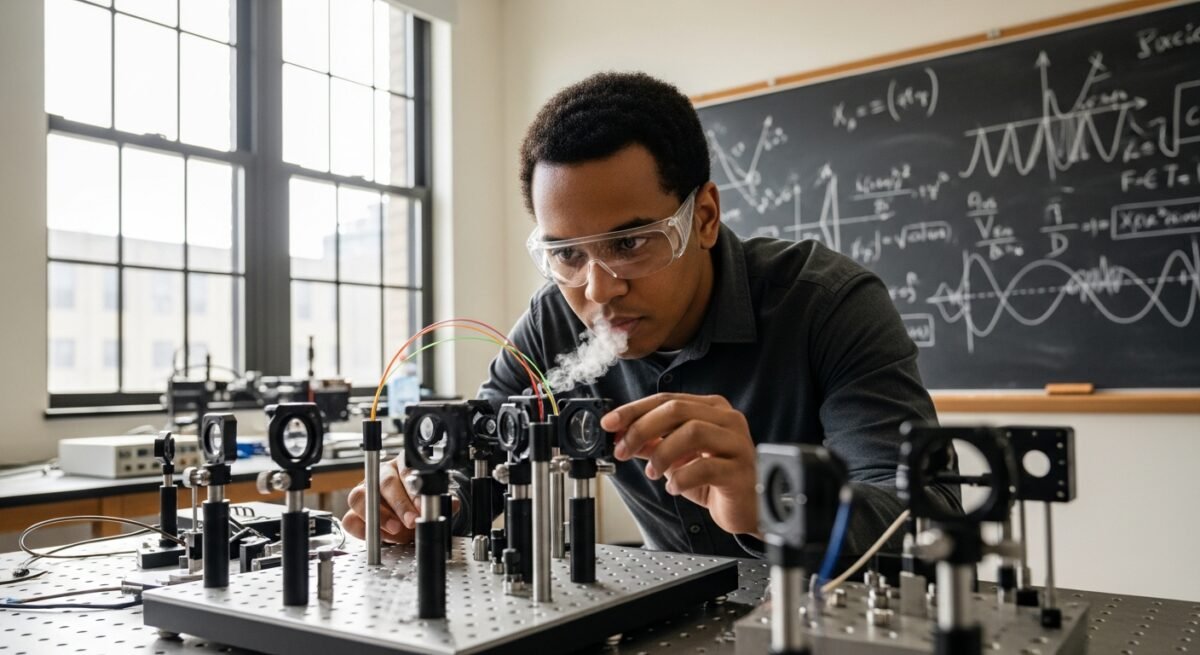
What a Masters in Physics Degree Curriculum and Career Paths Offer
A Masters in Physics builds advanced analytical and technical skills, leading to diverse careers in tech, finance, engineering, and research beyond academia.

By Elena Markova
A Masters in Physics represents a pivotal step for those captivated by the fundamental laws of the universe, offering a rigorous blend of advanced theory and practical application. This graduate degree serves as both a terminal qualification for specialized careers and a critical bridge to doctoral studies. The curriculum is designed to deepen analytical prowess and technical skill, while the resulting career paths extend far beyond academia into lucrative and impactful roles in technology, finance, engineering, and research. Understanding the structure of a Masters in Physics degree curriculum and the diverse career paths it unlocks is essential for any aspiring scientist or technologist.
Core Structure of a Masters in Physics Curriculum
The curriculum for a Masters in Physics is intentionally demanding, building upon undergraduate foundations to cultivate expert-level competence. Programs typically require 30 to 36 credit hours and can be completed in one to two years of full-time study. The structure generally bifurcates into thesis and non-thesis tracks, each serving distinct goals. The thesis track involves original research under faculty supervision, culminating in a defended thesis, and is ideal for students aiming for a PhD or research-intensive roles. The non-thesis, or course-based, track involves advanced coursework and often a comprehensive exam or capstone project, catering to those seeking to enter the workforce directly with enhanced technical skills.
Regardless of track, the core coursework forms the backbone of the degree. Students delve into advanced classical mechanics, quantum mechanics, electrodynamics, and statistical thermodynamics. These are not mere reviews, but profound explorations using sophisticated mathematical tools like complex analysis, differential geometry, and advanced linear algebra. The goal is to move from solving textbook problems to formulating and tackling open-ended questions. Many programs also require a graduate-level laboratory course, emphasizing modern experimental techniques, data acquisition, and error analysis, which is vital for both experimentalists and theorists to understand the empirical basis of physics.
Specializations and Elective Coursework
A key strength of a masters in physics is the opportunity for specialization. Through elective courses and thesis research, students can tailor their studies to align with specific intellectual passions and career objectives. Common specializations include condensed matter physics, which explores the properties of solids and liquids and is directly relevant to semiconductor and materials science industries, astrophysics and cosmology, focusing on celestial bodies and the universe’s origin, atomic, molecular, and optical (AMO) physics, crucial for quantum computing and precision measurement technologies, and high-energy/particle physics, probing the fundamental constituents of matter.
Other impactful specializations are biophysics, applying physics principles to biological systems, and computational physics, which develops advanced simulation and modeling skills. The elective structure allows students to take relevant courses from other departments, such as electrical engineering for device physics, computer science for machine learning applications, or mathematics for deeper theoretical work. This interdisciplinary approach is increasingly valuable, as many cutting-edge problems sit at the intersection of traditional fields. Choosing a specialization strategically is a critical step in shaping your Masters in Physics degree curriculum and career paths.
Thesis Versus Non-Thesis Paths: A Strategic Choice
The decision between a thesis and a non-thesis track is one of the most significant a student will make, with long-term implications for their career trajectory. The thesis track is a deep dive into original research. It involves identifying a research question, conducting literature reviews, designing experiments or theoretical frameworks, analyzing data, and formally presenting findings. This process hones project management, technical writing, and problem-solving skills at the highest level. It is almost a prerequisite for admission to competitive PhD programs and is highly valued by employers in national laboratories and industrial R&D divisions where independent research is paramount.
Conversely, the non-thesis track allows for a broader exploration of advanced coursework. Students can take more elective classes, often in applied or interdisciplinary areas like optics, nanotechnology, or data science. This path typically concludes with a comprehensive examination or a substantial project. It is an excellent option for students aiming for roles in applied engineering, quantitative finance, data analysis, or technical consulting, where a wide base of advanced knowledge is more immediately applicable than a deep, narrow research experience. When planning your degree, it is wise to research potential career paths early to inform this choice. For broader insights on aligning your education with professional goals, you can explore college degree programs and their structures.
Essential Skills Developed in a Physics Masters Program
Beyond specific knowledge of physical laws, a Masters in Physics cultivates a powerful toolkit of transferable skills that are in high demand across the economy. The most prominent is quantitative and analytical reasoning. Physics graduates learn to distill complex, messy real-world problems into tractable models, a skill directly applicable to financial modeling, logistics, and systems engineering. Advanced computational and programming skills are another major output, with students gaining proficiency in languages like Python, MATLAB, C++, and specialized simulation software, preparing them for careers in software development and data science.
Furthermore, the curriculum rigorously develops problem-solving tenacity. Students become accustomed to tackling problems with no obvious solution, learning iterative approaches and resilience. Technical communication is also emphasized, whether through writing a thesis, presenting research seminars, or preparing formal reports. The ability to convey complex technical information clearly to diverse audiences is invaluable. Finally, project management and meticulous attention to detail are ingrained through lab work and research projects. These skills collectively make physics masters graduates uniquely adaptable and capable professionals.
Diverse Career Paths for Physics Masters Graduates
The career landscape for holders of a masters in physics is remarkably broad and often surprisingly lucrative. While a segment of graduates continues to PhD programs for careers in academia or advanced research, many others transition directly into high-tech industries. In the technology sector, roles include semiconductor process engineer, optical systems engineer, and data scientist, where their modeling and analytical skills are prized. The finance and consulting industries actively recruit physics graduates for quantitative analyst (quant) positions, where they develop complex trading algorithms and risk assessment models.
Other significant career paths include positions in national and government research laboratories (e.g., NASA, DOE labs), focusing on areas from renewable energy to national security. The aerospace and defense sector hires physicists for simulation, sensor development, and advanced materials work. Additionally, the growing field of medical physics, which requires a specialized professional masters or certification, offers careers in radiation therapy and imaging technology in hospitals. For those interested in the intersection of law and technology, patent law firms seek individuals with advanced technical degrees to become patent agents or technical specialists. This diversity underscores that a Masters in Physics degree curriculum and career paths are not limited to traditional academic roles but open doors to innovation-driven industries worldwide.
Frequently Asked Questions
Is a Masters in Physics worth it for someone not pursuing a PhD?
Absolutely. The degree provides advanced technical and problem-solving skills that are highly marketable in finance, data science, engineering, and technology. Many find the non-thesis track specifically tailored for direct industry entry, often with a significant salary premium over a bachelor’s degree.
What is the typical salary range for a physics masters graduate?
Salaries vary widely by industry and location. According to data from professional societies like the American Institute of Physics, median starting salaries in industry often range from $80,000 to $110,000. Roles in quantitative finance or specialized engineering in high-cost areas can command considerably more.
Can I switch to an engineering field with a physics masters?
Yes, this is a common and successful transition. The strong fundamental background in physics is an excellent foundation. You may need to take a few supplemental courses or highlight relevant project work (e.g., computational modeling, optics labs) to align with specific engineering job requirements, such as those detailed in our guide on a Bachelor Degree in Accounting: Curriculum and Career Paths, which outlines a similar strategic approach to career pivoting.
How important is the choice of specialization for my career?
It is important but not permanently limiting. A specialization in condensed matter or computational physics provides a direct pipeline to tech and engineering roles. A more theoretical specialization still develops the core skills employers seek. Your research project or capstone experience often matters more to employers than your official specialization title.
What should I look for in a Masters in Physics program?
Key factors include faculty research areas aligning with your interests, strong industry connections or career placement support, availability of modern laboratory or computational resources, and the program’s track record of placing graduates into your desired career path or PhD programs.
Pursuing a Masters in Physics is a commitment to mastering complexity and contributing to technological and scientific advancement. The curriculum challenges students to think deeply and work rigorously, while the resulting career paths offer a spectrum of opportunities to apply that knowledge in meaningful ways. From unlocking the secrets of the cosmos to designing the next generation of computer chips, the skills forged in this graduate program are a powerful catalyst for a future defined by innovation and discovery.