
Welding Technology/Welder Certificate at ACTC: 1-2 Year Path
The Welding Technology/Welder Certificate at ACTC delivers hands-on training in 1-2 years, preparing you for in-demand trade jobs without a four-year degree.

By Mason Reed
Skilled welders are in demand across Kentucky and the nation, and a short, hands-on certificate can be your fastest route into the trade. The Welding Technology/Welder Certificate, 1 year to less than 2 years In-person at Ashland Community and Technical College (ACTC), is designed for students who want practical training, industry credentials, and a direct path to employment without committing to a four-year degree. If you are ready to trade a desk for a welding booth and learn a skill that employers actively recruit, this program deserves a close look.
Why Choose the Welding Technology/Welder Certificate at ACTC
ACTC, part of the Kentucky Community and Technical College System (KCTCS), offers a welding certificate that can be completed in roughly one to two years of full-time, in-person study. The program blends classroom instruction with extensive lab time, so you spend most of your hours practicing under the hood rather than sitting in lectures. That balance matters in a field where muscle memory, bead consistency, and safety habits separate employable welders from beginners.
The certificate is stackable, meaning credits you earn can often be applied toward an associate degree in welding technology later if you decide to deepen your training. For many students, the certificate is the goal itself: a credential that signals to employers that you have completed structured, verified training in shielded metal arc welding, gas metal arc welding, gas tungsten arc welding, and related processes. Local manufacturers, fabrication shops, and construction firms recognize ACTC's program because it aligns with industry standards and prepares students for common certification tests.
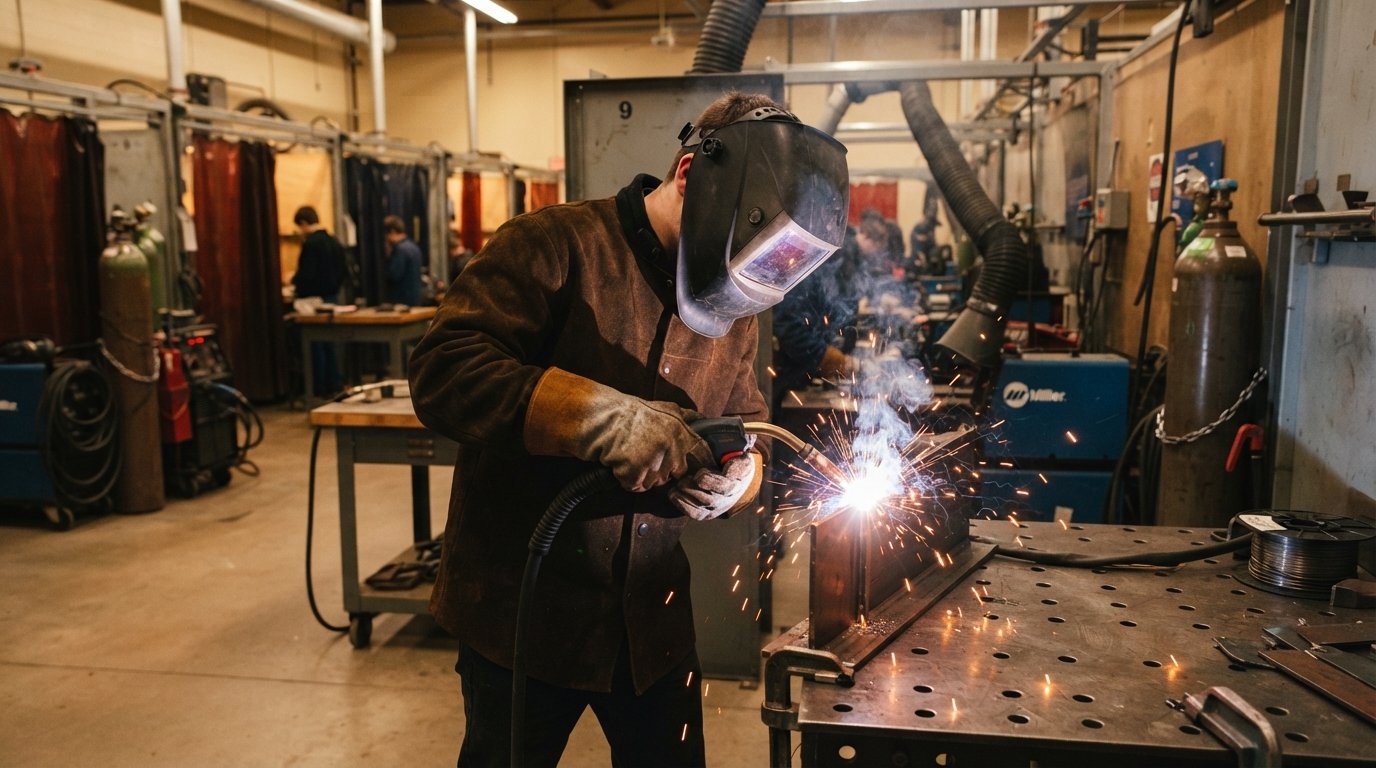
Because the program is in-person, you get access to industrial welding machines, cutting equipment, and shop environments that mirror real job sites. Instructors with industry experience provide immediate feedback on your technique, which is difficult to replicate in an online format. If you thrive on hands-on learning and want to see tangible progress week by week, this delivery model suits you well.
What You Will Learn in the Welding Program
The curriculum covers the core welding processes employers expect you to know, along with the supporting skills that make you a safer, more versatile employee. Coursework typically progresses from fundamental safety and theory to guided practice and, eventually, project-based work that simulates job conditions. You will learn to read blueprints, interpret welding symbols, and select the right electrodes, gases, and settings for each job.
Here is a snapshot of the key skill areas the certificate develops:
- Shielded metal arc welding (SMAW), often called stick welding, for structural and repair work
- Gas metal arc welding (GMAW), including MIG welding used in fabrication and manufacturing
- Gas tungsten arc welding (GTAW), or TIG welding, for precision work on thinner materials
- Flux-cored arc welding (FCAW) and plasma/oxy-fuel cutting techniques
- Blueprint reading, welding symbols, joint preparation, and quality inspection basics
Beyond the torch and the stinger, you will build workplace habits that employers value: attention to detail, safe handling of equipment, and the discipline to produce consistent results under deadlines. Instructors often structure labs around real-world scenarios, such as fabricating a bracket or repairing a structural joint, so you graduate with examples of your work and a better sense of what production environments demand.
Many students also prepare for industry certifications during the program. While certification requirements vary by employer and process, the structured practice you receive at ACTC helps you walk into a certification test with confidence rather than guesswork.
Admission Requirements and How to Enroll
Enrolling in the welding certificate at ACTC follows the standard community college admissions process. You will need to complete an application, submit proof of high school completion or equivalency, and take placement assessments in reading, writing, and math unless you qualify for exemptions. Because welding involves math for measurements and layout, strong foundational skills help, but the program is designed to support students who need a refresher.
To move from applicant to enrolled student, follow these general steps:
- Apply to ACTC online and set up your student account.
- Submit transcripts and any required placement test scores.
- Meet with an academic advisor to plan your certificate schedule.
- Complete financial aid paperwork or payment arrangements before classes begin.
- Attend orientation and purchase required safety gear, such as a welding helmet, gloves, and protective clothing.
Because welding courses fill quickly and lab space is limited, applying early gives you the best chance of securing a seat in the upcoming term. Advisors can also help you understand whether any prior coursework or industry experience qualifies for credit, which could shorten your timeline.
Cost is a common concern, and it is worth exploring every funding option before you assume the program is out of reach. Kentucky residents may qualify for state aid, federal Pell Grants, and workforce development programs. Scholarships specifically for trade and technical students also exist, and resources like Scholarship.Education can help you discover and evaluate opportunities you might otherwise miss. Combining aid sources often reduces out-of-pocket costs significantly.
Career Outcomes and Job Outlook for Welders
Welders work in manufacturing, construction, energy, automotive, aerospace, and maintenance, which means the certificate opens doors across multiple industries rather than funneling you into a single narrow role. Entry-level positions often include welder, fabrication assistant, structural welder, and maintenance technician. With experience and additional certifications, welders can move into pipe welding, underwater welding, robotic welding operation, inspection, or supervisory roles.
Pay varies by region, industry, and skill level, but welding consistently offers a solid return on a short training investment. According to the U.S. Bureau of Labor Statistics, employment of welders, cutters, solderers, and brazers is projected to remain steady, with demand driven by infrastructure repair, manufacturing reshoring, and energy projects. In regions with active fabrication and industrial bases, skilled welders are frequently recruited before they even finish their certificates.
One advantage of a certificate over a longer degree is speed to earning. You can complete the program in one to two years, start working, and continue building credentials on the job. Many employers also offer tuition assistance for employees who want to pursue an associate degree later, so the certificate can serve as a paid stepping stone rather than a final stop.
If you are comparing this path with other short-term healthcare or administrative programs, it helps to look at how each field matches your strengths. Our guide to the Medical Coding Specialist Certificate and Career Guide offers a useful contrast for anyone weighing hands-on trade work against desk-based roles in healthcare documentation.
Why In-Person Training Matters for Welders
Welding is a psychomotor skill, meaning it depends on coordination, posture, and real-time adjustments that cannot be learned from a video. In-person instruction at ACTC gives you access to actual welding machines, proper ventilation, and supervision that reduces safety risks. You also learn to troubleshoot equipment and adapt to different materials, which is exactly what employers need on the shop floor.
Classmates become a professional network, too. Lab partners and instructors often hear about job openings first, and local employers frequently contact program staff when they need new hires. That informal pipeline is one reason community college welding programs have strong placement rates in their regions.
The structure of in-person classes also builds accountability. Showing up on time, maintaining equipment, and working safely are habits that transfer directly to employment. Employers value reliability as much as raw skill, and the certificate program reinforces both.
How to Decide If This Certificate Is Right for You
This program fits students who prefer active, hands-on work, want to enter the workforce relatively quickly, and are comfortable with physical demands that include standing for long periods, lifting materials, and working in varied temperatures. It is also a strong option for career changers who want a practical skill with clear labor market demand, and for veterans who can apply military benefits toward trade training.
If you are unsure between welding and another technical field, consider visiting campus, speaking with an advisor, and touring the welding lab. Seeing the equipment and talking to current students can clarify whether the environment feels right. You can also compare program lengths, costs, and local job listings to understand what the certificate can realistically lead to in your area.
For students planning further education, the certificate can stack into an associate degree or transfer into industrial technology programs. For those who want to work soon, it provides a credible, employer-recognized credential in a fraction of the time of a bachelor's degree.
The Welding Technology/Welder Certificate, 1 year to less than 2 years In-person at Ashland Community and Technical College, is a practical investment in a durable trade. With focused training, industry-aligned coursework, and strong regional demand for skilled welders, it offers a direct path from classroom to career. If you are ready to build something real with your hands, start by contacting ACTC admissions and mapping out your start date.