
Welding Certificate at College of the Mainland: 2026 Guide
Earn a Welding Technology/Welder Certificate, 1 year to less than 2 years In-person at College of the Mainland. Call 8772187081 for program details.

By Ethan Clark
Skilled welders are in high demand across Texas and the nation, and a focused certificate can get you into the workforce faster than a traditional degree. The Welding Technology/Welder Certificate, 1 year to less than 2 years In-person at College of the Mainland gives students a direct route to entry-level welding roles without committing to a four-year program. If you are weighing a short-term credential against a longer degree path, understanding how this certificate works, what it costs, and where it leads can help you make a confident decision about your future.
Why Choose the Welding Technology/Welder Certificate at College of the Mainland
College of the Mainland (COM) is a public community college located in Texas City, Texas, serving students throughout Galveston County and the greater Houston area. Its welding program is designed for people who want hands-on training in a real shop environment, not just classroom theory. The certificate path is intended to be completed in one year to less than two years of full-time study, which means you can move into the job market relatively quickly compared to an associate degree or bachelor's program.
The appeal of this credential comes down to three factors: time, cost, and employability. A short-term certificate typically costs far less than a two-year or four-year degree, and it signals to employers that you have completed structured training in welding processes, safety, and blueprint reading. Many students choose this route because it aligns with the reality that welding is a skill-based trade where demonstrable competency often matters more than the length of your academic transcript.
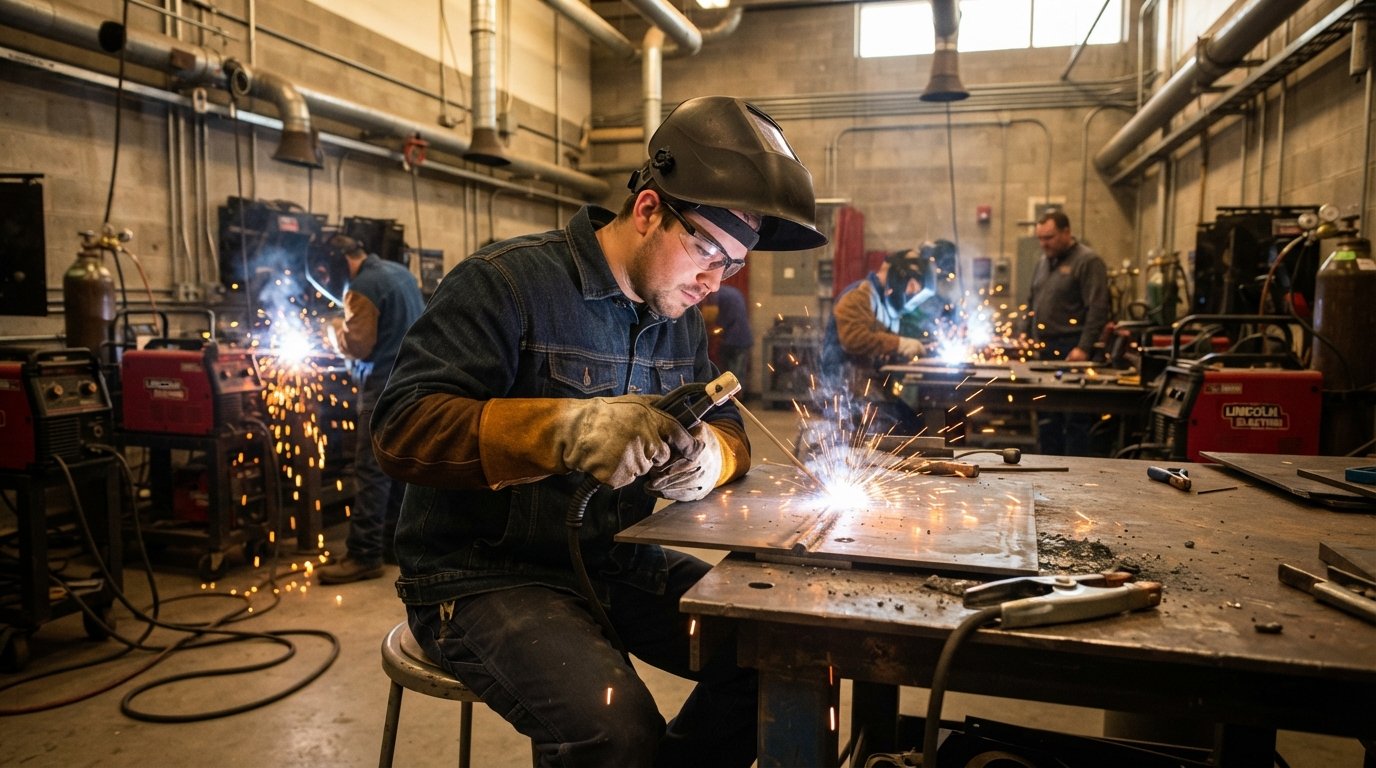
Another advantage is that the program is delivered in person. Welding is a tactile discipline; you need access to machines, shielding gas, electrodes, and instructors who can watch your technique and correct it in real time. In-person delivery at COM means you practice in a dedicated lab with equipment that mirrors what you will encounter on a job site or in a fabrication shop.
Program Format and What You Will Learn
The Welding Technology/Welder Certificate, 1 year to less than 2 years In-person at College of the Mainland is structured around a sequence of courses that build from fundamental safety and theory to advanced welding positions and processes. Because it is a certificate rather than a degree, the curriculum focuses on technical skill development rather than general education requirements. That focus is what allows you to finish faster and enter the workforce sooner.
Coursework typically covers shielded metal arc welding (SMAW), gas metal arc welding (GMAW), flux cored arc welding (FCAW), and gas tungsten arc welding (GTAW). You will also learn about joint design, welding symbols, inspection basics, and metallurgy concepts that affect weld quality. Safety training is woven throughout, covering personal protective equipment, ventilation, and proper handling of compressed gases.
- Hands-on lab hours in a supervised welding facility
- Instruction in multiple welding processes used across industries
- Blueprint reading and welding symbol interpretation
- Weld inspection and quality control fundamentals
- Workplace safety and OSHA-aligned practices
Because the program is hands-on, your progress is measured partly by the quality of the welds you produce. Instructors evaluate bead appearance, penetration, and structural integrity, and they often prepare students for industry-recognized certification tests. That practical assessment model is one reason employers trust certificate holders from community college welding programs.
Admission Requirements and How to Apply
Admission to the welding certificate at College of the Mainland generally follows the college's standard open-admission process for career and technical programs. You will need to apply to the college, submit transcripts or proof of high school completion or equivalent, and complete any placement requirements the program specifies. Some programs also require a brief advising session before registration so that students understand the time commitment and equipment expectations.
Prospective students should plan ahead for costs beyond tuition, including safety gear such as a welding helmet, gloves, jacket, and boots. Financial aid, scholarships, and workforce grants may be available for eligible students, and COM's financial aid office can help you determine what you qualify for. If you are comparing certificate programs across schools, it helps to review broader guidance on how long different credentials take and how they stack up, such as this overview of bachelor degree completion timelines, so you can see where a one-year certificate fits in the larger education landscape.
Application steps typically include:
- Complete the college admission application online.
- Submit official transcripts or documentation of prior education.
- Meet with an advisor for the welding program.
- Register for classes and arrange payment or financial aid.
- Purchase required safety equipment before the first lab session.
Completing these steps early is important because welding labs often have limited seats and equipment stations. Students who apply close to the start of the term may find that core courses are already full.
Career Outcomes and Earning Potential
Graduates of the Welding Technology/Welder Certificate, 1 year to less than 2 years In-person at College of the Mainland typically pursue entry-level positions as welders, fabrication technicians, or maintenance helpers in industries such as construction, shipbuilding, oil and gas, manufacturing, and aerospace. The Houston-Galveston region has a particularly strong demand for welders because of its concentration of industrial and maritime employers.
Earnings vary based on industry, location, shift differential, and certifications. Entry-level welders often start at hourly rates that compare favorably to other entry-level jobs that do not require a degree, and experienced welders who hold multiple process certifications or pipe welding credentials can command significantly higher pay. Overtime is common in many welding roles, especially during project-based work in refineries and shipyards.
Career advancement in welding can take several forms. Some welders move into lead or supervisory roles, while others pursue inspection, quality assurance, or welding engineering technology. Still others use their certificate as a stepping stone toward an associate degree in welding technology, which can open doors to teaching, management, or specialized technical positions. The certificate gives you a fast entry point, and additional education or certifications can expand your options over time.
Is This Certificate Right for You?
The Welding Technology/Welder Certificate, 1 year to less than 2 years In-person at College of the Mainland is a strong fit for students who prefer hands-on learning, want to start working quickly, and are comfortable with the physical demands of the trade. It is also a practical choice for career changers who need a focused credential rather than a broad academic degree, and for veterans or working adults who want to use education benefits efficiently.
It may not be the best fit if you are seeking a role that requires a bachelor's degree, such as welding engineering or industrial management. In those cases, you might use the certificate as a foundation and then continue into a degree program. If you are unsure which path matches your goals, exploring resources that explain degree options and career planning can help you compare trade credentials with traditional academic routes. For example, CollegeDegrees.School offers guides on degree types, higher education pathways, and career planning that can help you see how a welding certificate fits into a longer-term plan.
Before enrolling, consider your schedule, transportation, and budget. In-person labs require consistent attendance, and missing sessions can set you back because skills build sequentially. If you can commit to the schedule and the hands-on work, the certificate can be a fast, affordable way to enter a stable trade.
How to Succeed in the Program
Success in a welding certificate program depends on practice, safety, and professionalism. Instructors expect students to show up on time, wear required protective gear, and follow shop rules without exception. Welding is a discipline where small mistakes can cause injuries or failed inspections, so attention to detail matters from day one.
Students who do well tend to practice outside of class when possible, ask questions when they do not understand a technique, and treat feedback as a tool for improvement rather than criticism. Building good relationships with instructors can also lead to job leads, since many welding instructors maintain connections with local employers.
Finally, keep your credentials organized. As you complete courses and pass certification tests, document everything. Employers and unions may ask for proof of training, and having a clear record makes the hiring process smoother. The Welding Technology/Welder Certificate, 1 year to less than 2 years In-person at College of the Mainland is designed to prepare you for that next step, and how you use the training will shape your career trajectory.
For anyone in the Texas Gulf Coast region who wants a practical, fast path into a skilled trade, this certificate is worth serious consideration. It combines focused instruction, hands-on practice, and a timeline that respects your need to start earning. If welding appeals to you, the next step is to contact College of the Mainland, speak with an advisor, and confirm the current course schedule and admission deadlines.