
Quality Control Certificate in Under 12 Weeks at CT State
Earn a Quality Control Technology/Technician Certificate in under 12 weeks in person at Connecticut State Community College and step into manufacturing fast.

By Alex Jordan
Manufacturers across Connecticut need trained eyes on the production line. A quality control technician catches defects before products reach customers, and the role is one of the fastest entry points into advanced manufacturing. The Quality Control Technology/Technician Certificate, offered in person in less than 12 weeks at Connecticut State Community College, is designed for people who want that entry point without committing to a two-year degree. You learn measurement, inspection, and documentation in a lab setting, and you finish with a credential that employers in aerospace, medical devices, and precision machining recognize.
What makes this program worth a closer look is the combination of speed, hands-on training, and local relevance. Connecticut's manufacturing base is dense, and community college certificates are built with regional employers in mind. If you are a career changer, a recent high school graduate, or a working adult who needs a quick skills upgrade, a sub-12-week certificate can move you into a job interview faster than almost any other credential in the field. This guide covers what you learn, how the schedule works, what it costs, and how to decide whether it fits your plans.
What the Quality Control Technician Certificate Covers
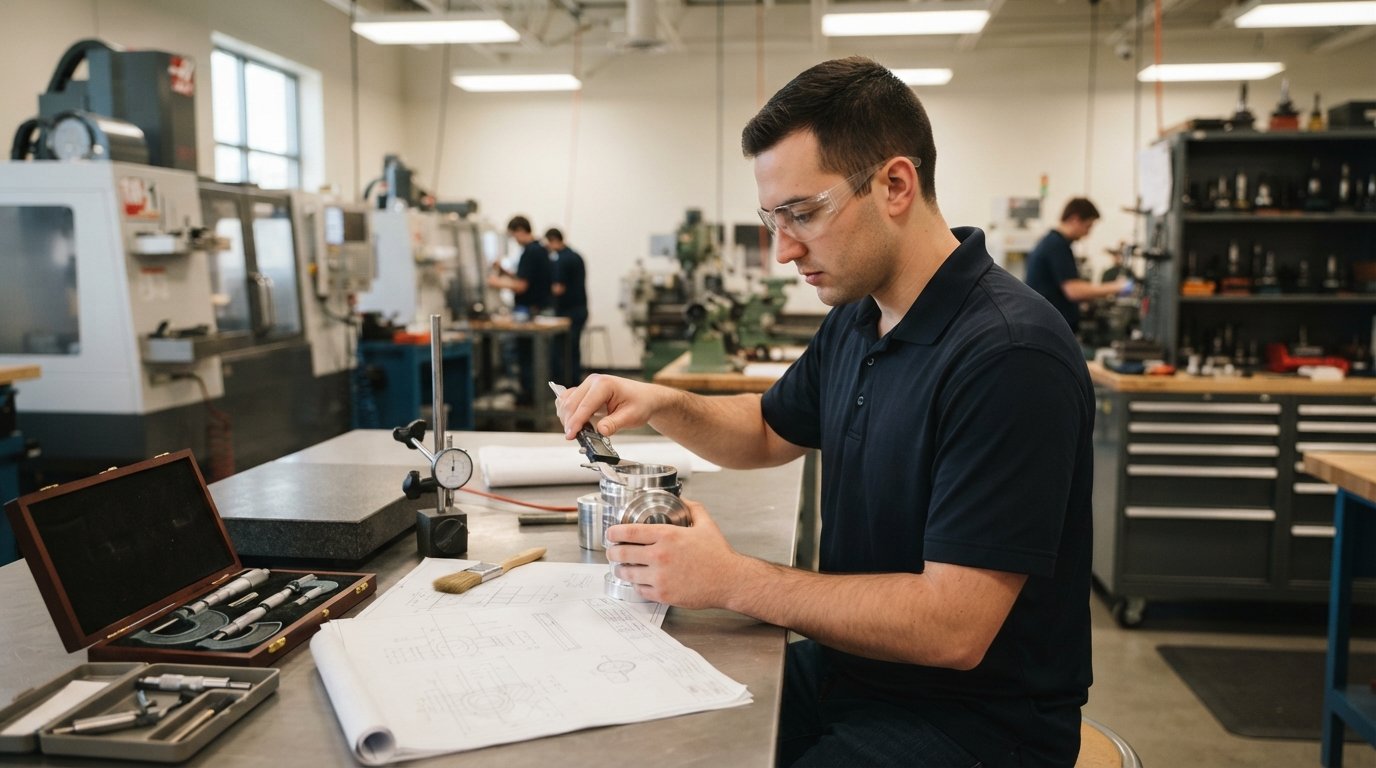
Quality control technicians inspect materials, components, and finished products to make sure they meet specifications. The certificate program teaches the technical side of that job: reading blueprints, using precision measurement tools, applying statistical process control, and documenting results so that problems can be traced and corrected. Because the program is delivered in person, you spend real time with calipers, micrometers, height gauges, and coordinate measuring machines rather than watching videos about them.
Coursework typically blends classroom instruction with lab practice. You might spend a morning learning the theory behind geometric dimensioning and tolerancing, then spend the afternoon measuring parts and comparing your readings to the tolerances on a drawing. That repetition builds the muscle memory employers expect. The short format means the curriculum is focused: you are not taking general education electives, so nearly every hour counts toward job-ready skills.
Core topics usually include:
- Blueprint reading and geometric dimensioning and tolerancing (GD&T)
- Precision measurement with hand tools and gauges
- Inspection methods, sampling, and acceptance criteria
- Statistical process control and basic data analysis
- Quality documentation, nonconformance reports, and root cause basics
Some programs also introduce calibration, lean manufacturing concepts, or an overview of ISO 9001 and AS9100 quality standards, which matter in aerospace and medical device supply chains. Ask the program coordinator which standards are covered, because that detail can shape which employers see your certificate as an immediate match.
Why the Under-12-Week In-Person Format Matters
Speed is the obvious advantage. A certificate completed in less than 12 weeks lets you finish a credential within a single semester and start applying for inspector or quality assistant roles while the skills are fresh. For adults balancing work and family, a compressed schedule is easier to plan around than a multi-year degree, and it produces a tangible credential at the end rather than a transcript with credits still in progress.
The in-person requirement is a feature, not a limitation. Quality control is a physical, hands-on job, and employers want to know you can hold a micrometer correctly, set up a gauge, and inspect a part without supervision. Online simulations help with theory, but they cannot replicate the feel of a gauge that is slightly out of calibration or the judgment call involved in deciding whether a surface finish is acceptable. Learning those skills in a lab, with an instructor looking over your shoulder, shortens the on-the-job learning curve considerably.
In-person delivery also builds professional habits. You show up on a schedule, work alongside classmates, and get immediate feedback on your technique. Those habits transfer directly to a shop floor where punctuality, documentation discipline, and clear communication with machinists and engineers are part of the job every day.
Admission Steps and What to Expect
Community college certificate programs are generally open-access, but there are still steps to complete before the first day of class. Because the program runs in a compressed format, missing a deadline can push you to the next cohort, so start the process early. The exact requirements vary by campus, so confirm details with the admissions office at the Connecticut State Community College campus offering the program.
A typical sequence looks like this:
- Complete the college application and any placement steps for math and reading.
- Meet with an advisor to confirm the certificate fits your goals and schedule.
- Register for the cohort and pay tuition or set up a payment plan.
- Attend any required orientation or safety briefing before labs begin.
- Purchase or borrow required tools and materials, such as safety glasses and a calculator.
Placement testing may sound intimidating, but it exists to make sure you can handle the math in statistical process control and tolerance calculations. If you place below college level, ask about refresher options before the cohort starts. Advisors would rather see you prepared than struggling in week three of a fast-moving program.
Cost, Financial Aid, and Return on Investment
Certificate programs at community colleges are among the most affordable credentials in manufacturing. Tuition for a short certificate is a fraction of a degree program, and many students qualify for federal financial aid, state workforce grants, or employer tuition assistance. Connecticut manufacturers frequently reimburse employees for job-related training, so if you are already working in a shop, ask your employer before you pay out of pocket.
To estimate the return, compare the total program cost to entry-level quality technician wages in your area. Even a modest salary increase, or a move from a temporary role to a permanent one with benefits, can recover the cost of a short certificate within a few months. Veterans should also check education benefits, which can often cover certificate programs at approved institutions.
Financial aid offices can walk you through the Free Application for Federal Student Aid and connect you with scholarships aimed at manufacturing students. For a broader picture of how certificate funding fits into the larger financial aid landscape, the career and education resources at Careers.org explain how training paths and funding options connect to specific occupations.
Career Outcomes for Quality Control Technicians
Quality control technicians work in manufacturing plants, testing laboratories, and supplier quality departments. Job titles include quality inspector, quality technician, calibration technician, and incoming inspection technician. In Connecticut, aerospace and defense suppliers, medical device makers, and precision machining shops are among the most common employers, and they tend to value certificates that include hands-on measurement training.
Career progression is realistic. With experience, technicians move into quality engineering support, auditing, supplier quality, or supervision. Some pursue an associate degree in quality or manufacturing technology to qualify for engineering-adjacent roles, and employers sometimes cover that tuition. The certificate is not a dead end; it is a first step that gives you income and experience while you decide how far to go.
It is also a hedge against automation. Inspection work increasingly involves digital tools and data analysis, and technicians who can read a drawing, program a measurement routine, and explain a nonconformance are harder to replace than workers who only perform repetitive checks. The certificate's blend of measurement fundamentals and documentation practice positions you for that evolution.
How This Certificate Compares With Other Paths
Prospective students often weigh a short certificate against a two-year degree or an online program. A certificate wins on speed and cost, and it gets you into the workforce quickly. An associate degree offers broader engineering and management coursework and may open more advanced roles, but it takes longer and costs more. Online certificates offer flexibility, but they struggle to deliver the hands-on measurement practice that quality control employers expect.
For a useful comparison point on how short, in-person trade certificates are structured and scheduled, see this guide to the 12-week nail technician certificate path, which follows a similar compressed format in a different field. The comparison highlights a common pattern: short certificates trade breadth for speed, and they work best when the credential maps directly to an entry-level job.
If you are unsure which path fits, use a program matching service to compare accredited options side by side. CollegeDegree.Education connects prospective students with colleges and universities, including community college certificate programs, and lets you request information without an obligation to apply. That is a low-pressure way to confirm whether the Connecticut State Community College certificate or a related program is the right next step.
Tips for Succeeding in a Fast Certificate Program
The compressed timeline is manageable, but it rewards preparation. Treat the program like a job: attend every session, ask questions during lab time, and practice measurement exercises until they feel routine. Students who fall behind in a 12-week format have little room to catch up, so address confusion the same day it appears.
Build relationships with instructors, who often have industry connections and can point you toward employers. Keep a folder of your lab work and inspection reports; it becomes a portfolio you can bring to interviews. Start your job search in week one, not week twelve, so that your resume and interview skills are ready when the certificate is in hand.
Finally, verify the details before you enroll. Confirm the exact start and end dates, the total cost including tools and fees, and whether the certificate appears on transcripts in a way employers can verify. A quick call to the program coordinator answers questions that a website cannot, and it signals to the college that you are serious about finishing.
The Quality Control Technology/Technician Certificate, less than 12 weeks In-person at Connecticut State Community College, is a practical route into a stable manufacturing career. It rewards students who want hands-on skills, a fast finish, and a credential that local employers recognize. If that describes you, contact the college, confirm the next cohort dates, and start the application now.