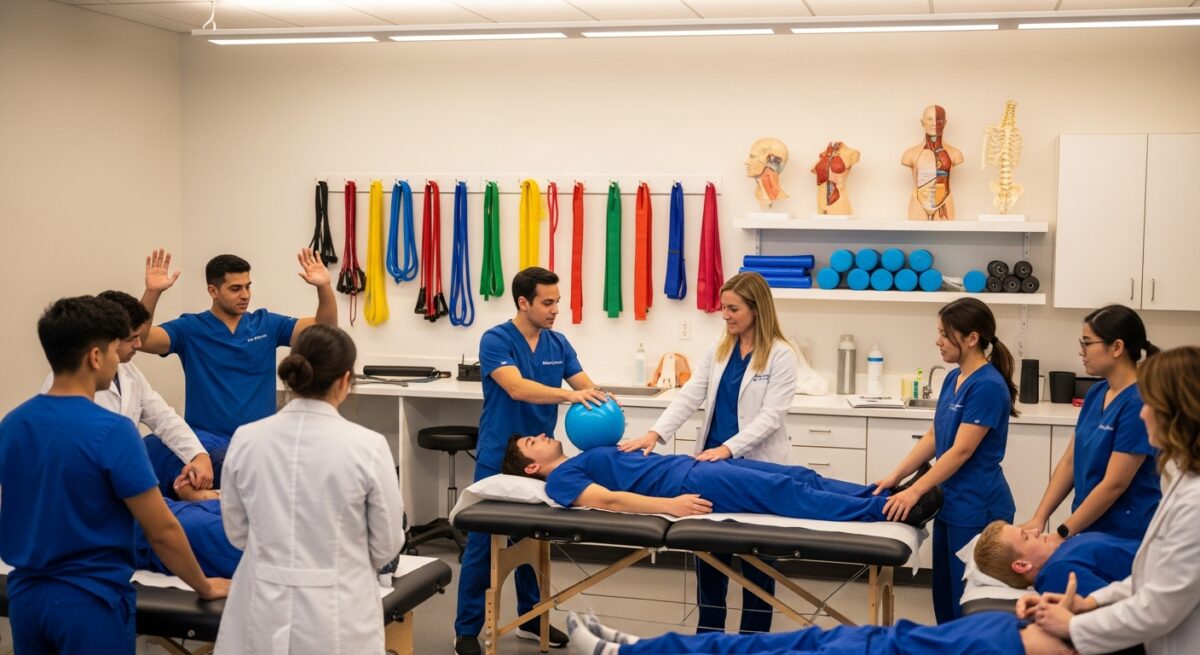
If you are looking for a healthcare career that offers meaningful patient interaction without the multi-year commitment of medical school, the physical therapy assistant path deserves your attention. Physical therapy assistants (PTAs) work under the supervision of physical therapists to help patients regain movement, manage pain, and improve their quality of life. This Physical Therapy Assistant Degree Career Guide walks you through every step from education to licensure and job search, so you can decide if this rewarding field is right for you.
What Is a Physical Therapy Assistant?
A physical therapy assistant is a licensed healthcare professional who implements treatment plans designed by a physical therapist. PTAs perform hands-on therapies, teach patients exercises, use modalities like ultrasound or electrical stimulation, and track progress over time. They work in hospitals, outpatient clinics, nursing homes, schools, sports medicine facilities, and home health settings.
The role is distinct from a physical therapy aide, who handles clerical tasks and equipment setup but does not deliver direct patient care. Becoming a PTA requires formal education and national certification, whereas aides typically learn on the job. This distinction matters when you choose your education path. A physical therapy assistant degree is the minimum credential needed to sit for the licensing exam.
Why Choose a Physical Therapy Assistant Career?
The demand for PTAs continues to grow as the population ages and more people seek rehabilitation services. The U.S. Bureau of Labor Statistics projects employment growth of 19 percent from 2022 to 2032, much faster than the average for all occupations. This translates to thousands of new job openings each year.
Beyond job security, PTA work offers tangible rewards. You help patients achieve milestones like walking after surgery or regaining arm strength after a stroke. The workday is active and varied. You are on your feet, moving between patients, and rarely stuck at a desk. For those who want a healthcare role with direct patient impact and a clear educational path, the physical therapy associate degree is a practical choice.
Educational Pathways to Becoming a PTA
The Physical Therapy Assistant Degree
The primary route into this career is an associate degree from an accredited program. These programs are typically offered at community colleges, technical schools, and some universities. They take about two years of full-time study to complete and include both classroom instruction and clinical fieldwork.
Accreditation is critical. The Commission on Accreditation in Physical Therapy Education (CAPTE) accredits PTA programs nationwide. Graduating from a CAPTE-accredited program is required to sit for the National Physical Therapy Exam (NPTE) for PTAs. Attending an unaccredited program wastes time and money because you cannot become licensed without it.
Prerequisites and Admission Requirements
Before you enroll, most programs require a high school diploma or GED, along with completed prerequisites in subjects like anatomy, physiology, biology, and mathematics. Some programs also require volunteer or observation hours in a physical therapy setting. Competitive programs may ask for a minimum GPA and letters of recommendation.
Plan ahead. If you are still in high school, take as many science and math courses as possible. If you are changing careers, you may need to complete prerequisites at a community college before applying. Many programs have limited seats and use a point system based on grades, experience, and interviews to select candidates.
What You Learn in a PTA Program
A typical physical therapy associate degree curriculum blends science foundations with hands-on clinical skills. Core courses include:
- Human anatomy and physiology with lab components
- Kinesiology and biomechanics
- Therapeutic exercise and manual therapy techniques
- Neurological rehabilitation
- Orthopedic conditions and interventions
- Medical terminology and documentation
- Patient safety and infection control
Clinical education placements begin early in the program, often in the second semester. You work under a licensed PTA or physical therapist in real healthcare settings. These rotations build confidence and help you apply classroom knowledge to actual patients. By graduation, you have logged hundreds of hours of supervised clinical experience.
Licensing and Certification
After earning your physical therapy assistant degree, you must pass the NPTE for PTAs, administered by the Federation of State Boards of Physical Therapy. The exam is computer-based and covers the entire scope of PTA practice. Most states also require a jurisprudence exam covering state-specific laws and regulations.
Once you pass, you apply for licensure in the state where you plan to work. Requirements vary slightly by state, so check with your state’s physical therapy board. Some states require background checks, additional fees, or proof of continuing education. Licensure must be renewed periodically, typically every two years, with ongoing education credits.
Cost and Financial Aid for PTA Programs
Tuition for an associate degree in physical therapy varies widely. In-state community college programs can cost as little as $5,000 to $15,000 total. Private or out-of-state programs may run $30,000 or more. Factor in fees for lab coats, equipment, textbooks, and travel to clinical sites.
Financial aid options include federal Pell Grants, student loans, and scholarships from professional organizations like the American Physical Therapy Association. Many community colleges offer payment plans. Veterans should check for GI Bill benefits. Some employers offer tuition reimbursement if you work as an aide while completing your degree. For more information on finding affordable programs and navigating financial aid, you can use a service like DegreeOnline.Education to compare accredited options and request cost details from multiple schools.
Job Search and Career Advancement
Where PTAs Work
PTAs find employment in a wide range of settings. Outpatient orthopedic clinics are the largest employer, followed by skilled nursing facilities and home health agencies. Hospitals, schools, and sports medicine centers also hire PTAs. Some PTAs work in multiple settings through per-diem or agency positions.
Geography matters. Rural areas often have higher demand and may offer signing bonuses or relocation assistance. Urban areas have more job openings but also more competition. Research your local job market before choosing a program location.
Tips for Landing Your First PTA Job
- Leverage your clinical rotations. Many students receive job offers from sites where they completed fieldwork. Impress preceptors with your work ethic and interpersonal skills.
- Network with classmates and instructors. They know about openings before they are posted publicly.
- Join the APTA as a student member. Access job boards, mentoring programs, and continuing education resources.
- Prepare for interviews by practicing common questions about patient handling, time management, and difficult scenarios.
- Consider temporary or per-diem positions to gain experience if full-time roles are scarce initially.
Once you have experience, opportunities to specialize emerge. PTAs can pursue certifications in areas like geriatrics, pediatrics, aquatic therapy, or lymphedema management. These credentials can lead to higher pay and more interesting caseloads.
Salary and Job Outlook
The median annual wage for physical therapy assistants was about $62,000 in 2023, according to BLS data. The top 10 percent earned more than $80,000. Pay varies by setting. Home health and skilled nursing facilities tend to pay higher than outpatient clinics. Geographic location also affects earnings, with states like California, Texas, and New York offering above-average salaries.
Benefits often include health insurance, paid time off, retirement plans, and continuing education allowances. Many employers offer flexible schedules, including four-day workweeks or part-time options. For those interested in further education, a PTA background provides a strong foundation for a Doctor of Physical Therapy (DPT) program. In our guide on Doctor of Physical Therapy Programs and Degree Guide, we explain how PTA credits can sometimes transfer and how clinical experience strengthens your application.
Frequently Asked Questions
How long does it take to become a physical therapy assistant?
Most associate degree programs take two years of full-time study. Add time for prerequisites if you have not completed them. After graduation, you need to pass the licensing exam, which adds a few months for study and test scheduling. Total timeline is typically two to three years from start to licensure.
Can I become a PTA with an online degree?
Hybrid programs exist where didactic coursework is delivered online, but clinical placements must be completed in person at approved sites. Fully online PTA programs are not possible because hands-on skills training is required. Look for programs that offer hybrid options if you need flexibility for work or family.
What is the difference between a PTA and a physical therapist?
A physical therapist holds a doctoral degree (DPT) and is responsible for evaluating patients, creating treatment plans, and establishing goals. A PTA holds an associate degree and implements the plan under the therapist’s supervision. PTAs cannot perform evaluations or modify treatment plans independently.
Is a physical therapy assistant degree worth it?
Yes, for most graduates. The cost of education is relatively low compared to four-year or graduate degrees, and the starting salary is competitive. Job growth is strong, and the work is personally fulfilling. The main downside is physical demands. PTAs spend long hours on their feet, lifting patients and performing repetitive motions. Burnout can occur if you do not practice self-care.
Can I specialize as a PTA?
Yes. While PTAs are generalists by training, many pursue advanced certifications in areas like geriatrics, pediatrics, or orthopedic manual therapy. These credentials typically require additional coursework, clinical hours, and an exam. Specialization can lead to higher pay and more autonomy within your scope of practice.
Your Next Steps
Becoming a physical therapy assistant is a clear, achievable goal for anyone with a passion for helping others and an interest in the science of movement. The educational path is straightforward: complete a CAPTE-accredited associate degree, pass the national exam, and obtain state licensure. From there, a stable career with growth potential awaits.
Start by researching programs in your area. Compare tuition, accreditation status, clinical placement partnerships, and graduation rates. Reach out to program directors to ask about prerequisite courses and application deadlines. If you are ready to take the first step toward a rewarding healthcare career, this Physical Therapy Assistant Degree Career Guide has given you the roadmap. Now it is time to act.