
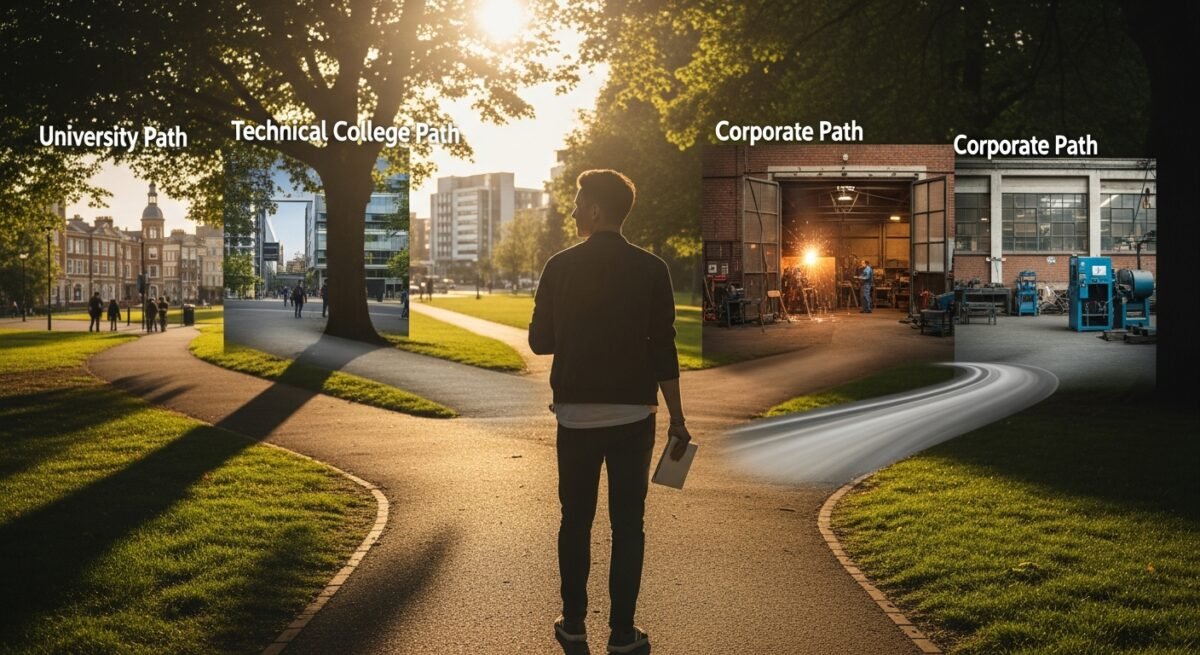
Navigating Your Education Pathways After High School
Explore diverse education pathways after high school, from four-year degrees and trade schools to online programs and apprenticeships. Make an informed choice that aligns with your career goals and learning style.

By Elena Markova
The moment you cross the high school graduation stage, a new landscape of choices unfolds. Your next steps are no longer prescribed by a mandatory curriculum, but shaped by your ambitions, skills, and vision for the future. This transition, while exciting, can feel daunting. Understanding the full spectrum of available education pathways after high school is the critical first step in charting a course that aligns with your personal and professional goals. This exploration is not about finding a single “right” answer, but about discovering the right fit for your unique journey, whether that leads directly to a career, into specialized training, or through the halls of a university.
The Four-Year University and College Route
For many, the most familiar education pathway after high school is pursuing a bachelor’s degree at a four-year college or university. This traditional route offers a deep dive into academic disciplines, fostering critical thinking, research skills, and a broad knowledge base. A bachelor’s degree is often a prerequisite for careers in fields like engineering, architecture, the sciences, and many business and liberal arts professions. The experience extends beyond the classroom, encompassing campus life, networking opportunities, and personal development. When considering this path, it’s essential to weigh factors like public versus private institutions, campus culture, and, significantly, cost. Tuition, housing, and fees can lead to substantial student debt, making financial planning a cornerstone of this decision. Prospective students should thoroughly research financial aid, scholarships, and work-study programs. For a detailed breakdown of degree types and structures, our resource on college degree options and education pathways is an excellent starting point.
The value of a four-year degree can be immense, but it’s not the only valuable path. It’s crucial to align this choice with a clear career objective. Some professions absolutely require this level of education, while for others, alternative pathways may offer a more direct and less costly route to employment. The key is intentionality: selecting a major with a realistic understanding of the associated career landscape and earning potential.
Career and Technical Education: The Power of Hands-On Learning
Directly countering the notion that a four-year degree is the sole path to success, Career and Technical Education (CTE) provides targeted training for specific skilled trades and technical careers. These programs, often offered at community colleges, technical institutes, or dedicated trade schools, are designed to equip students with job-ready skills in a relatively short time frame—often ranging from a few months to two years. This education pathway after high school is ideal for individuals who are hands-on learners and have a clear vocational goal.
CTE covers an incredibly diverse range of high-demand fields. Graduates from these programs enter the workforce as electricians, welders, dental hygienists, automotive technicians, web developers, and paralegals, to name just a few. The benefits are compelling: lower cost than a four-year degree, shorter time to completion, and a direct line to careers that are frequently in high demand and offer competitive wages with strong growth potential. For some students, exploring CTE can even begin earlier; understanding if a vocational high school is right for your future can provide a significant head start in these fields.
The curriculum in a quality CTE program is intensely practical, blending classroom instruction with lab work and often including apprenticeships or internships. This experiential learning ensures that students not only understand theoretical concepts but can also perform the tasks required on day one of their new career. For those seeking a clear, efficient, and practical route to a stable profession, CTE represents one of the most pragmatic and rewarding education pathways after high school.
The Strategic Launchpad of Community College
Community colleges serve a uniquely versatile role in the post-secondary landscape, acting as a bridge for a wide variety of student goals. For many, they are the most accessible and affordable entry point into higher education. Students can complete an associate degree—typically a two-year program—which can either be a terminal degree leading directly to a career (such as an Associate of Applied Science in Nursing) or a transfer degree designed to seamlessly move into the third year of a bachelor’s program at a four-year university.
This flexibility makes community college an incredibly strategic choice. It allows students to complete general education requirements at a fraction of the cost, explore academic interests without the immediate pressure of declaring a major at a large university, and improve academic standing before transferring. Furthermore, community colleges are deeply integrated into their local communities, offering certificate programs and courses tailored to meet regional workforce needs. The supportive environment, smaller class sizes, and focus on teaching (rather than research) can be particularly beneficial for students who may need additional academic preparation or a more gradual transition from high school.
Embracing Digital Learning Methods
The digital revolution has fundamentally transformed education pathways after high school, making learning more accessible and flexible than ever before. Online degree programs, offered by both traditional universities and dedicated online institutions, allow students to earn everything from certificates to doctorates without relocating. This modality is a game-changer for working adults, parents, and those with geographical constraints.
Digital learning, however, demands a high degree of self-discipline, time management, and motivation. Success in this environment requires proactive engagement with course materials, professors, and classmates through digital platforms. When evaluating online programs, accreditation is non-negotiable. An accredited program has met rigorous quality standards, ensuring your credential will be recognized by employers and other institutions. The rise of eLearning also encompasses massive open online courses (MOOCs) and micro-credentials, which allow for continuous skill development outside of a formal degree program. These tools enable lifelong learning and career pivots, making education an ongoing process rather than a one-time event after high school.
Military Service and Apprenticeships
Two other profound and structured pathways deserve special attention: military service and registered apprenticeships. Joining a branch of the armed forces is a commitment that offers extensive training, discipline, leadership development, and significant educational benefits, such as the GI Bill, which can fund future college education. Many technical and specialized roles within the military provide certifications and experience that are highly valued in the civilian job market.
Registered apprenticeships, often sponsored by employers, unions, or industry associations, represent the quintessential “earn while you learn” model. An apprentice works under the guidance of experienced professionals, receiving paid on-the-job training while simultaneously completing related classroom instruction. This pathway is standard in construction, manufacturing, and many healthcare roles. It leads to a nationally recognized credential and often to a guaranteed job upon completion. Both military service and apprenticeships offer structured progression, mentorship, and a direct link between training and employment, bypassing the theoretical gap that some graduates experience.
Making Your Informed Decision
With so many viable education pathways after high school, how do you choose? The decision should be a deliberate process of self-assessment and research, not a default choice. Begin by conducting an honest inventory of your interests, aptitudes, and values. What activities energize you? Are you drawn to working with your hands, analyzing data, helping people, or creating art? Next, research careers that align with these traits, focusing on job outlook, typical responsibilities, and earning potential.
Once you have target careers in mind, map backward to identify the required education or training. This is where thorough investigation is key. For many, effective degree planning for students involves comparing the total cost, duration, and potential return on investment for each pathway leading to their desired field. Don’t hesitate to gather real-world insights.
- Talk to Professionals: Conduct informational interviews with people currently working in fields you’re considering.
- Visit Campuses and Training Centers: Get a feel for the learning environment.
- Analyze Financials: Calculate total costs, explore all scholarship and grant opportunities, and understand the long-term implications of student loans.
- Consider Hybrid Approaches: Perhaps starting at a community college before transferring, or working part-time while completing an online degree, is your optimal strategy.
Remember, your first choice is not a life sentence. Many people change careers and return to education multiple times throughout their lives. The goal is to select an initial pathway that builds a foundation of skills and knowledge, whether academic or technical, that holds inherent value and opens doors. The landscape of work is constantly evolving, and the most successful individuals are those who cultivate adaptability and a commitment to continuous learning. The journey you begin after high school is just the first chapter in a lifelong story of growth and professional development.
Your future is not a single road, but a network of interconnected pathways. By carefully evaluating your options, from traditional degrees to skilled trades and digital credentials, you empower yourself to make a confident, informed first step. The most successful education pathway after high school is the one that thoughtfully aligns with who you are, the life you want to build, and the contributions you hope to make.