
Medical Assistant Certificate in 12 Weeks to Under 1 Year at CHAC
Train for a medical assistant career in 12 weeks to under 1 year at California Healing Arts College. Call 8772187081 for program details.
By Scott Thompson
A medical assistant career can start faster than most people realize, often in as little as 12 weeks to under a year of in-person training. For students in California who want hands-on clinical skills, direct patient contact, and a clear path into healthcare, the Medical/Clinical Assistant Certificate, 12 weeks to less than 1 year In-person at California Healing Arts College offers a focused, practical route. Instead of spending two or more years in a traditional degree program, you can train in a concentrated format that prepares you for entry-level roles in clinics, private practices, urgent care centers, and hospitals. The key is understanding what the certificate covers, who it fits, how to pay for it, and how to turn it into a real job offer.
Why a Short In-Person Medical Assistant Certificate Makes Sense
Healthcare is one of the few industries where demand for trained support staff remains steady regardless of the broader economy. Medical assistants perform a mix of clinical and administrative duties: taking vitals, preparing patients for exams, assisting with minor procedures, managing records, scheduling appointments, and communicating with patients and insurers. Because these tasks require both technical skill and human interaction, employers often prefer candidates who have completed in-person training rather than purely online coursework. That is where a program like the Medical/Clinical Assistant Certificate, 12 weeks to less than 1 year In-person at California Healing Arts College stands out.
In-person training gives you supervised practice with real equipment, real exam room workflows, and real-time feedback from instructors who have worked in clinical settings. You learn how to draw blood, perform EKGs, sterilize instruments, and handle patient intake properly. You also build the soft skills that matter in healthcare: bedside manner, clear communication, cultural sensitivity, and calm decision-making under pressure. These are difficult to replicate in a fully online format. For students who want to enter the workforce quickly and feel confident on day one, the in-person format is a major advantage.
Another benefit is the timeline. A 12-week to under-1-year certificate means you can complete your training and begin applying for jobs within a single academic year. That is significantly faster than an associate degree in medical assisting, which typically takes two years. If your goal is to start earning and gaining experience as soon as possible, a short certificate program can be the most efficient route.
What the Medical/Clinical Assistant Certificate Covers
At California Healing Arts College, the certificate program is designed to blend clinical and administrative training so you can work in a variety of healthcare settings. You will typically study anatomy and physiology, medical terminology, infection control, pharmacology basics, and patient communication. On the clinical side, you will practice vital signs, venipuncture, capillary puncture, EKG placement, wound care, and assisting with physical exams. On the administrative side, you will learn scheduling, electronic health records (EHR), billing and coding basics, insurance verification, and front-office customer service.
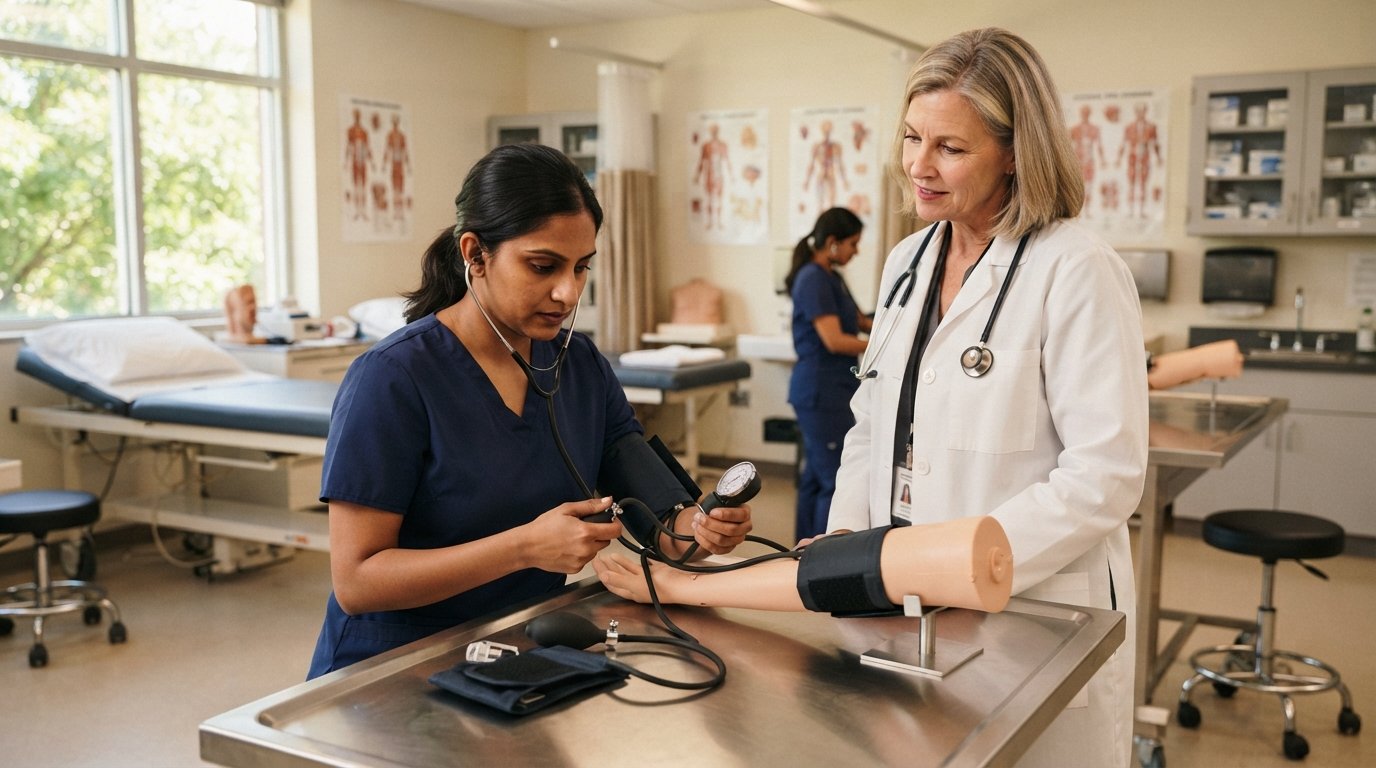
Because the program is in person, you will spend significant time in a lab or simulated clinical environment. This is where you develop muscle memory for procedures and learn how to manage the pace of a real clinic. Many students find that the hands-on repetition is what makes them feel job-ready. The program may also include an externship or clinical practicum, which gives you supervised experience in an actual healthcare facility. That externship can often lead directly to a job offer, since employers get to see your work ethic and skills firsthand.
Here are the core areas you can expect to study in a typical medical assistant certificate program:
- Clinical procedures: vital signs, venipuncture, EKG, sterile technique, wound care, and exam preparation.
- Administrative skills: scheduling, patient intake, EHR, billing, coding, and insurance basics.
- Medical terminology and anatomy: understanding body systems, medical abbreviations, and documentation.
- Patient communication and ethics: confidentiality, empathy, cultural competence, and professional boundaries.
- Externship or practicum: supervised hands-on experience in a clinic, hospital, or private practice.
After completing these areas, you should be prepared to sit for national certification exams such as the Certified Medical Assistant (CMA) or Registered Medical Assistant (RMA) credential, depending on your program and state requirements. Certification is not always required to start working, but it can improve your job prospects and earning potential.
Admission Requirements and Who This Program Is For
The Medical/Clinical Assistant Certificate, 12 weeks to less than 1 year In-person at California Healing Arts College is designed for students who want a direct path into healthcare without committing to a lengthy degree. Typical applicants include recent high school graduates, career changers, working adults seeking a more stable field, and military veterans transitioning to civilian roles. Some students have prior healthcare experience as nursing assistants or home health aides and want to expand their skills. Others are completely new to the field.
Admission requirements vary by school, but most certificate programs ask for a high school diploma or equivalent, a completed application, and sometimes a background check or immunization records before the clinical portion. Because the program is in person, you will also need to attend classes and labs on a set schedule. That is important to consider if you are balancing a job or family responsibilities. However, the short duration of the program means the commitment is intense but time-limited.
If you are comparing programs, it helps to look at accreditation, externship partnerships, certification exam pass rates, and job placement support. California Healing Arts College focuses on hands-on healthcare training, so students who thrive in interactive, lab-based environments tend to do well. You can also explore broader degree and certificate options through resources like CollegeDegrees.School, which provides guidance on college degrees, higher education pathways, and career planning. That kind of research can help you confirm that a medical assistant certificate is the right fit before you enroll.
Cost, Financial Aid, and How to Pay for Your Certificate
One of the biggest concerns for prospective students is cost. A short certificate program is generally much less expensive than a two-year or four-year degree, but you still need to plan for tuition, fees, books, uniforms, and possibly certification exam costs. At California Healing Arts College, tuition for the medical assistant certificate will depend on the specific program length and included materials. You should request a current tuition schedule and ask what is included in the total cost.
Financial aid options may include federal student aid (if the school is eligible), institutional payment plans, scholarships, and workforce development grants. Military veterans may be able to use GI Bill benefits or other VA education programs. Working adults should ask about evening or weekend cohorts, though in-person programs often have limited scheduling flexibility. It is also worth asking whether the school offers job placement assistance or externship-to-hire pathways, since those can reduce the time you spend searching for your first role.
To make the cost more manageable, consider these steps:
- Request a full cost breakdown, including tuition, lab fees, books, uniforms, and exam fees.
- Ask about payment plans, scholarships, and whether the school participates in federal financial aid programs.
- Check with your state workforce agency or local workforce board for healthcare training grants.
- If you are a veteran, contact the VA to confirm which benefits apply to certificate programs.
- Compare the total cost against expected entry-level wages in your area to estimate your return on investment.
After you have the numbers, you can make a more informed decision. Keep in mind that healthcare employers often value experience and certification over the prestige of the school, so a focused certificate from an accredited program can be a smart investment.
Career Outlook and Job Settings for Medical Assistants
Medical assistants work in a wide range of settings. The most common are private physician practices, outpatient clinics, urgent care centers, hospitals, and specialty offices such as dermatology, pediatrics, or cardiology. Some medical assistants work in chiropractic offices, physical therapy clinics, or community health centers. Because the role combines clinical and administrative tasks, it is a good fit for people who enjoy variety and direct patient interaction.
According to the U.S. Bureau of Labor Statistics, employment of medical assistants is projected to grow much faster than the average for all occupations over the next decade, driven by an aging population and increased demand for preventive care. Entry-level wages vary by region, but in California, medical assistants often earn above the national median due to the state's higher cost of living and strong healthcare sector. With experience and certification, you can move into lead medical assistant, clinical coordinator, or office manager roles. Some medical assistants later pursue nursing, physician assistant, or healthcare administration degrees.
If you are considering a longer-term path, you can use your certificate as a stepping stone. Many colleges and universities offer degree completion programs for working medical assistants, and online options make it easier to continue working while you study. The key is to start with a credential that gets you into the field quickly, then build on it as your career goals evolve.
How to Choose the Right Program and Get Started
Not all medical assistant programs are the same. When evaluating the Medical/Clinical Assistant Certificate, 12 weeks to less than 1 year In-person at California Healing Arts College or any similar program, look for accreditation, hands-on lab hours, externship placement, certification exam preparation, and job placement support. Ask about class size, instructor credentials, and whether the school has partnerships with local healthcare employers. A strong program will be transparent about outcomes and give you a clear picture of what to expect.
You should also visit the campus if possible, meet instructors, and talk to current students or recent graduates. Ask how long it took them to find a job after graduation and whether the externship led to employment. If you cannot visit in person, request a virtual tour or phone consultation. The more information you gather, the more confident you will feel about your choice.
Finally, think about your long-term goals. If you want to work in a clinical setting and start earning quickly, a certificate is a practical choice. If you eventually want to move into management, teaching, or advanced clinical roles, you can use your certificate as a foundation and pursue additional education later. Either way, the first step is to request information from accredited programs and compare your options carefully.
Taking the time to research, ask questions, and plan your finances can turn a short certificate into a lasting career. With the right training and a clear plan, you can move from the classroom to a clinic in less than a year and begin building a rewarding career in healthcare.