
Mechanical Engineering Technology Bachelor's at City Tech
Earn a hands-on Mechanical Engineering Technology bachelor's at CUNY City Tech. Affordable, in-person, and built for careers in NYC's technical workforce.

By Mason Reed
New York City runs on machines. From the subway cars that move millions of riders each day to the HVAC systems that keep skyscrapers habitable, the built environment depends on professionals who understand how things work and how to keep them working. If you want to be one of those professionals, the Mechanical/Mechanical Engineering Technology/Technician Bachelor's degree, usually 4 years In-person at CUNY New York City College of Technology (City Tech) offers a practical, affordable, and career-focused pathway into this essential field. Located in Downtown Brooklyn, City Tech is the designated senior college of technology within the City University of New York system, and its mechanical engineering technology programs have trained generations of technicians, technologists, and engineers for the New York City workforce.
This article examines what the degree entails, how the curriculum balances theory with hands-on application, what admissions and costs look like, and where graduates go after commencement. It also explores why the in-person format matters for a discipline rooted in laboratories, machine shops, and collaborative problem solving. Whether you are a high school student planning your next step, a working adult considering a career change, or a veteran seeking a technical credential, understanding this program in detail will help you decide if it fits your goals. For those still weighing broader engineering options, our guide to civil engineering bachelor's degree pathways offers a useful comparison point for how engineering disciplines differ in scope and career direction.
What the Mechanical Engineering Technology Degree Covers
Mechanical engineering technology differs from traditional mechanical engineering in emphasis rather than substance. Both fields deal with the design, analysis, and operation of mechanical systems, but the technology degree leans more heavily toward application, implementation, and hands-on problem solving. Students in the Mechanical/Mechanical Engineering Technology/Technician Bachelor's degree, usually 4 years In-person at CUNY New York City College of Technology learn to bridge the gap between an engineer's concept and a functioning product or system. They work with tools, instruments, and software that professionals use daily in manufacturing, maintenance, testing, and product development.
The curriculum typically spans four years of full-time study and includes a foundation in mathematics, physics, and engineering fundamentals before advancing to specialized coursework. Core subject areas include statics and strength of materials, dynamics, thermodynamics, fluid mechanics, machine design, manufacturing processes, and computer-aided design (CAD). Students also encounter electrical and electronic fundamentals, materials science, and industrial controls, reflecting the interdisciplinary nature of modern mechanical systems. Laboratory work is embedded throughout, ensuring that students do not just read about stress analysis or heat transfer but actually measure, test, and troubleshoot real components.
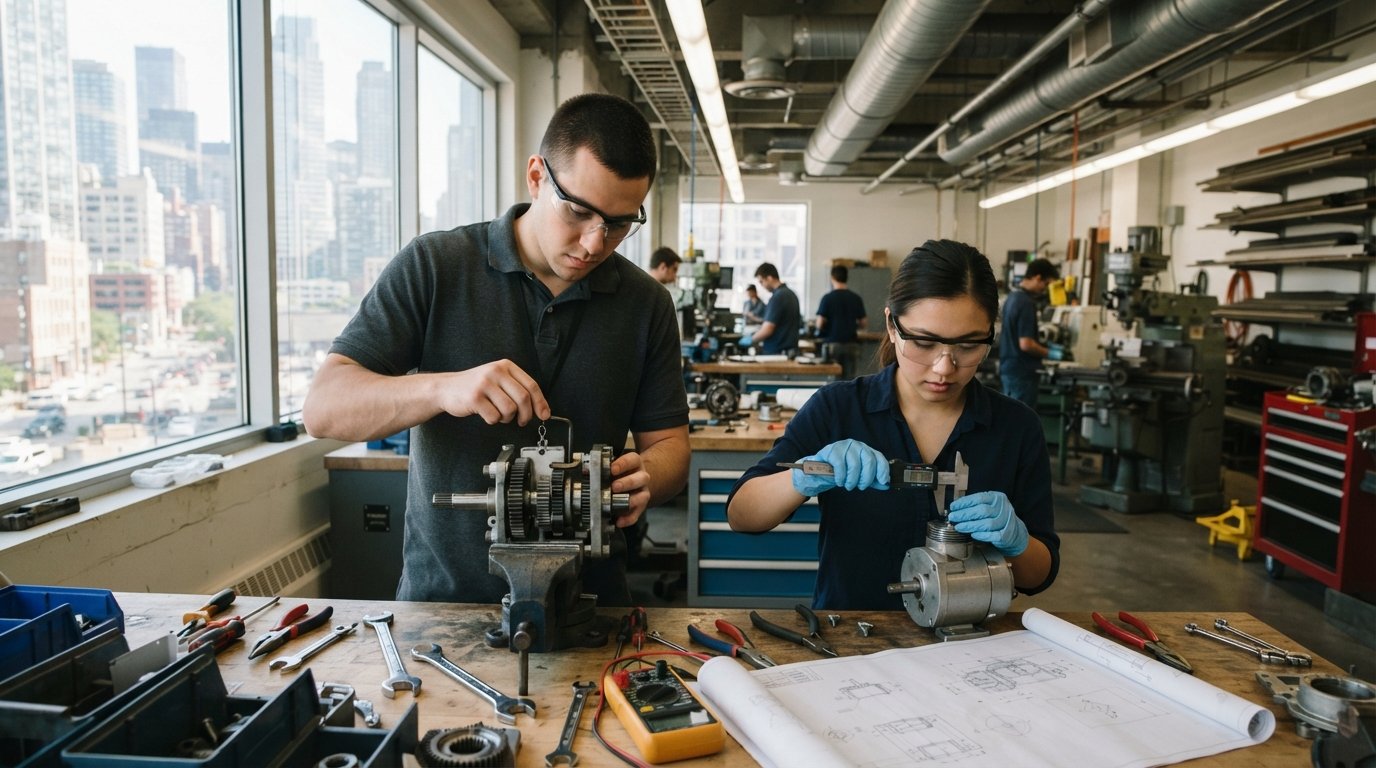
A distinctive feature of the City Tech program is its emphasis on real-world application within an urban context. New York City presents unique engineering challenges: aging infrastructure, dense building systems, energy efficiency mandates, and a growing focus on sustainability. Coursework and projects often reflect these realities, preparing graduates to contribute immediately to local industries. The in-person format is essential here, because much of the learning happens in laboratories, machine shops, and design studios where students collaborate with faculty and peers, gaining the tactile experience that employers value.
Curriculum Breakdown and Hands-On Learning
The degree structure generally follows a progression from foundational courses to advanced specialization. In the first two years, students build competence in calculus, physics, and introductory engineering topics. They learn drafting and CAD, become familiar with shop safety and basic fabrication, and begin to understand how forces and materials interact. The upper division deepens this knowledge with courses in machine design, thermal systems, vibrations, and control systems, often culminating in a capstone project that integrates everything learned.
Hands-on learning is not confined to a single course. Laboratories are woven into multiple subjects, and students frequently work in teams to design, build, and test devices or systems. For example, a thermodynamics lab might involve measuring the efficiency of a small engine, while a manufacturing course could require students to program a CNC machine or weld a structural joint. These experiences mirror the tasks that engineering technicians perform in the field, where the ability to diagnose a malfunction or optimize a process is as important as theoretical knowledge.
Because the program is offered in person at CUNY New York City College of Technology, students have access to dedicated facilities that would be difficult to replicate online. Machine shops, metrology labs, fluid power trainers, and computer labs with industry-standard software are all part of the learning environment. The physical presence also fosters mentorship and networking: faculty members often have industry experience, and guest speakers or site visits connect students with potential employers. For a field that values demonstrated competence, these opportunities are invaluable.
It is worth noting that the program is designed to satisfy accreditation standards, which matters for graduates seeking professional credentials or advanced study. While engineering technology graduates are typically not eligible for the same professional engineer (PE) licensure track as traditional engineering graduates, they are well positioned for roles in manufacturing, maintenance, testing, and technical management. Many students choose to continue their education, pursuing master's degrees in engineering technology, industrial management, or related fields.
Admissions, Cost, and Financial Aid
Admission to the Mechanical/Mechanical Engineering Technology/Technician Bachelor's degree, usually 4 years In-person at CUNY New York City College of Technology follows the general CUNY application process. Prospective first-year students submit the CUNY application, high school transcripts, and any required standardized test scores (though CUNY has adopted test-optional policies for many applicants). Transfer students must submit college transcripts for evaluation. Because the program is housed within a senior college, applicants should indicate City Tech as their campus choice and select the appropriate major. Meeting with an admissions advisor is recommended to ensure that prerequisite coursework in math and science is satisfied.
Cost is one of the strongest arguments for choosing CUNY. Tuition for New York State residents is significantly lower than at private institutions, and financial aid can reduce expenses further. Students may qualify for federal Pell Grants, New York State Tuition Assistance Program (TAP) awards, and institutional scholarships. Working adults and veterans should explore employer tuition benefits and GI Bill provisions, which can make the degree even more accessible. To explore additional funding opportunities beyond federal and state aid, students can search scholarship databases such as Scholarship.Education, which aggregates awards for undergraduate and non-traditional students.
Beyond tuition, students should budget for fees, books, and supplies. Some courses may require personal protective equipment or specialized calculators, and lab fees may apply. However, the overall return on investment for a mechanical engineering technology degree is strong: graduates enter a field with steady demand and competitive starting salaries. According to the Bureau of Labor Statistics, employment of mechanical engineering technologists and technicians is projected to grow in sectors such as manufacturing, research and development, and utilities, with median annual wages above the national average for all occupations.
Career Outcomes and Industry Demand
Graduates of the program find work in a variety of settings, from small manufacturing firms to large public agencies. Common job titles include mechanical engineering technician, CAD designer, manufacturing technician, quality assurance inspector, maintenance supervisor, and field service technician. In New York City, opportunities exist in building systems engineering, subway and transit maintenance, energy management, and product development for consumer goods. The hands-on training received at City Tech means that graduates can often step into these roles with minimal additional training.
Career advancement typically follows a path from technician to technologist to supervisory or management positions. Some graduates pursue certifications such as Certified Manufacturing Technologist (CMfgT) or Certified Engineering Technologist (CET), which can enhance credibility and earning potential. Others use the degree as a springboard to a bachelor's completion in engineering or a master's in a related field. The in-person cohort experience also builds a professional network that can be valuable when job searching.
It is important to recognize that the Mechanical/Mechanical Engineering Technology/Technician Bachelor's degree, usually 4 years In-person at CUNY New York City College of Technology is not a traditional engineering degree. Students who aspire to become licensed professional engineers should consider a traditional mechanical engineering program, which includes more advanced mathematics and theoretical coursework. However, for those interested in the applied side of engineering, the technology degree offers a faster route to employment and a curriculum that is directly relevant to the needs of industry.
Why the In-Person Format Matters
Online education has expanded access to many fields, but mechanical engineering technology is one where hands-on learning is irreplaceable. The in-person format at City Tech ensures that students spend significant time in laboratories, machine shops, and design studios, working directly with equipment and materials. This tactile experience cannot be replicated through video lectures or simulations alone. Employers expect graduates to be able to operate instruments, troubleshoot machinery, and collaborate with teams in real time, skills that are honed through face-to-face interaction.
Moreover, the in-person setting fosters a sense of community and professional identity. Students learn from faculty who have worked in the field, and they build relationships with classmates who will become colleagues. The urban campus in Downtown Brooklyn provides easy access to internships, part-time jobs, and networking events. For students who thrive in a structured, interactive environment, the in-person format is a major advantage.
It is also worth considering the discipline required for hands-on learning. Working with machinery requires attention to safety, precision, and teamwork, all of which are best cultivated in a shared physical space. The program's emphasis on laboratory work and collaborative projects prepares students for the realities of the workplace, where communication and coordination are as important as technical knowledge.
How to Apply and Succeed in the Program
Applying to the program begins with a clear plan. Students should ensure they meet the math and science prerequisites, which typically include algebra, trigonometry, and physics. Those who need to strengthen their foundation can take preparatory courses at a CUNY community college before transferring. The application process involves submitting transcripts, completing the CUNY application, and possibly attending an orientation or advising session. Because the program is competitive, early application is encouraged.
Once enrolled, success depends on consistent engagement. Students should take advantage of office hours, study groups, and tutoring services. Time management is critical, as laboratory courses often require additional hours outside of class. Internships and cooperative education opportunities can provide valuable experience and often lead to job offers. Finally, students should maintain a professional portfolio of projects and designs, which can be showcased to employers upon graduation.
For those who are still exploring their options, CollegeDegree.Education offers tools to compare accredited programs and request information from schools. The platform can help prospective students find programs that match their career goals, whether in mechanical engineering technology or other fields. However, it is important to verify accreditation and program outcomes directly with the institution before making a final decision.
The Mechanical/Mechanical Engineering Technology/Technician Bachelor's degree, usually 4 years In-person at CUNY New York City College of Technology represents a practical investment in a stable and rewarding career. With its blend of theoretical instruction and hands-on application, its affordable tuition, and its location in the heart of New York City's industrial and commercial landscape, the program prepares graduates to meet the demands of a rapidly evolving technical workforce. For students who learn by doing and want to see the tangible results of their work, this degree offers a clear and accessible pathway.