
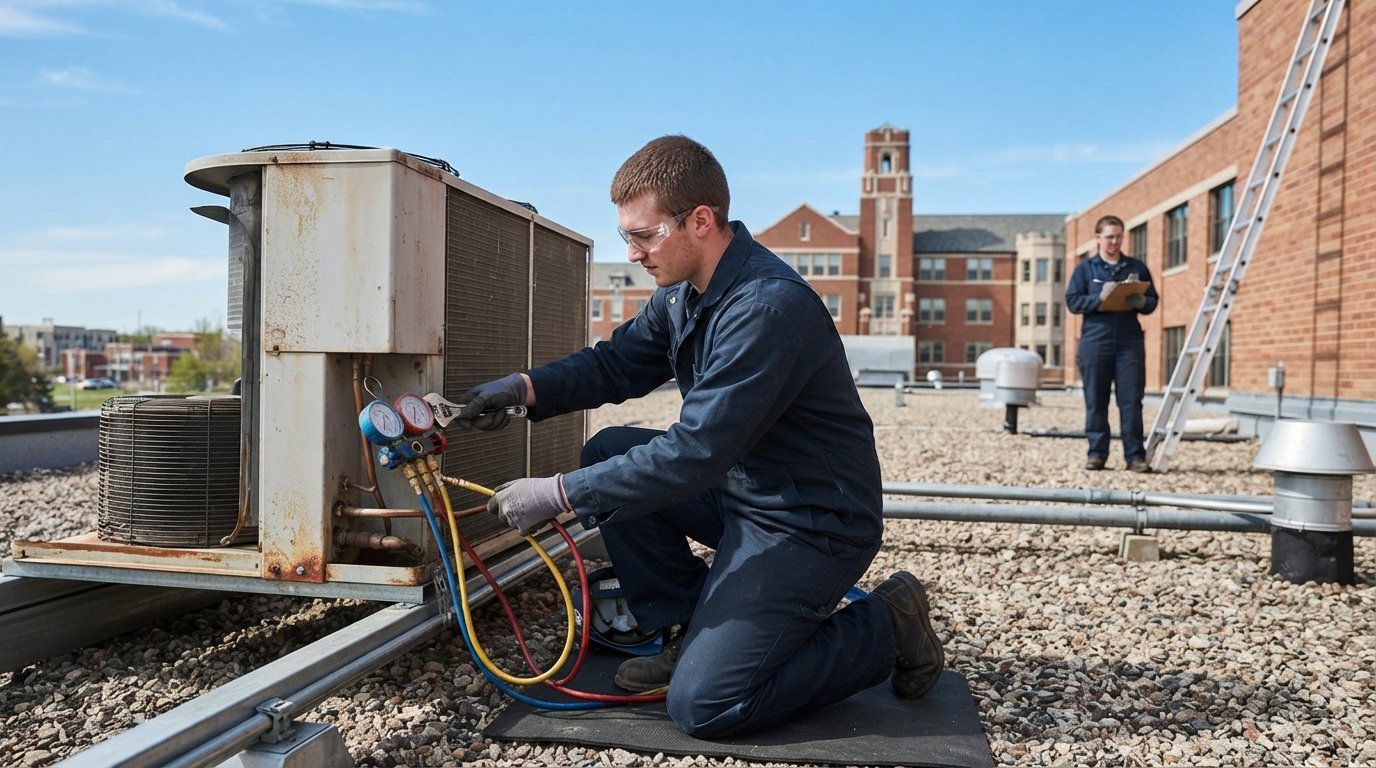
HVAC/R Technician Certificate at Bismarck State College
Earn your HVAC/R technician certificate at Bismarck State College in 1-2 years with hands-on training that prepares you for a stable, in-demand career.

By Noah Collins
Skilled trades are back in demand, and few fields offer the steady, hands-on stability of heating, air conditioning, ventilation, and refrigeration. If you are looking for a fast track into a technical career without committing to a four-year degree, the Heating, Air Conditioning, Ventilation and Refrigeration Maintenance Technology/Technician Certificate, 1 year to less than 2 years In-person at Bismarck State College could be the practical launchpad you need. This program is designed for people who want to work with their hands, understand mechanical systems, and enter the workforce quickly with credentials that employers recognize.
Bismarck State College (BSC) is a well-known institution in North Dakota, and its HVAC/R program stands out because it combines classroom theory with extensive lab time. The certificate is structured to take between one and two years, depending on your pace and course load, and it is delivered entirely in person. That means you get direct access to instructors, equipment, and real-world troubleshooting scenarios that online programs simply cannot replicate. For anyone in or near Bismarck, or willing to relocate, this program offers a clear, affordable pathway to a career that keeps buildings comfortable and food safe.
Throughout this article, we will break down what the certificate covers, who it is for, how to apply, what it costs, and what career outcomes you can expect. We will also explain why hands-on training matters in this field and how you can use this credential as a stepping stone to further education or immediate employment. Whether you are a recent high school graduate, a career changer, or a veteran looking for a new direction, this guide will give you the information you need to make a confident decision.
What the HVAC/R Maintenance Technician Certificate Covers
The Heating, Air Conditioning, Ventilation and Refrigeration Maintenance Technology/Technician Certificate, 1 year to less than 2 years In-person at Bismarck State College is a focused program that teaches the fundamentals of HVAC/R systems. You will start with the basics of safety, tools, and electrical theory, then move into more advanced topics like refrigeration cycles, heating systems, ventilation design, and system controls. The curriculum is hands-on, meaning you will spend significant time in labs working with actual equipment, not just reading about it.
BSC's program is built around industry standards, so you will learn the skills that employers are looking for. Courses typically cover:
- Electrical fundamentals for HVAC/R, including wiring, motors, and controls
- Refrigeration principles, including compressors, condensers, evaporators, and refrigerants
- Heating systems, including gas, electric, and oil furnaces, plus heat pumps
- Air distribution, ductwork, and ventilation systems
- System troubleshooting, maintenance, and repair procedures
Beyond technical skills, the program emphasizes safety and professionalism. You will learn how to work with tools and equipment safely, how to read schematics and blueprints, and how to communicate with customers and colleagues. These soft skills are just as important as technical knowledge in the field, because HVAC/R technicians often work directly with homeowners and business owners.
One of the key advantages of this certificate is its length. Because it can be completed in as little as one year (or up to two years if you take a lighter course load), you can enter the workforce quickly. That means less time without income and a faster return on your investment. For many students, this is a major draw, especially if they are balancing work or family commitments.
Why Hands-On, In-Person Training Matters
HVAC/R is a tactile trade. You cannot learn to fix a furnace or diagnose a refrigerant leak by watching videos alone. You need to touch the equipment, hear the sounds it makes, and smell the telltale signs of a problem. That is why the in-person format of the Heating, Air Conditioning, Ventilation and Refrigeration Maintenance Technology/Technician Certificate, 1 year to less than 2 years In-person at Bismarck State College is so valuable. In the lab, you will work with real systems, often under the guidance of instructors who have years of field experience.
BSC's labs are equipped with trainers that simulate real-world HVAC/R systems. You will practice tasks like:
- Brazing and soldering pipes
- Charging and recovering refrigerants
- Testing electrical components with multimeters
- Adjusting airflow and balancing systems
- Diagnosing common faults in heating and cooling equipment
These hands-on experiences build confidence and muscle memory. When you graduate, you will not just know the theory; you will have done the work. That makes you more attractive to employers who need technicians who can hit the ground running. Many employers prefer to hire candidates who have already spent time in a lab environment rather than those who only have book knowledge.
Additionally, in-person training gives you access to networking opportunities. Your instructors may have connections in the local industry, and your classmates will become part of your professional network. BSC often hosts job fairs and employer visits, giving you a chance to meet potential employers before you even graduate. This is a significant advantage that online programs cannot easily replicate.
Admission Requirements and How to Apply
Getting into the Heating, Air Conditioning, Ventilation and Refrigeration Maintenance Technology/Technician Certificate, 1 year to less than 2 years In-person at Bismarck State College is straightforward, but you should prepare ahead of time. BSC has general admission requirements for all students, and the HVAC/R program may have additional prerequisites. Typically, you will need a high school diploma or equivalent (GED), and you may need to take placement tests in math and English. Some programs also require a background check or drug screening before you start lab work, so check with the admissions office for specifics.
Here is a general step-by-step process to apply:
- Complete the BSC online application and pay the application fee.
- Submit official high school transcripts and any college transcripts if applicable.
- Take the placement tests if required, or submit ACT/SAT scores if you have them.
- Meet with an academic advisor to discuss the program and plan your schedule.
- Apply for financial aid by filling out the FAFSA.
- Register for classes and attend orientation.
It is important to apply early because lab space may be limited. BSC operates on a semester system, with fall and spring starts, and some programs have a summer start as well. Check the BSC website for exact deadlines and start dates. If you are a veteran or active-duty military, BSC has resources to help you use your GI Bill benefits. If you are a career changer, advisors can help you map out a schedule that fits your life.
One thing to note: the certificate program is designed to be completed in one to two years, but the exact time depends on your course load and whether you need to take developmental courses first. Meeting with an advisor early will help you avoid surprises and stay on track.
Cost and Financial Aid Options
Cost is a major consideration for any educational program, and the Heating, Air Conditioning, Ventilation and Refrigeration Maintenance Technology/Technician Certificate, 1 year to less than 2 years In-person at Bismarck State College is generally more affordable than a full degree. Tuition at BSC is competitive, especially for North Dakota residents, and the program's shorter length means you pay for fewer credits overall. You will also need to budget for tools, safety gear, and possibly uniforms. Some courses may require you to purchase a basic tool kit, which you can often keep after graduation.
Financial aid is available for eligible students. You can apply for federal grants, loans, and work-study through the FAFSA. BSC also offers scholarships specifically for students in technical programs, including the HVAC/R program. Additionally, North Dakota has workforce development grants that may cover some costs for in-demand fields. It is worth speaking with the financial aid office to explore all options. Some employers offer tuition reimbursement or apprenticeships that can help offset costs, so ask about those as well.
Compared to a four-year degree, the certificate offers a faster return on investment. You can start earning a paycheck sooner, and many HVAC/R technicians earn competitive wages with opportunities for overtime and advancement. The hands-on nature of the work also means you can build a reputation quickly, and some technicians eventually start their own businesses. For many students, the certificate is a low-risk, high-reward investment.
If you are considering other healthcare or trades certificates, you might also explore programs like a Medical Coding Specialist Certificate and Career Guide, which offers a different path in the growing healthcare field. But for those who prefer mechanical work, HVAC/R is a solid choice.
Career Outlook and Job Opportunities
The demand for HVAC/R technicians is strong and growing. As buildings become more complex and energy efficiency becomes a priority, skilled technicians are needed to install, maintain, and repair systems. The Bureau of Labor Statistics projects steady growth for HVAC/R mechanics and installers over the next decade, with many job openings expected each year due to retirements and industry expansion. In North Dakota, the oil and gas industry, agriculture, and commercial facilities all rely on HVAC/R systems, creating a steady demand for trained workers.
Graduates of the Heating, Air Conditioning, Ventilation and Refrigeration Maintenance Technology/Technician Certificate, 1 year to less than 2 years In-person at Bismarck State College can pursue a variety of roles, including:
- HVAC service technician
- Refrigeration technician
- Installation technician
- Maintenance mechanic
- Building automation technician
Many technicians work for HVAC contractors, but others find jobs in hospitals, schools, factories, and government buildings. Some choose to specialize in commercial refrigeration or residential heating and cooling. With experience, you can move into supervisory roles, start your own business, or become a trainer. The certificate also provides a foundation for further education, such as an associate degree in HVAC/R or a related field, if you decide to advance your skills later.
According to Careers.org, HVAC/R technicians typically need postsecondary training and licensure, and the field offers opportunities for advancement without a four-year degree. The site notes that technicians often learn through apprenticeships and certificate programs, and that certification can improve job prospects. This aligns with the hands-on, credential-focused approach of BSC's program.
Salaries vary by region and experience, but HVAC/R technicians generally earn a living wage with room for growth. In North Dakota, the cost of living is relatively low, so a technician's salary can go further. Overtime is common during peak seasons (summer and winter), which can boost earnings. Many employers also offer benefits like health insurance and retirement plans.
How This Certificate Fits Into Your Career Path
The Heating, Air Conditioning, Ventilation and Refrigeration Maintenance Technology/Technician Certificate, 1 year to less than 2 years In-person at Bismarck State College is not just a standalone credential; it is a stepping stone. For some, it is the fastest route to a good job. For others, it is the first step toward an associate degree or specialized certifications. BSC offers stackable credentials, meaning you can apply the credits you earn in the certificate toward an associate degree if you choose to continue your education. That flexibility is valuable if you are unsure about your long-term goals but want to start working soon.
If you are a high school student, you might be able to take dual-credit courses that count toward both your high school diploma and the certificate. If you are a veteran, the structured, hands-on nature of the program may appeal to you, and BSC has support services to help you transition to civilian life. If you are a working adult, evening or part-time options may be available, though you should check with the program advisor to see what fits your schedule.
It is also worth considering how the certificate compares to other programs. Some schools offer online HVAC/R training, but the in-person format at BSC provides irreplaceable lab time. If you are looking for a program that balances theory with practice, this is a strong choice. The fact that it can be completed in one to two years means you can start earning sooner, which is a big advantage for career changers and those who want to avoid student debt.
Tips for Success in the Program
To make the most of your time in the Heating, Air Conditioning, Ventilation and Refrigeration Maintenance Technology/Technician Certificate, 1 year to less than 2 years In-person at Bismarck State College, here are a few practical tips:
- Show up and participate: Attendance in labs is critical. You cannot make up hands-on time easily.
- Build relationships with instructors: They have industry connections and can offer advice and references.
- Practice outside class: If you have access to tools, practice basic tasks like wiring or brazing.
- Study for certifications: Consider earning EPA Section 608 certification while in the program, as many employers require it.
- Network: Attend job fairs and connect with local contractors. Many jobs are filled through word of mouth.
Also, be prepared for physical work. HVAC/R technicians often lift heavy equipment, work in tight spaces, and brave extreme temperatures. If you have physical limitations, talk to the program advisor about accommodations. The work can be demanding, but it is also rewarding for those who enjoy problem-solving and working with their hands.
Comparing BSC's Program to Other Options
When researching HVAC/R programs, you will find a range of options, from community college certificates to for-profit trade schools. Bismarck State College stands out for its affordability, reputation, and hands-on training. As a public institution, BSC offers lower tuition than many private schools, and its credits are more likely to transfer if you decide to pursue further education. The program's in-person format ensures you get the lab time you need, and the instructors are experienced professionals.
If you are comparing online programs, keep in mind that HVAC/R is a trade that requires physical practice. While some online programs offer simulation software, nothing replaces working with real equipment. BSC's labs are equipped with industry-standard tools, and you will graduate with the confidence that comes from having done the work. That said, if you live far from Bismarck, you may need to relocate or commute. Weigh that cost against the benefits of hands-on training.
Another factor to consider is job placement. BSC has a career services office that can help you find internships and jobs. The program's connections with local employers can give you a leg up in the job market. Ask about job placement rates and employer partnerships when you speak with an advisor.
Final Steps to Get Started
If the Heating, Air Conditioning, Ventilation and Refrigeration Maintenance Technology/Technician Certificate, 1 year to less than 2 years In-person at Bismarck State College sounds like the right fit for you, the next step is to reach out. Visit the BSC website to review the program page, then contact the admissions office to request information. You can also schedule a campus visit to see the labs and meet instructors. Applying early is recommended, as seats may fill up.
Before you apply, make sure you have your transcripts and financial aid documents ready. If you are unsure about your career goals, talk to an advisor about job shadowing or informational interviews with local technicians. This can help you confirm that HVAC/R is the right field for you. The program is designed to be accessible, but it still requires commitment and effort. If you are ready to work hard and learn a valuable trade, this certificate can open doors to a stable, in-demand career.
In a world where many jobs require a four-year degree, the HVAC/R certificate offers a practical alternative. You can complete it in one to two years, gain hands-on skills, and enter a field with strong demand. Whether you want to work in residential service, commercial refrigeration, or building maintenance, the skills you learn at BSC will serve you well. Take the first step today by contacting the college and exploring your options. Your future in the trades could start sooner than you think.