
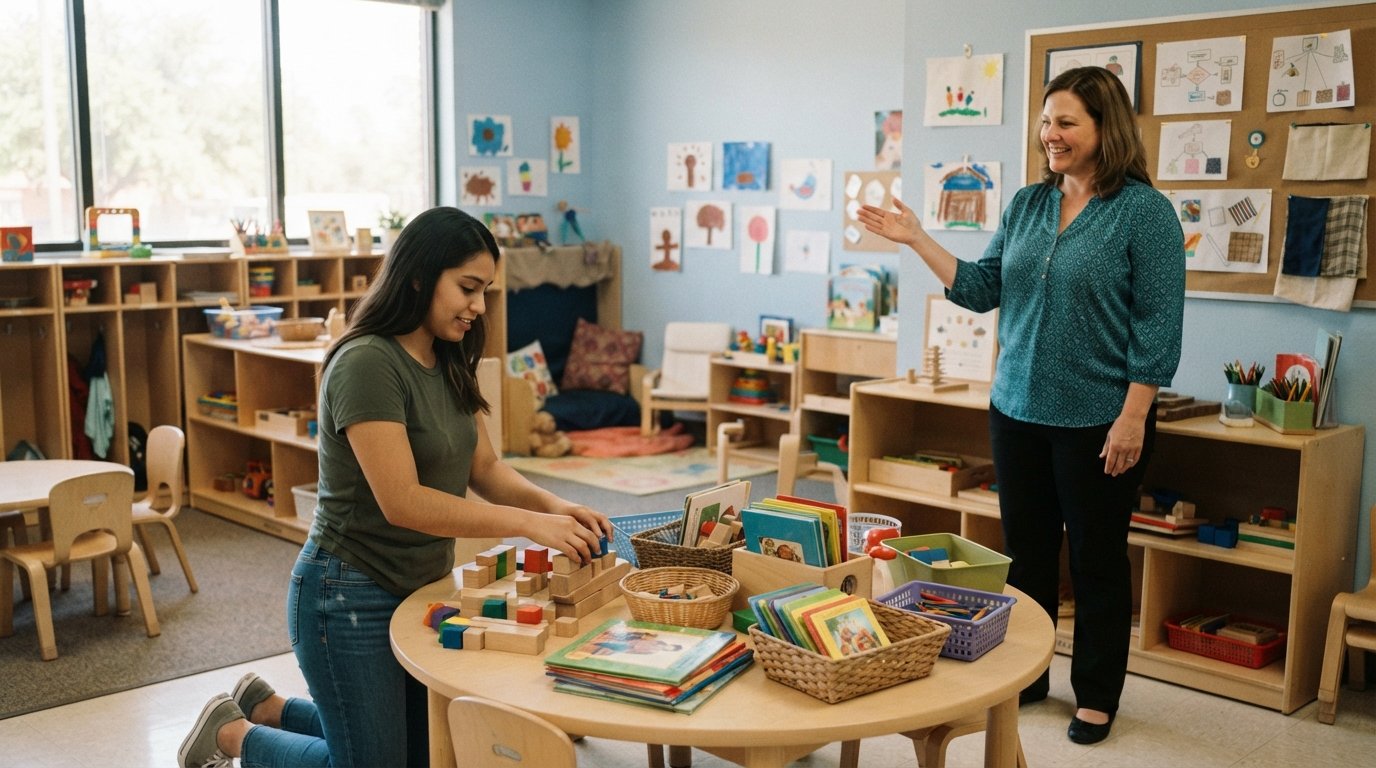
Child Development Certificate at Alvin Community College
Earn a Child Development Certificate, 1 year to less than 2 years In-person at Alvin Community College and gain hands-on training for early childhood careers.

By Mason Reed
If you want to start a career working with young children but cannot commit to a full associate degree, a short-term credential can be the fastest route to a classroom. The Child Development Certificate, 1 year to less than 2 years In-person at Alvin Community College is designed for exactly that situation. It packs the core skills of early childhood education into a focused program you can complete in roughly three to four semesters, and it is delivered face to face on the Alvin, Texas campus. For students who learn best by doing, who want direct access to instructors, and who need to balance school with a job, this certificate deserves a close look.
This guide explains what the certificate covers, who it is for, how the in-person format works, what it costs, and how it connects to real jobs and further education. It also shows how a credential like this fits into the broader landscape of career-focused training, and how you can compare it with other options before you apply. By the end, you should have a clear picture of whether this program matches your goals and what your next step should be.
What the Child Development Certificate Covers
At its core, a child development certificate is a compact, career-oriented credential. It introduces the theory and practice of early childhood education: how children grow and learn from infancy through the early elementary years, how to design safe and engaging environments, and how to communicate with families and colleagues. The program is built to satisfy entry-level hiring requirements for child care centers, preschools, and some Head Start classrooms, and it often aligns with state training requirements for early childhood professionals.
Because the program runs one year to less than two years, you should expect a sequence of foundational courses rather than a sprawling academic survey. Typical coursework in a certificate of this kind includes child growth and development, curriculum planning for young children, observation and assessment, health and safety, and guidance and classroom management. Many programs also include a practicum or field experience component, which is a major reason the in-person format matters: you get supervised time in a real early learning setting, not just simulations.
At Alvin Community College, the in-person requirement means you will attend classes on campus and likely complete lab or field hours at partner sites in the region. That structure gives you immediate feedback from instructors who have worked in the field, and it builds the kind of professional habits (punctuality, teamwork, documentation, and parent communication) that employers look for when they hire. You can also expect the certificate to stack into further study: many of the credits you earn can often be applied toward an associate degree in child development or early childhood education if you decide to continue.
Core Skills You Build
Certificate programs are practical by design, so the skills you develop map directly to job duties. You will learn to plan developmentally appropriate activities, create schedules and routines, observe and document children's progress, and respond to behavioral challenges with positive guidance strategies. You will also study the legal and ethical responsibilities of caregivers, including mandated reporting and health and safety protocols. These are not abstract concepts: they are the daily tools of a preschool teacher, a child care lead, or a family support worker.
Communication is another major thread. Early childhood professionals spend as much time talking with adults as with children, so the program typically emphasizes family engagement, cultural responsiveness, and professional documentation. If you are considering a longer path toward teaching, counseling, or social work, this certificate gives you a realistic preview of the work and a credential you can use while you continue your education.
Who This Program Is For
This certificate is a strong fit for several groups. First, it serves people who want to enter the early childhood workforce quickly. If you need a job in a child care center or preschool within a year or two, a certificate is often the most efficient way to meet hiring requirements. Second, it serves current early childhood workers who need formal credentials to move into lead teacher or director roles. Many centers require or prefer a certificate or degree for advancement, and the in-person format lets working adults attend evening or part-time classes depending on the schedule.
Third, it is a good option for career changers. Adults moving from retail, customer service, or health care often find that early childhood education offers meaningful work and predictable demand. The certificate provides a low-risk way to test the field before committing to a longer degree. Fourth, it can benefit parents and community members who want a deeper understanding of child development for personal or volunteer reasons, though the credential is primarily designed for employment.
Finally, the program is a stepping stone for students who plan to pursue a bachelor's degree in education, psychology, or human services. Starting with a certificate lets you earn while you learn and confirm your interest before taking on the cost of a four-year program. If you later decide to transfer, your advisor can help you map certificate credits into a degree plan.
A Quick Comparison of Student Profiles
To see whether this program fits, compare your situation with the profiles below. Each one highlights a different reason students choose the certificate.
- Recent high school graduate: Wants a fast credential and hands-on experience before deciding on a full degree.
- Working child care aide: Needs formal training to qualify for a lead teacher or director position.
- Career changer: Seeks a stable, people-centered field with clear entry requirements and room to grow.
- Future teacher: Uses the certificate as a bridge into an associate or bachelor's program in education.
If you see yourself in one of these profiles, the next question is logistics: schedule, location, and cost. The in-person format is a strength for hands-on learning, but it also means you need to plan around commute time and campus availability. Alvin Community College serves the greater Houston region, so students from nearby towns should factor travel into their weekly routine.
In-Person Learning at Alvin Community College
The in-person delivery model is one of the defining features of this program. Unlike fully online certificates, which can feel isolated, face-to-face classes put you in a room with peers who are preparing for the same career. That environment supports role-playing, group projects, and immediate Q and A with instructors. For a field built on relationships and observation, that interaction is not a bonus; it is part of the training.
Alvin Community College is located in Alvin, Texas, south of Houston, and it serves a mix of traditional students and working adults. The campus setting gives you access to student services such as advising, tutoring, and financial aid counseling. If you are balancing a job, ask about evening and part-time options early, because in-person programs often have more limited sections than online ones. Meeting with an advisor before registration is the best way to build a schedule that fits your life.
Another advantage of the in-person format is the practicum. Field experiences are usually arranged with local early learning centers, and being on campus makes coordination easier. You will likely need to complete background checks and health clearances before working with children, so plan for those requirements during the application process. Instructors can often help you find placement sites and prepare for the expectations of a professional child care environment.
What a Typical Week Looks Like
Most certificate students take a mix of lecture and lab courses. A typical week might include two or three class meetings, reading and observation assignments, and scheduled field hours later in the program. Because the credential is designed to be completed in one year to less than two years, the pace is steady but manageable if you are not overloading your schedule. Students who work full time often spread the program over four semesters; students who can attend full time may finish closer to the one-year mark.
It helps to treat the certificate like a job. Attendance matters, group work matters, and documentation matters. Instructors use those habits to gauge whether you are ready for a classroom, and employers will ask about them in interviews. If you build strong relationships with your instructors and field supervisors, you also gain references that can help you land your first position.
Admission Steps and Practical Planning
Admission to a community college certificate program is generally straightforward, but it still requires planning. You will need to apply to the college, provide transcripts or proof of high school completion, and complete any placement or advising steps the program requires. Because this is an in-person program, you should also confirm the campus location, class times, and any orientation sessions before the semester begins.
Financial planning is the next step. Certificate programs are often more affordable than degree programs, and community college tuition is typically lower than four-year institutions. You may qualify for federal financial aid, state grants, or workforce scholarships, especially if the program leads to a high-demand occupation. Ask the financial aid office about the cost of attendance, book and supply costs, and any fees for background checks or field placements. If you are a veteran or military family member, review education benefits carefully; resources like a GI Bill guide for veterans can help you understand how benefits apply to certificate and degree programs.
It is also worth comparing this certificate with other credentials in the region. Some students choose a child development associate credential, while others go straight into an associate degree. The right choice depends on your timeline, budget, and career goal. If you want to work soon, the certificate is the faster route. If you want to become a lead teacher in a public school or pursue a bachelor's degree, you may want to plan for additional education after the certificate.
Steps to Get Started
Here is a simple sequence you can follow to move from interest to enrollment:
- Review the program page and course sequence on the college website, and note the application deadlines.
- Apply to Alvin Community College and submit your transcripts or proof of high school completion.
- Meet with an academic advisor to confirm the certificate requirements and plan your schedule.
- Complete the financial aid application and ask about scholarships or workforce funding.
- Register for classes and complete any background check or health clearance required for field placements.
Following these steps early gives you the best chance of getting the class times you need. In-person programs can fill up, and some courses are offered only once per year. If you are uncertain about the order of courses, ask for a degree audit or program map so you do not take unnecessary classes.
Career Outcomes and Next Steps
What can you do with a child development certificate? Graduates typically work as preschool teachers, child care lead teachers, teacher assistants, family child care providers, and early intervention aides. Some move into administrative roles in child care centers, while others use the credential as a foundation for further study in education, psychology, or social work. Demand for early childhood professionals remains steady because working families need reliable care and early learning programs.
Earnings vary by role, setting, and region. Entry-level child care positions generally pay less than public school teaching roles, but the certificate can lead to advancement and higher pay over time. If you want to compare specific occupations, duties, and training requirements, a career research site such as Careers.org can help you explore job profiles and understand what different roles involve. That kind of research is useful before you commit to a program, because it shows you the day-to-day reality of the work.
For students who want to keep going, the certificate can stack into an associate degree, and an associate degree can often transfer into a bachelor's program. If your long-term goal is teaching in a public school, plan on a bachelor's degree and teacher certification. If your goal is center leadership or family services, an associate degree plus experience may be enough. The important thing is to choose a path that matches your timeline and budget, and to revisit that plan with an advisor each semester.
Before you enroll, take one more pass through the practical details: confirm the total cost, the schedule, the field placement requirements, and the transfer options. Then compare the program with at least one alternative, such as an online certificate or a nearby community college, so you know you are making an informed choice. If you want help finding and comparing accredited programs in your area, a matching service can save time and surface options you might have missed.
The Child Development Certificate, 1 year to less than 2 years In-person at Alvin Community College is a practical, hands-on credential for people who want to work with young children and need a fast, affordable pathway into the field. It offers real classroom experience, stackable credits, and a clear route to entry-level employment. If that sounds like your goal, the next step is simple: contact the college, speak with an advisor, and map out your first semester.