
Geology Associate's Degree at Cypress College: 2-Year Guide
Explore the Geology/Earth Science Associate's degree at Cypress College: a 2-year, in-person program with field trips and transfer pathways to UC and CSU.

By Mason Reed
Choosing a college major can feel like standing at the base of a mountain, unsure which trail leads to the summit. For students fascinated by earthquakes, volcanoes, minerals, and the forces that shape our planet, the Geology/Earth Science, General Associate's degree, usually 2 years In-person at Cypress College offers a clear and rewarding path. This program combines rigorous classroom instruction with hands-on field experiences, preparing graduates for transfer to four-year universities or entry-level positions in environmental and geotechnical fields. If you have ever wondered how continents drift, why California has so many faults, or how to turn a love of rocks into a stable career, this degree deserves a close look.
Why Geology and Earth Science Matter in California
California sits on the Pacific Ring of Fire, a geologically active zone where tectonic plates collide, slide, and separate. Living here means living with earthquakes, landslides, coastal erosion, and occasional volcanic activity. Understanding these processes is not just academic; it is a matter of public safety, urban planning, and environmental stewardship. Geologists and Earth scientists work behind the scenes to assess hazards, locate groundwater, manage mineral resources, and advise on construction projects.
Cypress College, located in Orange County, places students right in the middle of this dynamic landscape. The college's Geology/Earth Science program leverages Southern California's unique geology as an outdoor laboratory. Students examine fault lines in the Peninsular Ranges, study sedimentary layers in coastal cliffs, and analyze rock formations in the Mojave Desert. This regional advantage makes the program especially valuable for anyone who wants to understand the ground beneath their feet.
Beyond California, Earth science skills are in demand nationwide. As climate change intensifies and water resources become scarcer, geoscientists are needed to model aquifers, map flood zones, and develop sustainable energy solutions. The Bureau of Labor Statistics projects steady growth for geoscientists, with median salaries well above the national average. An associate degree from Cypress College provides a strong foundation for these careers or for further study.
Program Overview: What the Associate Degree Entails
The Geology/Earth Science, General Associate's degree, usually 2 years In-person at Cypress College is designed as a transfer degree. That means most students complete it with the goal of continuing to a bachelor's program at a California State University, University of California, or private institution. The curriculum balances general education requirements with core geology and supporting science courses.
Full-time students typically finish in two years, though part-time options exist. All courses are delivered in person, which is crucial for a field-heavy discipline like geology. You will spend time in lecture halls learning about plate tectonics, mineralogy, and stratigraphy, but you will also spend long hours in the lab identifying rocks and in the field mapping outcrops. This hands-on approach builds practical skills that online programs simply cannot replicate.
The degree requires completion of 60 semester units, including major preparation, general education, and electives. Core geology courses cover physical geology, historical geology, mineralogy, and petrology. Supporting courses in chemistry, physics, and mathematics ensure you have the analytical tools to succeed in upper-division work. Many students also take courses in geographic information systems (GIS), which is increasingly important in environmental consulting and hazard assessment.
One of the strengths of the program is its small class sizes. Geology is a niche major, so students often form close bonds with professors and peers. Field trips are a regular part of the experience, ranging from day trips to local outcrops to multi-day excursions to Death Valley or the Sierra Nevada. These trips are not just educational; they are also a lot of fun and a great way to build a professional network.
Admission Requirements and How to Apply
Applying to Cypress College is straightforward. As a community college, Cypress has open admission for California residents and welcomes international students as well. To enroll in the Geology/Earth Science program, you need a high school diploma or equivalent, or you must be at least 18 years old and demonstrate the ability to benefit from instruction.
There are no separate admission requirements for the geology major itself. However, because the program includes college-level math and science courses, it is helpful to have a solid background in algebra, geometry, and chemistry from high school. If you feel rusty, Cypress offers placement tests and developmental courses to get you up to speed.
The application process involves completing the online application, submitting transcripts, and attending an orientation session. You will then meet with a counselor to develop an educational plan. The counselor will help you map out the sequence of courses, ensuring you take prerequisites in the right order. For example, you must complete general chemistry before taking mineralogy, and physical geology is a prerequisite for historical geology.
Financial aid is available through federal and state programs, including the Free Application for Federal Student Aid (FAFSA) and the California College Promise Grant, which waives enrollment fees for eligible students. Scholarships specifically for STEM majors are also available through the Cypress College Foundation. The college's financial aid office can guide you through the process.
Core Courses and Learning Outcomes
The heart of the Geology/Earth Science, General Associate's degree, usually 2 years In-person at Cypress College is its core curriculum. These courses provide a comprehensive understanding of Earth's materials, processes, and history. Let's break down the key classes you will take.
- Physical Geology (GEOL 101): Introduces rocks, minerals, plate tectonics, earthquakes, volcanoes, and surface processes. Includes a lab component where you identify minerals and interpret geologic maps.
- Historical Geology (GEOL 102): Explores the evolution of Earth and life over 4.6 billion years. You will learn about fossils, stratigraphy, and the geologic time scale.
- Mineralogy (GEOL 201): Covers the crystallography, chemistry, and identification of minerals. Lab work focuses on hand specimen identification and optical mineralogy.
- Petrology (GEOL 202): The study of igneous, sedimentary, and metamorphic rocks. You will learn how rocks form and how to classify them using thin sections and hand samples.
- Structural Geology (GEOL 203): Examines how rocks deform under stress, including folds, faults, and fractures. Field mapping is a major component.
In addition to geology courses, you will take a year of general chemistry, a semester of physics, and calculus or statistics. These supporting courses are essential for understanding geochemical processes and for transferring to a four-year institution. Many universities require them for admission to upper-division geology courses.
Upon completing the degree, students should be able to identify common rocks and minerals, interpret geologic maps and cross-sections, explain plate tectonic theory, and communicate scientific information effectively. These learning outcomes align with the requirements for transfer to CSU Fullerton, CSU Long Beach, UC Irvine, and other nearby universities.
If you are also considering other science pathways, you might find our guide on what an Associate of Science in Computer Science entails helpful for comparing degree structures and career outcomes.
Transfer Pathways and University Partnerships
Most students who earn the Geology/Earth Science, General Associate's degree, usually 2 years In-person at Cypress College intend to transfer. The good news is that Cypress has strong articulation agreements with many California universities. The Associate Degree for Transfer (ADT) in Geology guarantees admission to a CSU campus, though not necessarily to a specific campus or major. This is a powerful benefit for students who want a clear, affordable route to a bachelor's degree.
For students aiming for a UC school, the Transfer Admission Guarantee (TAG) program offers a similar pathway. UC Irvine, UC Santa Barbara, and UC Davis all have TAG agreements with Cypress College for geology and related majors. You must meet specific GPA and course requirements to qualify, so work closely with a counselor.
Private universities like USC, Chapman University, and Loyola Marymount University also accept Cypress geology transfer students. Each institution has its own requirements, but the core curriculum at Cypress is designed to be broadly transferable. In fact, many geology professors at four-year schools appreciate the field experience that Cypress students bring to upper-division courses.
Transferring is not the only option. Some graduates enter the workforce directly as geological technicians, environmental field technicians, or lab assistants. These entry-level positions typically involve collecting samples, conducting tests, and assisting professional geologists. While advancement usually requires a bachelor's degree, these jobs provide valuable experience and a paycheck while you continue your education part-time.
Career Outlook and Salary Potential
A degree in geology or Earth science opens doors to a variety of careers. The skills you gain, such as critical thinking, data analysis, and field observation, are valued in many industries. Here are some common career paths for graduates with a bachelor's degree or higher, which is the typical requirement for geoscientist roles.
- Environmental Consultant: Assesses soil, water, and air quality; conducts site remediation; ensures regulatory compliance. Median salary around $75,000 per year.
- Geotechnical Engineer: Studies soil and rock mechanics to design foundations, tunnels, and slopes. Often requires an engineering degree, but geologists play key supporting roles.
- Hydrologist: Studies water distribution and movement; manages water resources. Median salary around $85,000.
- Petroleum Geologist: Explores for oil and gas reserves. Salaries can exceed $150,000 but the industry is cyclical.
- Mining Geologist: Locates and evaluates mineral deposits. Median salary around $95,000.
According to the U.S. Bureau of Labor Statistics, employment of geoscientists is projected to grow 5 percent from 2022 to 2032, about as fast as the average for all occupations. Demand for environmental consulting and water resource management is expected to drive growth. In California, stricter environmental regulations and ongoing drought concerns are likely to keep geologists busy.
For those who stop at the associate degree level, job prospects are more limited but still promising. Geological and hydrologic technicians earned a median annual wage of $50,000 in 2022. With experience and additional certifications, technicians can advance to supervisory roles. Some employers offer tuition reimbursement, making it possible to earn a bachelor's degree while working.
It is worth noting that many geology graduates eventually pursue graduate degrees. A master's degree is often required for advancement in research, academia, and senior consulting roles. The strong foundation you build at Cypress College will serve you well if you choose that path.
Hands-On Learning: Field Trips and Lab Work
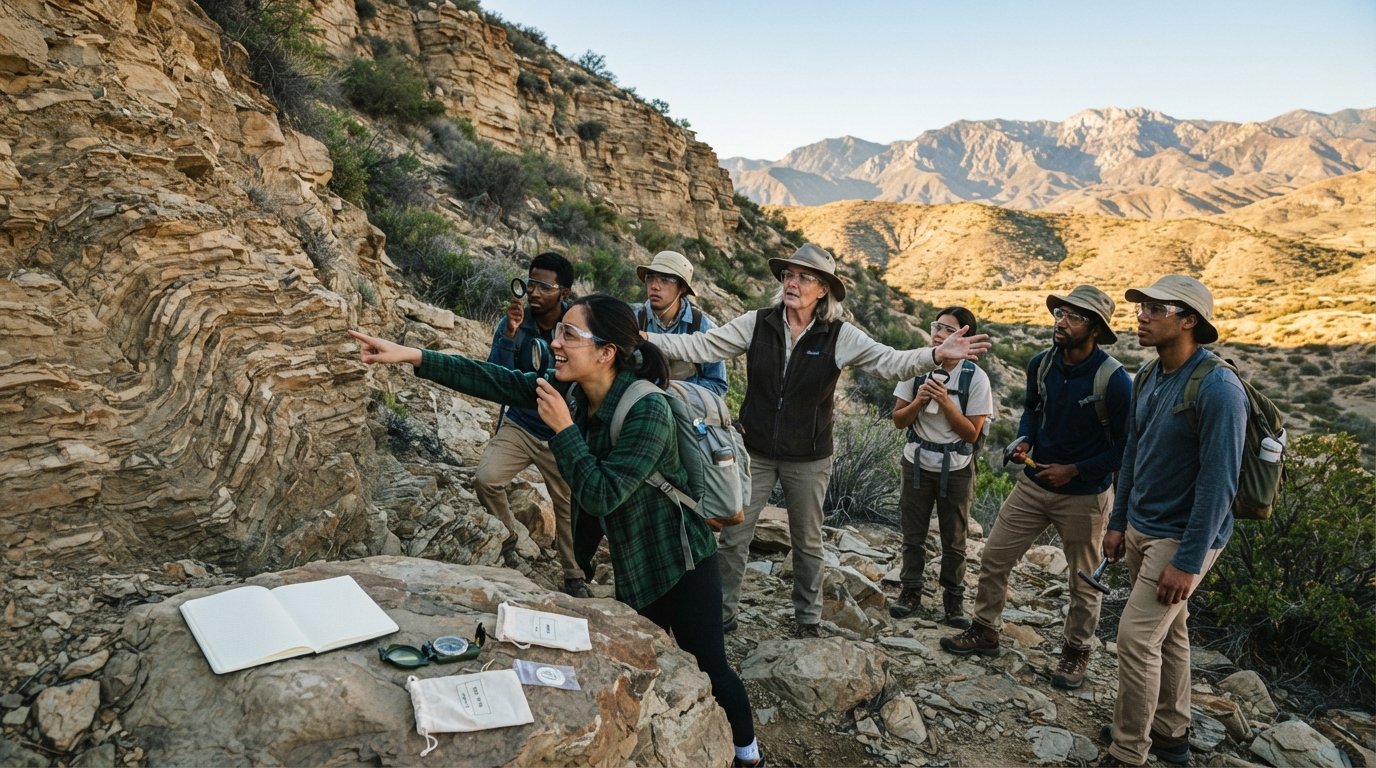
One of the most distinctive features of the Geology/Earth Science, General Associate's degree, usually 2 years In-person at Cypress College is its emphasis on experiential learning. You cannot become a geologist by reading textbooks alone; you must go outside and look at rocks. The program incorporates numerous field trips that take you to some of the most geologically interesting places in California.
Recent field trips have included:
- Mapping faults in the San Andreas system near Palmdale
- Studying marine terraces along the Orange County coast
- Exploring volcanic rocks in the Mojave Desert
- Examining metamorphic core complexes in the Death Valley region
These trips are usually day-long or weekend excursions. They are led by faculty who are experts in the local geology. You will learn how to use a Brunton compass, read topographic maps, and take field notes. These are the same skills used by professional geologists every day.
On campus, the geology lab is well-equipped with rock and mineral collections, microscopes, and computer workstations for GIS and modeling software. Small class sizes mean you get plenty of one-on-one attention from instructors. If you are struggling with a concept, you can usually drop by during office hours and get personalized help.
For students who are unable to attend in person, it is important to note that this program is not offered online. Geology is inherently a field science, and the hands-on components are essential. If you need a fully online option, you may want to explore other fields such as computer science or business, which offer more flexibility. For those who can attend in person, the immersive experience is well worth it.
Comparing Cypress College to Other Geology Programs
California has many community colleges that offer geology courses, but not all offer a dedicated associate degree for transfer. Cypress College stands out for its comprehensive curriculum, dedicated faculty, and strong transfer agreements. The college is also known for its supportive environment, with tutoring centers, study groups, and a STEM club that organizes additional field trips.
When comparing programs, consider factors like class size, field trip opportunities, lab facilities, and transfer success rates. Cypress College performs well on all these metrics. The geology department is small enough that professors know students by name, yet large enough to offer a full slate of courses each semester. The college's location in Orange County provides easy access to diverse geologic settings, from beaches to mountains to deserts.
If you are exploring other degree options, you might also look at related fields like environmental science, geography, or civil engineering. Each has its own focus and career outcomes. For a broader perspective on higher education pathways, you can visit CollegeDegrees.School, which offers resources on college degrees and career planning. This can help you weigh your options and make an informed decision about your future.
Financial Aid and Cost of Attendance
Cost is a major consideration for any college student. As a community college, Cypress College offers affordable tuition. For California residents, enrollment fees are $46 per unit, which means a full-time semester (12 units) costs about $552. Books and supplies can add another $500 per semester. Living expenses vary depending on whether you live at home or rent an apartment nearby.
Fortunately, financial aid is available to help cover these costs. The California College Promise Grant waives enrollment fees for eligible students, and the Federal Pell Grant can provide up to $7,395 per year for low-income students. Many students also qualify for the Cal Grant, which provides additional funds for tuition and living expenses. The Cypress College Financial Aid Office can help you apply for these programs and explore scholarships.
Compared to a four-year university, completing your first two years at Cypress College can save you tens of thousands of dollars. You can then transfer to a university to finish your bachelor's degree, paying university tuition for only two years instead of four. This strategy is popular among geology students who want to minimize debt.
It is also worth noting that some employers offer tuition assistance or reimbursement for employees pursuing degrees in STEM fields. If you are already working in a related industry, check with your human resources department to see what benefits are available.
Is This Degree Right for You?
The Geology/Earth Science, General Associate's degree, usually 2 years In-person at Cypress College is an excellent choice for students who are curious about the natural world, enjoy working outdoors, and want a degree that leads to meaningful careers. It is also a smart financial move for students who want to start at a community college before transferring to a university.
If you are unsure whether geology is right for you, consider taking an introductory course like Physical Geology. It fulfills a general education science requirement and gives you a taste of what the major entails. Talk to a counselor, attend a department information session, and join a field trip. The geology community at Cypress College is welcoming and enthusiastic, and you may find yourself hooked after your first rock identification lab.
Whatever path you choose, remember that education is an investment in your future. Whether you pursue geology, computer science, or another field, the key is to find a program that matches your interests and career goals. With careful planning and hard work, you can achieve your academic dreams and build a rewarding career.