
Dunwoody Electrician Associate's Degree: 2-Year In-Person Path
An Electrician Associate's degree, usually 2 years In-person at Dunwoody College of Technology, combines lab training with industry ties to launch electrical careers.

By Mia Roberts
Skilled electricians keep the lights on, power modern manufacturing floors, and wire the buildings where people live and work. For students who want a structured, hands-on route into that trade, an Electrician Associate's degree, usually 2 years In-person at Dunwoody College of Technology, offers a focused blend of classroom theory and daily lab practice. Dunwoody is a private, nonprofit institution in Minneapolis with a long history of applied and technical education, and its electrical programs are built around the realities of the job site rather than abstract lectures. This guide explains what the program covers, how the in-person format works, what it costs, and how to decide whether this path fits your career goals.
What an Electrician Associate's Degree at Dunwoody Actually Involves
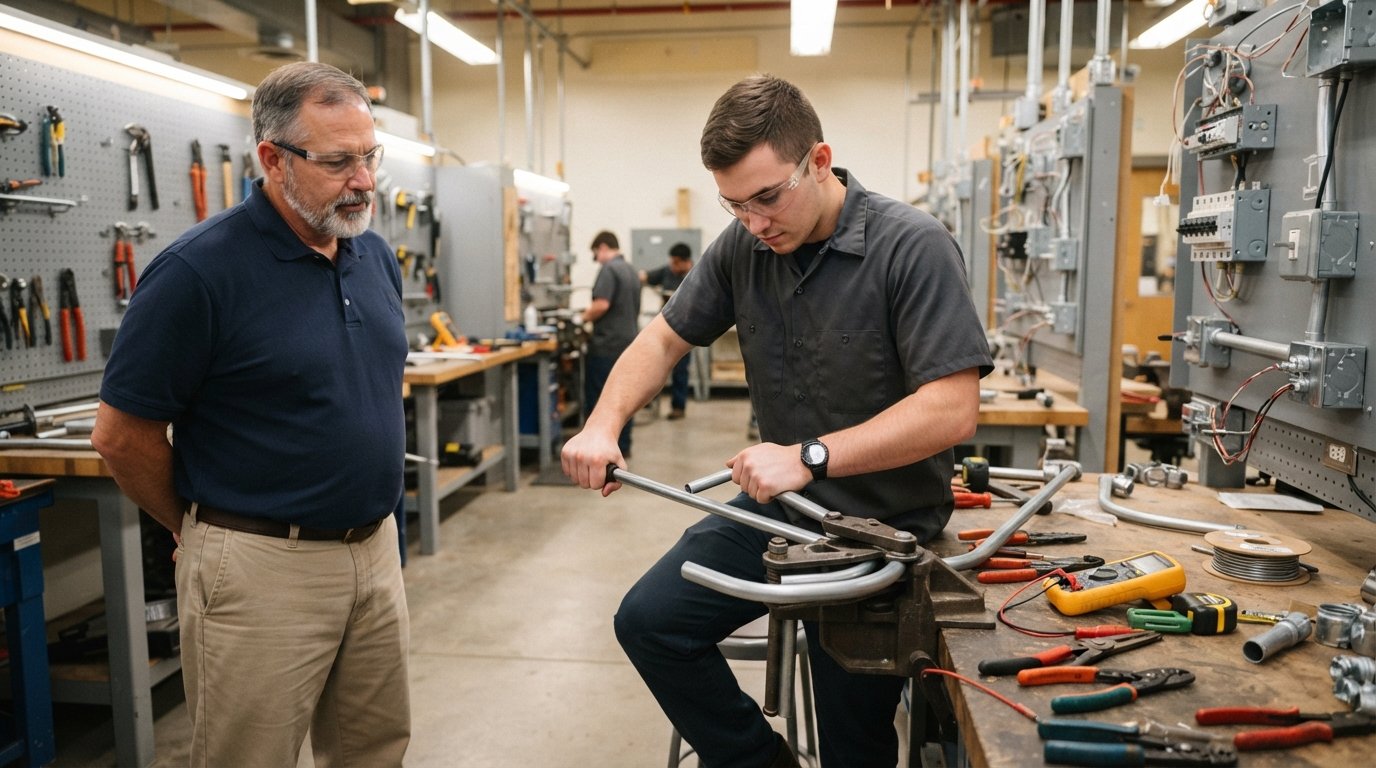
An associate's degree in electrical construction or electrical maintenance is a two-year undergraduate credential, typically around 60 to 70 credits, that combines general education with technical coursework. At Dunwoody, the emphasis falls heavily on the technical side. Students spend substantial time in labs wiring circuits, interpreting the National Electrical Code (NEC), practicing conduit bending, and troubleshooting motors and controls. Because the program is delivered in person, learners work directly with instructors who have field experience and with equipment that mirrors what they will encounter on actual job sites.
The curriculum generally moves from foundational electrical theory, such as Ohm's law and AC/DC circuits, into more specialized topics like three-phase power, motor controls, grounding and bonding, and building automation. General education courses in communication, math, and safety round out the degree so that graduates can read specifications, document work, and communicate with clients and inspectors. For students comparing options, it helps to understand that this is not a loose collection of trade classes: it is a sequenced program designed to build competence week by week.
One of the most valuable aspects of the in-person format is the immediate feedback loop. When a student miswires a motor control circuit in a lab, the instructor can point out the fault on the spot, and the student can correct it before the mistake becomes a habit. That kind of supervised repetition is difficult to replicate online, and it is a major reason why electrical programs at technical colleges remain predominantly hands-on. Students who thrive here tend to enjoy problem-solving, are comfortable working with their hands, and are willing to ask questions when a concept does not click.
Why the In-Person Format at Dunwoody Matters for Electrical Training
Electrical work is physical, spatial, and safety-critical. You cannot learn to bend conduit to precise angles or terminate a panel safely by watching a video alone. The in-person requirement at Dunwoody exists because the trade demands muscle memory, familiarity with tools, and an understanding of how components behave under load. Labs are equipped with training panels, motors, transformers, and test instruments, and students rotate through exercises that simulate real installation and maintenance scenarios. This environment also builds the professional habits that employers expect: arriving on time, wearing proper personal protective equipment, keeping a clean work area, and communicating clearly with a team.
In-person instruction also creates natural networking opportunities. Classmates become colleagues, and instructors often know local contractors who are hiring. Dunwoody has deep ties to the Twin Cities construction and manufacturing sectors, and those relationships can translate into internships, apprenticeships, or entry-level job leads. For a student who is weighing a purely online program against this option, the tradeoff is usually flexibility versus hands-on depth. The Electrician Associate's degree, usually 2 years In-person at Dunwoody College of Technology, is designed for people who want the latter and are prepared to attend classes and labs on a campus schedule.
It is also worth noting that in-person programs tend to have clearer pathways to licensure-related experience. While the degree itself does not replace the supervised field hours required for a journeyman license in most states, it can shorten the related-instruction component and make the transition into an apprenticeship smoother. Students should confirm the specific requirements of the state where they intend to work, because licensing rules vary.
Admission Requirements and How to Apply
Dunwoody's admissions process is designed to be accessible to recent high school graduates, career changers, and working adults. Applicants typically submit an application, high school transcripts or a GED, and may need to demonstrate readiness for college-level math and communication courses through placement testing or prior coursework. Some programs have additional requirements, so prospective students should check the specific electrical program page for details. The application is generally straightforward, and admissions staff are available to help students understand prerequisites and transfer credit policies.
Because the program is in person, applicants should also plan for the logistics of attending classes on campus. That includes transportation, parking, and scheduling around work or family commitments. Dunwoody offers financial aid counseling, and students are encouraged to complete the FAFSA early to see what grants, loans, and work-study options they qualify for. For a broader look at how technology-focused degrees are structured and what to expect from application timelines, the guide on a Bachelor of Information Technology Degree Guide offers useful context that parallels many of the same planning steps.
Prospective students should also ask about credit for prior learning. If you have completed electrical courses at another institution, served in the military in a related role, or have documented industry training, you may be able to transfer some credits. The key is to start the conversation early and provide official documentation. Admissions advisors can walk you through the evaluation process and help you map out a realistic timeline.
Cost, Financial Aid, and Return on Investment
Tuition for a private technical college like Dunwoody is higher than at a public community college, but the total cost depends on the program length, fees, and living expenses. Students should budget for tools, safety equipment, and textbooks in addition to tuition. Financial aid can significantly reduce out-of-pocket costs. In addition to federal and state aid, Dunwoody offers institutional scholarships, and some employers sponsor employees who are pursuing electrical credentials. Veterans may be eligible for GI Bill benefits, and working adults should ask about payment plans.
To make a sound financial decision, compare the total cost of attendance against expected earnings. Electricians in Minnesota and across the country earn solid middle-class wages, and demand for skilled trades workers remains strong. The Bureau of Labor Statistics projects steady employment growth for electricians over the next decade, driven by construction, renewable energy projects, and the need to maintain aging infrastructure. An associate's degree can position graduates for roles in construction, maintenance, industrial controls, and building automation, and it can also serve as a stepping stone to supervisory or estimator positions later in a career. Students who want to explore funding strategies in more depth can find helpful planning resources at CollegeAndTuition, a site focused on college costs and financial aid.
It is important to treat cost estimates as starting points, not final numbers. Tuition changes, scholarship availability varies, and individual circumstances affect aid packages. A conversation with a financial aid advisor is the best way to get an accurate picture. The goal is to avoid unnecessary debt while still gaining the training that employers value.
Career Outcomes and Licensure Pathways
Graduates of an electrician associate's program typically enter the workforce as electrical apprentices, maintenance technicians, or installation helpers, and they advance as they accumulate supervised field hours and pass licensing exams. In Minnesota, electricians are licensed by the state, and the path generally involves a combination of classroom instruction and on-the-job training. The degree can fulfill or reduce the related-instruction requirement, depending on the program and the state's rules. Students should verify the specifics with the Minnesota Department of Labor and Industry or the licensing board in the state where they plan to work.
Career options widen with experience. Electricians can specialize in industrial maintenance, solar installation, fire alarm systems, or building controls. Some move into project management, estimating, or owning their own contracting businesses. The associate's degree also provides a foundation for further study in electrical engineering technology or construction management, for students who decide they want to pursue a bachelor's degree later. Because the program is in person, students have regular access to instructors who can advise on specialization and job search strategies.
Job placement support at technical colleges often includes resume reviews, mock interviews, and employer networking events. Dunwoody's career services team works with students and alumni, and the school's employer relationships can be a real advantage in a competitive job market. The combination of a recognized credential, hands-on training, and local industry connections makes this path attractive for people who want to enter the trade with a solid foundation.
How to Decide If This Program Fits You
Choosing a two-year, in-person program is a significant commitment. It requires time, money, and a willingness to be on campus regularly. To decide whether the Electrician Associate's degree, usually 2 years In-person at Dunwoody College of Technology, is right for you, consider your learning style, your schedule, and your career timeline. If you learn best by doing, value direct access to instructors, and want a structured pathway into the electrical trade, this program is worth a close look. If you need maximum flexibility or cannot relocate or commute, an online or hybrid option might be a better fit, though hands-on training will still be essential somewhere in your journey.
A practical next step is to visit the campus, meet with an admissions advisor, and sit in on a lab tour if possible. Ask about class sizes, instructor credentials, equipment, and job placement rates. Talk to current students or alumni if you can. These conversations will give you a clearer sense of the day-to-day experience than any brochure. It is also wise to compare the program against local apprenticeship options, since some students enter the trade through apprenticeship alone. The degree path and the apprenticeship path are not mutually exclusive, and some people combine them.
Finally, think about your long-term goals. If you want to own a business, supervise crews, or move into engineering technology, the associate's degree provides a broader foundation than a short certificate. If you want to start earning as quickly as possible, a certificate or apprenticeship might get you there faster. The right choice depends on how you weigh time, cost, and career ceiling. For students who want a comprehensive, in-person electrical education with strong industry ties, Dunwoody's program is a credible and well-established option.
Electricians are in demand, and the skills they use every day are learned through repetition, mentorship, and real equipment. An associate's degree from a respected technical college can open doors and provide a durable foundation for a career that offers stability and growth. By planning carefully, asking the right questions, and understanding the costs and requirements, you can make an informed decision about whether this path is the right one for you.