
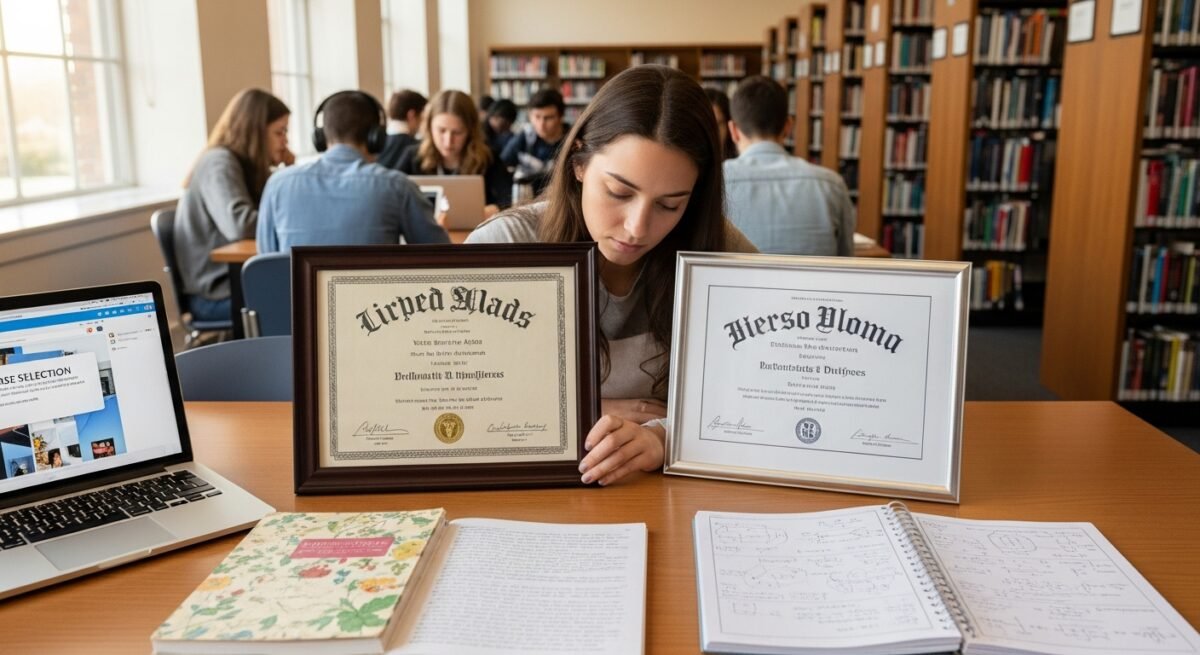
Dual Degree vs Double Major: Key Differences Explained
Understand the key structural differences between a dual degree and a double major to make an informed decision about your academic path and career trajectory.

By Elena Markova
You are ambitious, driven, and eager to maximize your college education. The idea of studying two distinct fields is compelling, but the path forward isn’t always clear. Should you pursue a dual degree or a double major? This critical decision can shape your academic journey, financial investment, and career trajectory for years to come. While both options allow you to explore multiple disciplines, they are fundamentally different in structure, requirements, and outcomes. Understanding these differences is the first step in crafting an academic plan that aligns with your personal goals, timeline, and budget.
Defining the Core Concepts
At first glance, a double major and a dual degree might seem similar, as both involve a commitment to two academic fields. However, the distinction lies in the depth of study and the credential you earn upon completion. A double major is a single academic program leading to one bachelor’s degree, but with a concentration in two distinct subjects. For example, you might earn a Bachelor of Arts (B.A.) with a double major in Political Science and Economics. Both majors are fulfilled within the credit requirements of that single degree, often sharing general education and elective courses.
A dual degree program, in contrast, is a more intensive undertaking where a student simultaneously pursues two separate degrees. This typically results in earning two distinct diplomas. Common combinations include a Bachelor of Science (B.S.) in Engineering and a Bachelor of Arts (B.A.) in Business, or a B.A. in Psychology alongside a Bachelor of Social Work (B.S.W.). These programs require admission to and fulfillment of the distinct requirements for two different schools or colleges within a university. Consequently, they demand a significantly higher credit load, often extending the time to graduation.
The Structural and Logistical Differences
The practical differences between these two paths are substantial and impact every aspect of your college experience. The most immediate difference is the total number of credits required. A standard bachelor’s degree with a double major usually requires 120-130 credits, with both majors fitting within that framework. A dual degree program, however, often requires 150 to 180 credits or more, as you must meet the full core and major requirements for two separate degrees. This credit disparity directly influences the time commitment.
Double majors are frequently completed within the traditional four-year undergraduate timeline, especially with careful planning. Dual degree programs almost always require a fifth year, and sometimes a sixth, of study. This extended timeline has significant financial implications, including additional tuition, fees, and living expenses, as well as the opportunity cost of delayed entry into the workforce. Furthermore, the administrative path differs. Double majors are usually managed within a single academic department or dean’s office. Dual degrees require coordination between two separate schools, each with its own advisors, policies, and graduation checklists, which can add a layer of complexity to your academic planning. For a deeper look at navigating these complex programs, our guide on dual degree programs explained offers strategic advice for students.
Strategic Benefits and Potential Drawbacks
Choosing between these paths is not about which is objectively better, but which is better for you. Each option offers unique advantages and comes with its own set of challenges. A double major is an efficient way to develop interdisciplinary expertise without extending your time in school. It signals to employers a versatile skill set and the ability to manage a complex workload. For instance, combining Computer Science with Linguistics can be powerful for natural language processing careers, while Marketing paired with Data Analytics is highly sought after in the modern business world.
The benefits of a dual degree are more profound in terms of credentialing. You graduate with two full degrees, which can be particularly valuable if the fields are distinct and each requires its own professional accreditation (e.g., Nursing and Public Health). It can open doors to specialized career paths or graduate programs that require a specific foundational degree. However, the intensity is much greater. The workload can be overwhelming, and the extended timeline means a later start on earning a full-time salary and potentially higher student debt. It requires exceptional time management and a clear long-term vision to justify the investment.
To help you weigh these factors, consider the following key distinctions:
- Credential Outcome: Double major yields one degree, two majors. Dual degree yields two separate diplomas.
- Time to Completion: Double major often fits in 4 years. Dual degree typically requires 5+ years.
- Credit Requirements: Double major uses ~120-130 credits. Dual degree requires ~150-180+ credits.
- Academic Focus: Double major offers depth in two fields under one umbrella. Dual degree provides deep, separate immersion in two distinct disciplines.
- Best For: Double major suits students seeking interdisciplinary skills efficiently. Dual degree suits those pursuing two distinct professional tracks or accredited fields.
Making the Right Choice for Your Goals
Your decision should be guided by a clear assessment of your career objectives, learning style, and personal circumstances. Start by asking yourself some foundational questions. Are the two fields you love closely related or wildly different? A double major often works best for complementary fields within the same broader college (e.g., both in the College of Arts and Sciences). A dual degree is designed for fields housed in different schools (e.g., Engineering and Fine Arts). What is your career goal? If you aim for a career that sits at the intersection of two fields, a double major may be perfect. If you want to be fully qualified in two separate professions, a dual degree may be necessary.
Financial considerations are non-negotiable. Can you afford an extra year or two of tuition and living expenses? Have you explored all scholarship, grant, and work-study opportunities for extended programs? Your personal stamina is also crucial. Are you prepared for the sustained high workload and administrative coordination of a dual degree, or would you prefer the relatively more manageable pace of a double major? Speaking with current students in both types of programs, as well as academic advisors from both departments of interest, is an essential step. They can provide realistic insights into daily workloads and post-graduation outcomes. Remember, seeking professional college degree guidance can also provide clarity in aligning your academic choices with long-term career pathways.
Frequently Asked Questions
Do employers or graduate schools prefer a dual degree over a double major?
It depends on the field. Employers generally value demonstrated skills, relevant experience, and your ability to apply knowledge. A well-chosen double major that aligns with the job can be just as impressive as a dual degree. For graduate programs, especially professional ones (like law or medicine), the specific prerequisite courses and your GPA matter more than whether you had one or two diplomas. A dual degree may offer an advantage if it provides a unique, rigorous combination directly relevant to the advanced study.
Can I switch from a double major to a dual degree, or vice versa?
It is possible but can be complicated. Switching from a double major to a dual degree often means adding a full year or more of coursework and applying for formal admission to the second school or program. Switching from a dual degree to a double major is usually simpler administratively, as you are dropping one degree and consolidating, but you must ensure you can meet the single-degree requirements for both majors. Both scenarios require close consultation with academic advisors in both departments.
Is a dual degree or double major more expensive?
A dual degree is almost always more expensive in direct costs due to the additional semesters of tuition, fees, and campus housing. The total cost can be 25% to 50% higher than a standard four-year degree. A double major completed in four years should not cost more in tuition than a single major, assuming you stay within the credit limit for full-time status each semester.
Can I pursue a dual degree with one degree online and one on-campus?
This is increasingly possible at universities with robust online divisions. However, it requires careful verification that both programs are accredited, that the credits are fully transferable between the modalities, and that you can manage the logistical demands of both schedules. Synchronous online programs with set meeting times may conflict with on-campus classes.
What is the biggest mistake students make when considering these options?
The most common mistake is pursuing a second major or degree for the wrong reason, such as perceived prestige or parental pressure, without a clear connection to personal passion or professional goals. This can lead to burnout, a lower GPA, and a costly extension of time in school. The second biggest mistake is failing to plan early, which can result in unnecessary extra courses and delayed graduation.
Ultimately, the choice between a dual degree and a double major is a deeply personal strategic decision. It requires honest self-reflection about your intellectual passions, career vision, financial reality, and capacity for work. By thoroughly understanding the structural differences, weighing the long-term benefits against the immediate costs, and seeking advice from mentors and advisors, you can confidently select the academic path that will best equip you for future success. The right choice is the one that aligns with your unique definition of achievement and provides the knowledge and credentials you need to build the career you envision.