
Cuyamaca College Electromechanical Certificate Guide
Finish in about 18 months with hands-on training that leads to stable maintenance and automation technician roles in San Diego County.

By Ryan Taylor
Finding a fast, hands-on path into advanced manufacturing often feels like searching for a hidden door. The Electromechanical Technologies/Technicians, Other Certificate, 1 year to less than 2 years In-person at Cuyamaca College is one of those doors, and it opens onto a job market that desperately needs people who can keep automated systems running. This program blends electrical theory, mechanical repair, and programmable logic controllers into a compact credential you can finish in roughly three to four semesters of full-time study.
If you are a career changer tired of desk work, a recent high school graduate who wants to earn while learning, or a maintenance worker ready to move from manual labor into technical troubleshooting, this certificate was built with you in mind. It sits in the sweet spot between a short-term vocational award and a full associate degree, giving you enough depth to be genuinely employable without asking for four years of tuition and lost income.
Cuyamaca College, part of the Grossmont-Cuyamaca Community College District in El Cajon, California, has long been a regional hub for career technical education. Its electromechanical offerings feed directly into San Diego County's manufacturing, biotech, and logistics employers, many of which recruit from the program before students even finish their final capstone course. Understanding what this certificate includes, what it costs, and where it leads is the first step toward deciding whether it fits your life. For a broader look at how certificates and degrees fit together financially, our guide on using federal aid for certificates walks through the funding mechanics that apply here.
What the Electromechanical Technologies Certificate Covers
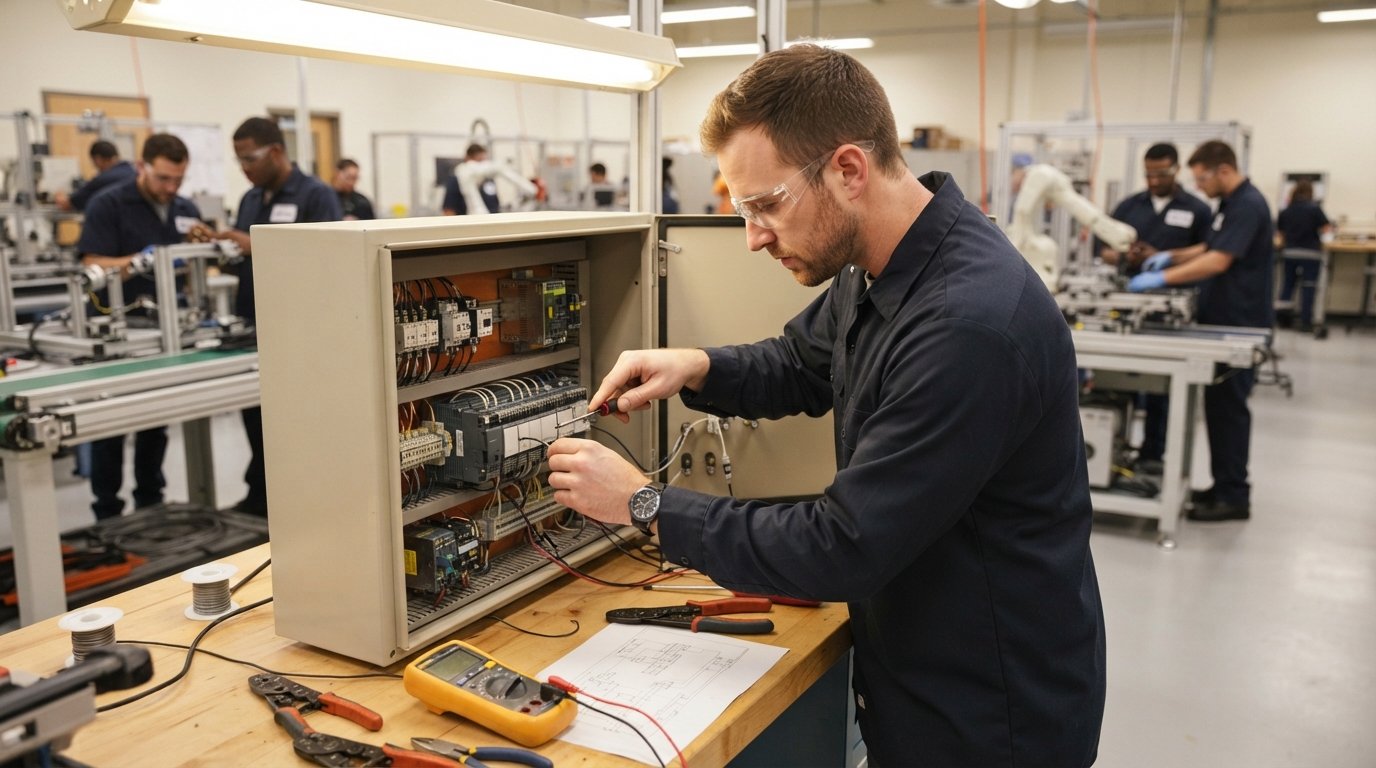
At its core, this credential teaches you how electricity, mechanics, and control systems interact inside modern industrial equipment. You will not just read about motors and relays; you will wire them, test them, and diagnose faults on training benches that mirror real production floors. The curriculum typically stacks foundational courses in direct current and alternating current circuits, then moves into motor controls, fluid power, mechanical drives, and industrial automation.
Because the program is listed under the "Other" category of electromechanical technologies, it can flex to include emerging topics that do not fit neatly into traditional machine tool or electronics tracks. Students often encounter introductory robotics, sensor calibration, and basic networking for industrial devices, which are exactly the skills employers list in maintenance technician job postings.
Here is a representative sample of the course areas you can expect to complete:
- Electrical safety, schematics, and multimeter use
- AC/DC motor theory and troubleshooting
- Programmable logic controller (PLC) programming and wiring
- Hydraulic and pneumatic system maintenance
- Mechanical power transmission and alignment
Each of these areas builds on the last. You cannot troubleshoot a PLC-driven conveyor until you understand the motor starters and sensors feeding it information. That layered design is deliberate: employers want technicians who can trace a problem from a mechanical jam all the way back to a faulty input module, and the certificate sequence trains you to think in systems rather than isolated parts.
Why the 1 to 2 Year Format Matters for Working Adults
A certificate that takes one year to less than two years to complete hits a practical sweet spot. It is long enough to include real lab hours and safety certifications, but short enough that you can see the finish line from the first day of class. For adults balancing a job or family, that timeline reduces the risk of life interrupting your education before you earn a marketable credential.
In-person instruction is a deliberate feature rather than a limitation. Electromechanical work is physical and tactile. Learning to feel the resistance of a binding bearing, hear the hum of a miswired transformer, or smell overheating insulation cannot be replicated through a video lecture. Cuyamaca's labs give you supervised repetition with equipment that behaves like the machines you will service in the field.
The compressed timeline also means you enter the workforce sooner. Instead of deferring income for four years, you can be interviewing for entry-level maintenance roles within 12 to 24 months while optionally continuing toward an associate degree at night. Many students stack this certificate into a broader engineering technology degree later, using the credits they already earned.
Admission Steps and What to Expect as a Student
Cuyamaca College follows the standard California community college admission model, which is notably accessible. You apply online, obtain a student ID, complete orientation, and take placement assessments in English and math. There is no competitive GPA cutoff for the certificate itself, though individual courses may have prerequisites such as intermediate algebra or introductory electronics.
Once enrolled, your typical week blends lecture with substantial lab time. Expect to spend two to three hours in hands-on practice for every hour of theory. Safety glasses, closed-toe shoes, and a basic tool kit are usually required, and instructors emphasize lockout/tagout procedures from the first week because industrial environments do not forgive carelessness.
To move through the program efficiently, plan your sequence around these milestones:
- Complete English and math placement, then register for the introductory electrical course.
- Finish AC/DC fundamentals before attempting motor controls.
- Take PLC coursework only after you are comfortable reading ladder logic diagrams.
- Schedule the capstone or internship in your final term so it overlaps with job searching.
Meeting with a program advisor early prevents the most common delay: taking courses out of order and then waiting a full semester for a prerequisite to be offered again. Advisors can also flag which courses transfer to four-year engineering technology programs if you are considering that route.
Costs, Financial Aid, and Return on Investment
As a California community college, Cuyamaca charges per-unit enrollment fees that are among the lowest in the nation for credit courses. Add textbooks, tools, and modest lab fees, and the total cost of the certificate typically lands in the low thousands rather than tens of thousands. That matters because entry-level electromechanical technicians in the San Diego region commonly start in the $22 to $30 per hour range, with experienced maintenance techs earning considerably more.
Financial aid is widely available. The Free Application for Federal Student Aid (FAFSA) unlocks Pell Grants, California Promise waivers, and potentially work-study funds. Because this is a credit-bearing certificate, it qualifies for federal aid in most cases, unlike some short non-credit workshops. The Cal Grant and the California College Promise Grant can reduce or eliminate tuition for eligible students.
You should also ask about employer tuition assistance. Many manufacturing companies pay for employees to earn maintenance certificates because it directly upgrades their workforce. If you are already working in a warehouse or production role, your supervisor may approve reimbursement before you spend a dollar of your own money.
When comparing this program to other options, weigh total cost against time to employment. A bachelor's degree in electrical engineering is a powerful credential, but it takes four or more years and costs far more. This certificate gets you into the industry quickly, and you can always continue your education later using the credits you have already banked. Exploring resources like CollegeDegrees.School can help you compare certificate, associate, and bachelor's pathways side by side before committing.
Career Outcomes and Local Demand
San Diego County is not just a tourism and biotech town; it also hosts a dense cluster of advanced manufacturing, from medical device makers to aerospace suppliers. These facilities run on automated equipment, and every automated line needs technicians who can maintain, calibrate, and repair it. The Bureau of Labor Statistics projects steady demand for industrial machinery mechanics and electromechanical technicians nationwide, and local employers consistently report difficulty filling these roles.
Graduates of this certificate typically pursue titles such as maintenance technician, electromechanical technician, automation technician, field service technician, and controls assistant. Some move into facilities maintenance for hospitals, universities, or water treatment plants, where the same electrical and mechanical skills apply to a different setting.
Career progression is real. A technician who masters PLC programming and robotics can move into controls engineering support, project coordination, or equipment sales. Others use the certificate as a stepping stone to a bachelor's degree in engineering technology, often with an employer covering part of the tuition. The key is that you are earning and learning simultaneously rather than choosing one over the other.
How It Compares to Other Electromechanical Programs
Not all electromechanical certificates are equal. Some are non-credit, meaning they do not generate financial aid or transferable units. Others focus narrowly on one industry, such as HVAC or automotive, which limits your mobility. Cuyamaca's program sits in the credit-bearing, broad-based category, which gives you more options after graduation.
Its in-person format also distinguishes it from fully online alternatives. While online theory courses exist for electrical fundamentals, no reputable program claims you can master motor alignment or PLC wiring through a screen alone. The lab requirement is a feature that employers recognize and respect.
If you are comparing multiple schools, ask each one three questions: Is the certificate credit-bearing and financial-aid eligible? What percentage of graduates find work in the field within six months? Does the program include PLCs and robotics, or only older relay logic? Cuyamaca's answers to these questions are generally favorable, which is why its career technical programs maintain strong completion and placement rates.
Making the Decision
The Electromechanical Technologies/Technicians, Other Certificate, 1 year to less than 2 years In-person at Cuyamaca College is not for everyone. It rewards people who enjoy diagnosing problems, working with their hands, and understanding how physical systems function. If you prefer purely abstract or sedentary work, a different path may suit you better.
But if you want a credential that employers actually ask for, that you can finish in about 18 months, and that leads to stable, well-paid work in a growing field, this program deserves serious consideration. The combination of low cost, hands-on training, and regional employer demand makes it one of the more pragmatic educational investments available in Southern California.
Start by requesting information from Cuyamaca College, speaking with a program advisor, and filing your FAFSA. Those three steps cost nothing and will tell you quickly whether the timing and logistics work for your situation. The machines are waiting, and so are the jobs.