
Craven Community College Criminal Justice Degree Guide
Earn a Criminal Justice/Police Science Associate's degree, usually 2 years Mix of in-person and online at Craven Community College. Start your law enforcement career.

By Mia Roberts
Choosing a path into law enforcement or the legal system often starts with a practical question: what credentials do I actually need, and how long will it take to earn them? For many students in eastern North Carolina, the answer runs through a Criminal Justice/Police Science Associate's degree, usually 2 years Mix of in-person and online at Craven Community College. That combination of a two-year timeline, flexible delivery, and hands-on training makes the program a realistic entry point for people who want to work in policing, corrections, or security without committing four years and tens of thousands of dollars before their first paycheck. If you are weighing whether this specific pathway fits your goals, the details below will help you decide with clear eyes.
What the Craven Community College Program Actually Covers
Craven Community College, based in New Bern, North Carolina, offers an Associate in Applied Science (AAS) in Criminal Justice Technology. The program is designed to prepare students for entry-level positions in law enforcement, corrections, juvenile justice, and private security, and it also transfers in some cases to four-year institutions for students who later want a bachelor's degree. The curriculum blends general education courses (English, math, social sciences) with core criminal justice courses that cover the legal system, patrol operations, criminal investigation, and ethics in criminal justice.
Because the program is an AAS rather than a transfer-oriented AA, it leans practical. You will spend time on topics like constitutional law, evidence handling, and report writing, which are the daily realities of police work. That practical focus is one reason community college criminal justice programs remain popular with people who plan to go straight into the workforce rather than continue to graduate school immediately.
The program typically requires around 65 to 70 credit hours. Full-time students who take 12 to 15 credits per semester can finish in two years, which matches the "usually 2 years" expectation most people have when they look at associate degrees. Part-time students, including working adults and parents, often take three to four years depending on course availability and how many credits they can handle each term.
How the Mix of In-Person and Online Classes Works
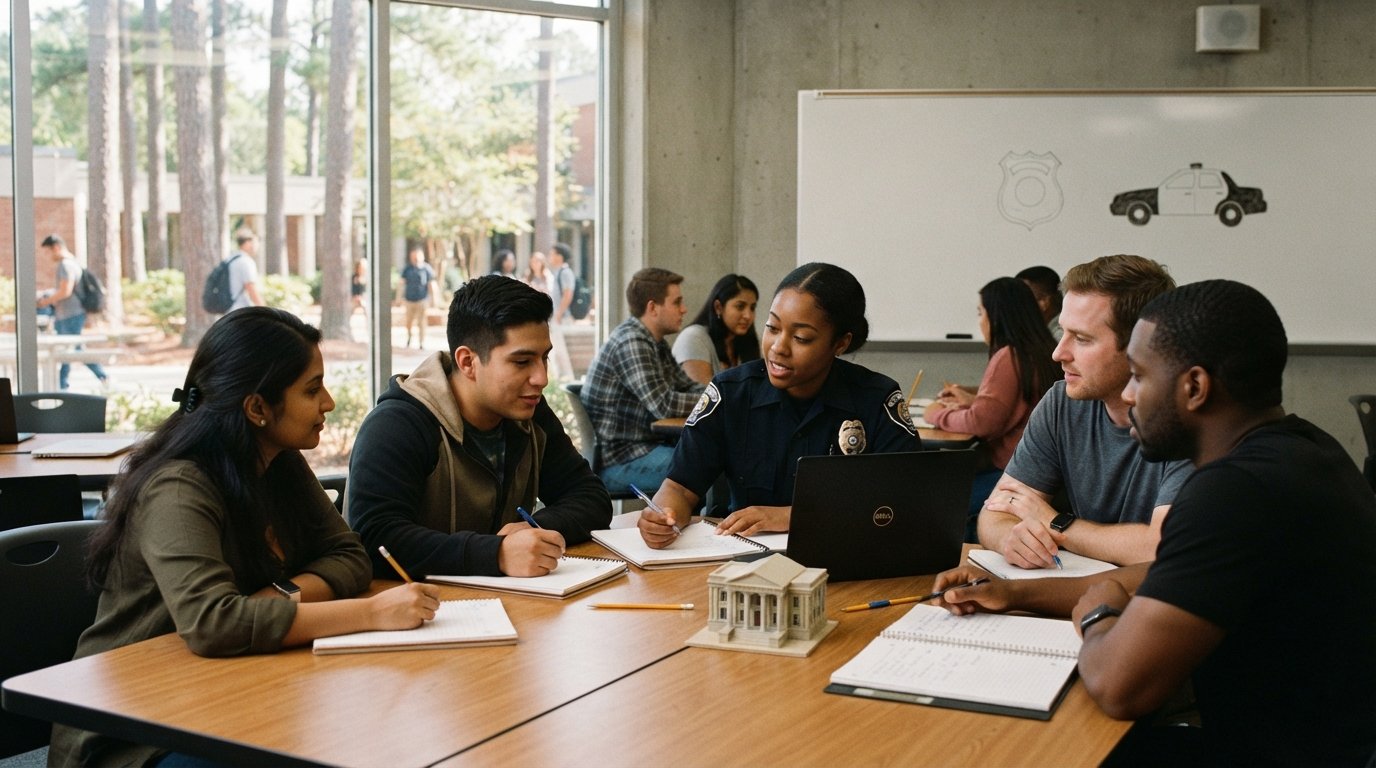
One of the more useful features of this program is that it does not force you to choose between fully online and fully on-campus study. Craven Community College uses a mix of in-person and online courses, which matters for two groups in particular: students who work full-time and need flexibility, and students who want hands-on practice with things like defensive tactics, firearms training, or crime scene processing, which cannot be replicated through a screen.
In practice, the mix often looks like this: general education courses such as English composition, psychology, and American government are frequently available online, while criminal justice core courses may be offered in person, online, or in a hybrid format depending on the semester. Hybrid courses usually combine online lectures or readings with scheduled on-campus meetings for labs, discussions, or exams.
That structure gives you room to build a schedule around a job, a family, or a volunteer role with a local agency. It also means you should check the course catalog each semester rather than assuming a specific class will always be online. Course formats can change based on instructor availability and enrollment.
What a Typical Semester Might Look Like
A full-time student in the fall might take Introduction to Criminal Justice online, English Composition I online, and a criminology or patrol operations course in person on campus twice a week. A part-time student might take one online course and one evening in-person course. The flexibility is real, but it requires planning, because online courses still have deadlines, discussion posts, and exams.
Admission Requirements and How to Apply
Admission to Craven Community College is generally open to students with a high school diploma or equivalent, and the criminal justice program does not usually require a separate competitive application beyond general college admission. That said, there are a few steps and practical considerations worth knowing before you register.
- Complete the college application online and submit official high school transcripts or GED scores.
- Take placement tests or submit ACT, SAT, or prior college transcripts if you want to waive developmental courses.
- Meet with an academic advisor to map out your first two semesters and confirm which courses are offered online versus in person.
- Apply for financial aid by completing the FAFSA, and check whether you qualify for North Carolina resident tuition or military-related benefits if you are connected to nearby Marine Corps Air Station Cherry Point.
Because this is an AAS program, some four-year colleges may not accept every credit if you later decide to pursue a bachelor's degree. If transfer is a possibility, talk with your advisor early about which courses are most likely to transfer. You can also explore broader transfer pathways through resources like our Bachelor of Science in Criminal Justice guide, which explains how two-year credits often apply toward a four-year degree.
Careers and Salary Outlook for Graduates
Graduates of a Criminal Justice/Police Science Associate's degree, usually 2 years Mix of in-person and online at Craven Community College, typically pursue roles with local police departments, sheriff's offices, state highway patrol, correctional facilities, probation and parole offices, and private security firms. In North Carolina, many local agencies require only a high school diploma for entry-level sworn positions, but an associate degree can improve your chances of being hired, speed up promotion timelines, and qualify you for higher pay steps in some departments.
According to the U.S. Bureau of Labor Statistics, police and sheriff's patrol officers earned a median annual wage of around $74,910 nationally as of May 2023, though pay varies widely by region and agency size. Correctional officers earned a median of about $53,300, and private security guards earned considerably less, often in the $35,000 to $45,000 range. In eastern North Carolina, salaries tend to run below the national median, but the cost of living is also lower.
Beyond sworn officer roles, the degree can support jobs as a dispatcher, crime scene technician, loss prevention specialist, or court security officer. Some graduates use the degree as a stepping stone into federal agencies, though federal law enforcement typically requires a bachelor's degree or significant prior experience.
Cost, Financial Aid, and Flexibility for Working Adults
Community college tuition is one of the strongest arguments for this pathway. North Carolina residents currently pay roughly $76 per credit hour at community colleges, which means a 68-credit associate degree costs around $5,200 in tuition alone before fees and books. Out-of-state students pay more, but still far less than most four-year universities. Federal Pell Grants, state grants, and scholarships can reduce that cost further, and students connected to the military may qualify for tuition assistance or GI Bill benefits.
Flexibility is another practical advantage. Because the program mixes in-person and online courses, you can keep working while you study. That matters for career changers and working adults who cannot afford to stop earning an income for two years. If you are exploring how different degree formats compare on cost and scheduling, resources like CollegeDegrees.School provide guidance on degree types, online options, and planning your education around a full-time job.
One caveat: online courses require self-discipline. Students who struggle with time management often do better with a hybrid schedule that includes at least one in-person class per semester for accountability and access to instructors.
How This Program Compares to Other Criminal Justice Pathways
There are three common routes into criminal justice careers: a two-year associate degree, a four-year bachelor's degree, and direct entry into a police academy with only a high school diploma. Each has trade-offs.
- Associate degree: Fastest credential beyond high school, lower cost, practical training, but limited transferability and fewer promotion opportunities at the federal level.
- Bachelor's degree: Broader career options, required for many federal and supervisory roles, but takes four years and costs significantly more.
- Academy only: Fastest path to a sworn position, but no college credential, which can slow promotions and limit career mobility later.
For students who know they want to work in local law enforcement and want to start earning sooner, the associate degree is often the most efficient choice. For students who are unsure or who aspire to federal agencies, starting at a community college and transferring to a four-year program can be a smart middle path. Either way, the key is to plan your courses with an advisor so you do not waste credits.
Is This Program Right for You?
The Criminal Justice/Police Science Associate's degree, usually 2 years Mix of in-person and online at Craven Community College, fits students who want a practical, affordable, and flexible entry point into law enforcement or corrections. It is a particularly strong fit for working adults in eastern North Carolina, military-connected students near Cherry Point, and career changers who need to keep earning while they study.
If you are still comparing options, spend time on program websites, talk to advisors at more than one school, and ask specific questions about course formats, transfer agreements, and job placement rates. A two-year degree is a significant investment of time, but when it aligns with a clear career goal, it can pay off quickly.