
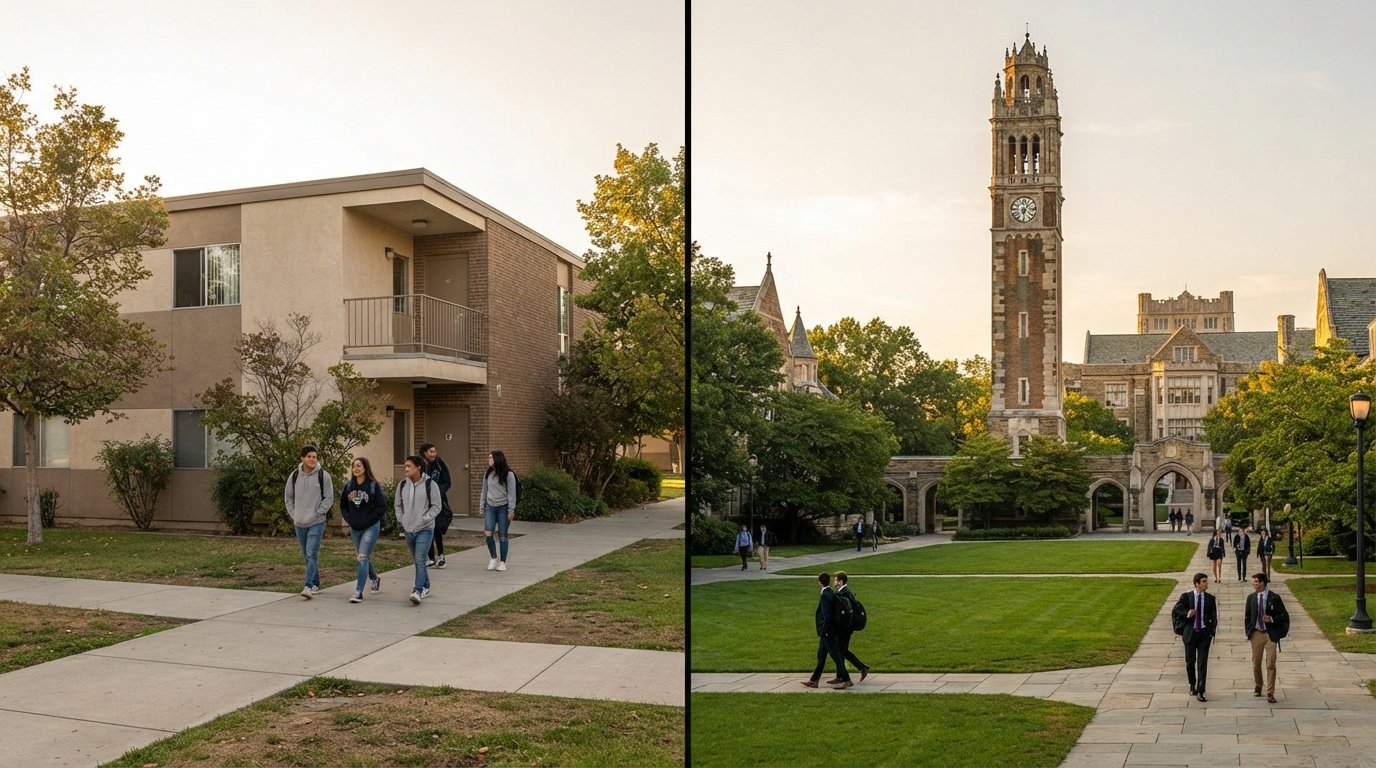
Community College vs University for Bachelor's Degree Pros and Cons
Compare community college vs university for bachelor's degree pros and cons, from tuition savings to transfer risks, to choose the right path for your goals.

By Ethan Clark
Choosing where to earn a bachelor's degree is one of the most consequential financial and academic decisions you will make. The debate over community college vs university for bachelor's degree pros and cons has grown louder as tuition costs climb and more students seek flexible, affordable pathways. Community colleges offer lower sticker prices, smaller classes, and open-access admissions, while four-year universities provide sprawling campuses, research opportunities, and deep alumni networks. Neither option is universally better: the right choice depends on your budget, career goals, academic preparedness, and willingness to navigate transfer processes. This guide breaks down the real trade-offs so you can make an informed decision and avoid costly detours.
The Cost Equation: Tuition, Fees, and the True Price of a Bachelor's Degree
Cost is often the first factor families consider, and for good reason. According to the College Board, the average published tuition and fees at public two-year colleges run roughly one-third to one-half of the cost at public four-year institutions for in-state students. Private universities can be three to four times more expensive than community college. Over a four-year bachelor's degree, that difference can translate into tens of thousands of dollars in savings, or tens of thousands in debt.
But sticker price is not the whole story. Financial aid packages vary dramatically. Four-year universities often have larger endowments and can offer generous need-based or merit-based aid, sometimes bringing net cost closer to community college levels. Community colleges, meanwhile, typically offer limited institutional aid but participate in federal Pell Grants, state grants, and work-study programs. The key is to compare net price, not published tuition, using each school's net price calculator.
Here is a quick breakdown of the primary cost differences:
- Tuition and fees: Community college is significantly cheaper per credit hour, often under $150 per credit for in-district students, compared to $300 to $500 or more at public universities and $1,000+ at private colleges.
- Living expenses: Community college students often live at home, saving on room and board, while university students frequently pay for housing and meal plans.
- Financial aid: Universities may offer larger aid packages, but community colleges qualify for Pell Grants and state aid that can cover most or all of tuition.
- Hidden costs: Transportation, books, and technology fees apply to both, but university ancillary fees (athletics, recreation centers, student services) are typically higher.
When you factor in opportunity cost, the savings from community college can be reinvested into your future. For example, completing your first two years at a community college and transferring to a university for your final two years (the 2+2 model) can cut total bachelor's degree costs by 40 to 60 percent. To explore how this compares across engineering fields, see our guide on what a civil engineering bachelor's degree involves, which often follows this transfer-friendly structure.
However, cost savings come with trade-offs. Community college students may need to budget for reliable transportation, and some may find that certain courses fill quickly, delaying completion. Universities, despite higher costs, often provide more predictable course availability and on-campus resources that can accelerate graduation. Understanding these nuances is essential when weighing community college vs university for bachelor's degree pros and cons.
Transfer Pathways and Credit Acceptance: The Make-or-Break Factor
One of the most significant advantages of starting at a community college is the potential to transfer credits seamlessly to a four-year institution. Many states have articulation agreements or guaranteed admission programs that allow community college graduates with a certain GPA to enter a university as juniors. These pathways can make the transfer process smooth and predictable.
But credit acceptance is not guaranteed. Universities may reject credits for courses that do not match their curriculum, or they may accept them as electives rather than major requirements. This can add semesters and thousands of dollars to your degree. Before enrolling in a community college, you must verify that your intended university will accept your planned courses. Meet with transfer advisors at both institutions, and use statewide transfer databases if available.
Here is a step-by-step framework to protect your credits:
- Identify your target universities and their specific major requirements.
- Obtain a transfer equivalency guide or articulation agreement from the community college.
- Work with a community college advisor to map your courses to university requirements.
- Confirm in writing (email or official form) that credits will transfer as intended.
- Apply to the university early and monitor your transfer credit evaluation.
Four-year universities have their own pros and cons on this front. They offer internal continuity: all your credits count toward graduation, and you avoid the risk of lost credits. However, if you change majors or need to repeat a course, the higher tuition applies to every additional credit. The financial risk of switching majors is amplified at a university.
For students who choose community college, the transfer process demands initiative and planning. Some community colleges have honors programs or transfer partnerships that provide additional support. For a deeper look at how different degree structures affect transfer decisions, explore our article on civil engineering bachelor's degree pathways, which often include community college transfer options.
Campus Experience and Networking: What You Gain and What You Give Up
The traditional university experience, with its dormitories, clubs, athletic events, and research labs, offers immersive social and professional opportunities. Universities often host career fairs with major employers, alumni mentoring programs, and research projects that can lead to internships and jobs. For students in fields like business, engineering, or media, these networks can be invaluable.
Community colleges, by contrast, are primarily commuter campuses. They serve a diverse population of working adults, parents, and students who live at home. While they may lack the vibrant residential life of a university, they often provide smaller classes, more personalized instruction, and flexible scheduling that accommodates work and family obligations. Many community colleges also offer clubs, honor societies, and internship connections, though on a smaller scale.
Networking is not limited to campus. In today's digital age, professional connections can be built through internships, part-time jobs, and online platforms. Community college students can still participate in career fairs, join professional associations, and build relationships with professors who often have industry experience. The key is to be proactive.
Consider the following trade-offs when evaluating campus experience:
- University pros: Extensive alumni networks, on-campus recruiting, research opportunities, diverse student organizations, and a traditional college atmosphere.
- University cons: Larger class sizes, less personalized attention, higher costs for housing and social activities, and potential isolation in a big campus.
- Community college pros: Small classes, accessible faculty, flexible schedules, and a supportive environment for nontraditional students.
- Community college cons: Limited campus life, fewer research opportunities, smaller alumni networks, and less prestige in some competitive fields.
Your career goals should guide this decision. If you aim for a role that relies heavily on networking, such as investment banking or management consulting, a four-year university may offer a stronger pipeline. If you plan to work in healthcare, education, or skilled trades, community college can provide excellent training with less debt. Many students find a middle ground by starting at community college and transferring to a university for their final two years, gaining both affordability and access to university resources.
Financing your education is another critical piece of the puzzle. Whether you choose community college or university, understanding financial aid, scholarships, and loan options is essential. For comprehensive resources on college costs and financial planning, visit CollegeAndTuition, a trusted guide for families navigating higher education expenses.
How to Decide Based on Academic and Career Goals
The best choice between community college and university depends on your specific academic and career objectives. Start by clarifying your intended major and career path. Some fields, like nursing, information technology, and skilled trades, have strong community college programs that lead directly to employment. Others, like law, medicine, or academia, require a bachelor's degree from a university and often a graduate degree.
Assess your academic preparedness and learning style. Community colleges offer developmental courses and smaller classes that can help students who need to strengthen their skills. Universities may be a better fit for students who are ready for rigorous, fast-paced coursework and independent learning. Also, consider your financial situation and willingness to take on debt. If minimizing debt is a priority, community college is a smart start.
Here is a decision framework to help you weigh the options:
- Define your career goal: Does it require a specific degree from a university, or is a community college credential sufficient?
- Calculate net cost: Use net price calculators for both options, factoring in financial aid, living expenses, and time to graduation.
- Evaluate transfer policies: If considering community college, confirm that credits will transfer to your target university.
- Visit campuses and speak with advisors: Meet with faculty, transfer counselors, and career services to understand support systems.
- Consider your lifestyle and obligations: Are you able to relocate? Do you need flexible scheduling for work or family?
Many students find that a hybrid approach works best: complete general education requirements at community college, then transfer to a university for major coursework. This strategy balances cost savings with access to specialized resources and networking. However, it requires careful planning to avoid excess credits.
Whichever path you choose, remember that success depends on engagement and planning. Community college students who actively participate in honors programs, internships, and transfer advising often achieve the same outcomes as university students. University students who take advantage of smaller classes, office hours, and career services also thrive. The institution matters less than what you make of it.
As you research programs, use tools that connect you with accredited colleges and universities. CollegeDegree.Education offers a matching service that helps prospective students find programs aligned with their goals, whether at a community college or a four-year institution. By comparing options and understanding the pros and cons, you can choose the path that sets you up for financial stability and career satisfaction.
In the end, the community college vs university for bachelor's degree pros and cons debate has no single winner. Community college offers affordability, flexibility, and a supportive start, while university provides immersive experiences and expansive networks. Your decision should reflect your financial reality, academic readiness, and long-term aspirations. Take the time to research, ask questions, and plan your route, and you will find a pathway that works for you.