
Your Forensic Science Associate Degree: A Career Starter Guide
An associate degree in forensic science provides the essential skills for entry-level crime lab and investigation careers in just two years. This overview explains the curriculum, career paths, and how to choose the right program.

By Mia Roberts
Imagine a career where your attention to detail and scientific curiosity help solve crimes and deliver justice. An associate degree in forensic science is the foundational credential that opens the door to this dynamic field. This two-year program provides the essential scientific knowledge and technical skills needed to begin a career supporting law enforcement and legal investigations. For many, this degree serves as the critical first step toward becoming a forensic science technician, a crime scene investigator, or a laboratory analyst, offering a faster entry into the workforce than a four-year degree. This comprehensive overview will detail what you can expect from an associate’s program in forensic science, from core curriculum and specializations to career outcomes and pathways for further education.
What Is an Associate Degree in Forensic Science?
An associate degree in forensic science, often called an Associate of Science (A.S.) or Associate of Applied Science (A.A.S.) in Forensic Science, is a 60-credit, typically two-year undergraduate program offered by community colleges, technical schools, and some universities. It is designed to provide students with a solid grounding in the natural sciences as they apply to criminal investigation. The curriculum blends classroom instruction in biology, chemistry, and criminal justice with hands-on laboratory work, creating a practical skill set for entry-level positions. This forensic science associate degree is distinct from a bachelor’s program in its scope and depth; it focuses on applied skills and foundational knowledge, preparing graduates for technician roles or for seamless transfer to a four-year institution to continue their education.
The degree is highly versatile, acting as both a terminal degree for immediate employment and a stepping stone. Students learn to recognize, collect, and analyze physical evidence, understand the chain of custody, and grasp the legal standards for evidence admissibility. The goal is to produce competent professionals who can support forensic scientists and detectives in the field and the lab. For those exploring educational options, many reputable online education resources and platforms can help you compare accredited forensic science associate degree programs to find the right fit for your schedule and career goals.
Core Curriculum and Coursework
The coursework for a crime lab degree is rigorous and interdisciplinary, demanding proficiency in both science and criminal procedure. Programs are carefully structured to build competency from the ground up, starting with general education requirements and progressing to specialized forensic topics.
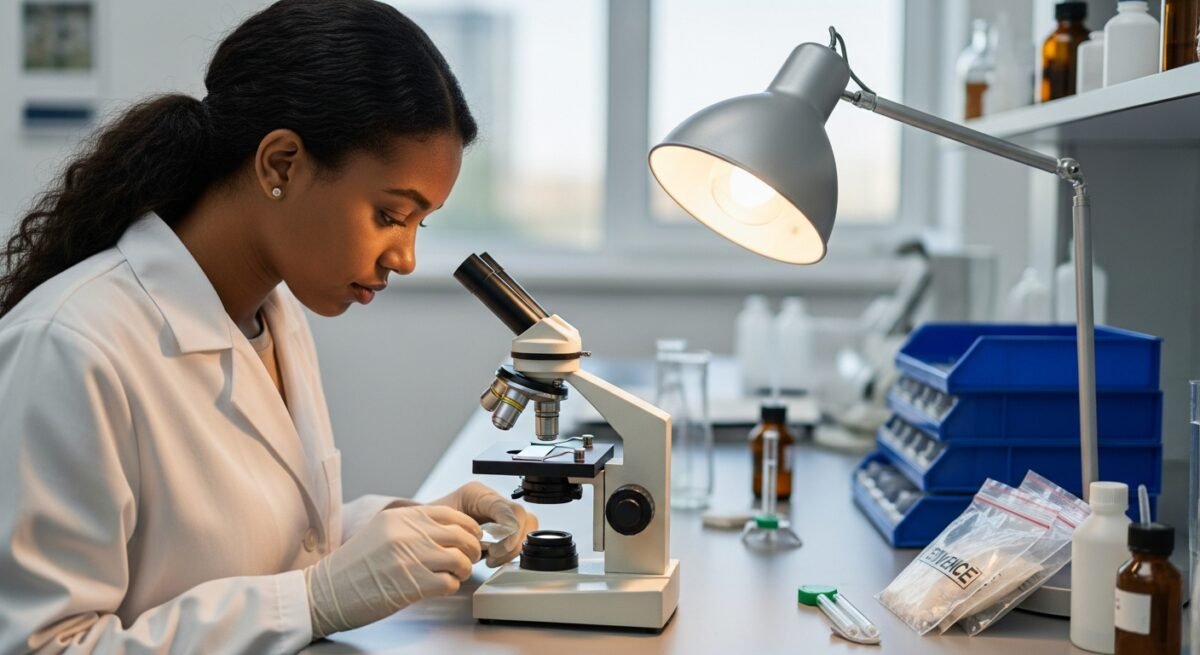
In the first year, students typically complete general education courses in English composition, mathematics, and social sciences, alongside introductory science classes. These foundational science courses are crucial. General Biology and General Chemistry, each with accompanying lab sessions, form the bedrock of forensic analysis. Students learn about cell structure, chemical reactions, and molecular interactions, all of which are directly applicable to analyzing biological evidence like blood, hair, and DNA, or chemical evidence like drugs and explosives.
The second year delves into the specialized forensic applications. Coursework becomes more focused, integrating scientific principles with criminal investigation techniques. Here is a list of common upper-level courses found in a quality associates in forensic science program:
- Criminalistics: This is often the cornerstone course, covering the methods for analyzing physical evidence such as fingerprints, firearms, toolmarks, and impression evidence.
- Forensic Biology: Focuses on the identification and analysis of biological evidence, including serology (body fluids) and an introduction to DNA typing techniques.
- Crime Scene Investigation: Teaches proper procedures for securing, documenting, and processing a crime scene, including photography, sketching, and evidence collection protocols.
- Criminal Law and Procedure: Provides essential knowledge of the legal system, rules of evidence, courtroom testimony, and the role of the forensic expert.
- Trace Evidence Analysis: Explores the examination of microscopic materials like fibers, glass, paint, and soil.
Following these specialized courses, many programs require a capstone project or an internship. An internship at a local police department, medical examiner’s office, or private lab is invaluable, providing real-world experience, professional networking, and a significant boost to a graduate’s resume.
Specializations and Career Pathways
While an associate degree provides a broad overview, some programs may offer concentrations or elective tracks that allow students to lean into specific interests within forensic science. These specializations can tailor your education toward your desired career path. A digital forensics track, for instance, would include courses on computer crime and recovering data from electronic devices, a rapidly growing field. A forensic chemistry concentration would delve deeper into toxicology and arson analysis. Understanding these pathways is crucial when selecting a program, as it aligns your education with the specific technical skills employers in your niche are seeking.
The career outcomes for graduates with a forensic science associate degree are primarily at the technician level. These are hands-on, support-oriented roles that are essential to the investigative process. The most common job title is Forensic Science Technician. According to the U.S. Bureau of Labor Statistics, these professionals earn a median annual wage significantly above the national average for all occupations, with demand driven by the application of scientific techniques to criminal investigations. However, job titles and duties can vary widely depending on the employing agency. A graduate might work as a Crime Scene Technician (or Evidence Technician), responding to scenes to document and collect evidence. In a laboratory setting, they might work as a Latent Print Examiner, Firearms and Toolmark Examiner, or Forensic Photography Specialist. Other potential employers include coroners’ offices, insurance companies, and private forensic consulting firms.
It is important to have realistic expectations. An associate degree typically qualifies graduates for supportive or technician roles, not for positions as lead forensic scientists or DNA analysts, which almost always require a bachelor’s or master’s degree. However, this degree is the perfect launchpad. Many professionals start in a technician role with their associate degree, gain invaluable experience, and then pursue a bachelor’s degree part-time with tuition assistance from their employer. This “earn and learn” model is a powerful career strategy. Furthermore, the analytical and technical skills gained are transferable to quality control positions in pharmaceuticals, environmental monitoring, and clinical laboratories, broadening career prospects beyond the traditional crime lab.
Choosing the Right Program: Accreditation and Format
Selecting the right forensic science associate degree program is a decision that impacts your education quality, career eligibility, and transfer prospects. The single most important factor to consider is accreditation. You should ensure the institution is accredited by a recognized regional accrediting body. For the forensic science program itself, look for affiliation or endorsement from the Forensic Science Education Programs Accreditation Commission (FEPAC). While fewer associate programs hold FEPAC accreditation compared to bachelor’s programs, seeking one that does, or one that is actively modeled on FEPAC standards, ensures a curriculum that meets rigorous professional benchmarks.
Beyond accreditation, evaluate the program’s format and resources. More students than ever are considering online or hybrid formats for their flexibility. A well-designed online forensic science associate degree can be excellent, but it’s vital to scrutinize how they handle the hands-on lab component. Do they use virtual lab simulations, send lab kits to students, or require periodic campus intensives? For a field as practical as forensic science, a program with a robust solution for practical skill development is non-negotiable. On-campus programs offer direct access to laboratory equipment and face-to-face mentorship, which can be a significant advantage.
Other key considerations include the faculty’s professional experience (are they former forensic practitioners?), the program’s internship partnerships with local agencies, and the job placement rate for graduates. Don’t hesitate to contact admissions counselors and ask detailed questions about these points. Your choice should balance academic rigor, practical training opportunities, and your personal logistical needs. This careful selection process is a critical first investigation in your forensic career.
Advancing Your Education: The Transfer Pathway
For many students, the ultimate goal is a bachelor’s degree. An associates in forensic science degree overview would be incomplete without discussing the transfer pathway. This is one of the most strategic and cost-effective ways to earn a four-year degree. Students complete their general education and foundational science courses at a more affordable community college, then transfer to a university to complete their bachelor’s in forensic science or a related field like chemistry or biology.
To ensure a smooth transfer, planning is essential from day one of your associate program. This is known as a “2+2” articulation agreement. Many community colleges have formal agreements with specific four-year universities that guarantee the acceptance of all credits toward the bachelor’s degree, provided the student meets certain GPA requirements. You must work closely with an academic advisor to select courses that will transfer. Taking the correct sequence of chemistry, biology, and math courses is critical. A course in Organic Chemistry, for example, is often a prerequisite for upper-level forensic science courses at a university and may be required for transfer.
Successfully navigating this pathway requires proactive communication. Meet with your community college advisor regularly and make contact with the transfer advisor at your target university early. Confirm that your forensic science associate degree curriculum aligns perfectly with the first two years of the bachelor’s program. This diligence prevents the costly and time-consuming problem of lost credits, ensuring your hard work at the associate level fully counts toward your advanced degree and career ambitions. For those interested in scientific careers with a different focus, understanding various educational paths is key. For instance, students drawn to biological evidence analysis may find value in exploring an animal science degree career guide to understand how life science degrees can open diverse laboratory and research opportunities.
Frequently Asked Questions
Is an associate degree in forensic science enough to get a job?
Yes, an associate degree is sufficient for many entry-level technician positions, such as crime scene technician, evidence custodian, or laboratory assistant. These roles are vital support positions in police departments, sheriff’s offices, and crime labs. However, advanced analytical roles (like DNA analyst or toxicologist) require a bachelor’s degree or higher.
What is the difference between an A.S. and an A.A.S. in Forensic Science?
An Associate of Science (A.S.) is generally considered a transfer degree, with a curriculum heavy in academic science courses designed to feed into a bachelor’s program. An Associate of Applied Science (A.A.S.) is often a terminal career degree, focusing more on immediate job skills and technical applications. Choose an A.S. if you plan to transfer; choose an A.A.S. for direct workforce entry.
Can I complete this degree online?
Many schools offer online or hybrid formats for the lecture-based portions of the curriculum. However, due to the hands-on nature of forensic science, fully online programs will have in-person requirements for lab work, often through scheduled intensives on campus or through partnered local facilities. Always verify how a program fulfills its laboratory component.
What skills are most important for success in this field?
Beyond scientific knowledge, critical skills include meticulous attention to detail, strong written and verbal communication (for report writing and courtroom testimony), ethical integrity, problem-solving ability, and the capacity to handle stressful or disturbing situations with professionalism.
What is the job outlook for forensic science technicians?
The U.S. Bureau of Labor Statistics projects growth for forensic science technicians, though competition for jobs is often strong. Growth is fueled by technological advances that allow for more forensic analysis and its application to a wider range of crimes. Candidates with an associate degree and relevant internship experience will have the best prospects.
An associate degree in forensic science is a powerful and efficient entry point into a fascinating profession that sits at the crossroads of science and law. It provides the foundational knowledge, technical skills, and professional mindset required to begin contributing to the justice system. Whether you choose to enter the workforce immediately as a skilled technician or use the degree as a springboard to further education, this program equips you with a valuable and respected credential. By carefully selecting an accredited program that emphasizes hands-on learning and offers strong career or transfer support, you can build a solid foundation for a rewarding career dedicated to uncovering the truth.