
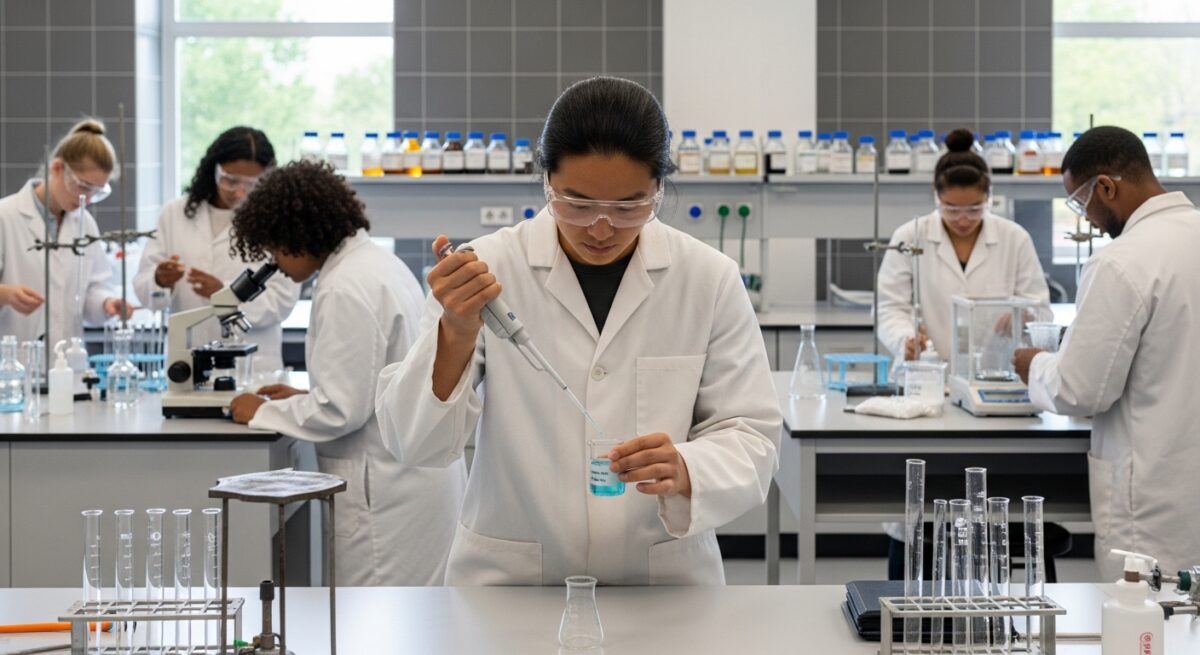
Choosing to pursue a Bachelor of Science in Chemistry is a decision that opens doors to a world of discovery, innovation, and diverse career paths. This rigorous science program provides the foundational knowledge and hands-on laboratory skills to understand matter at its most fundamental level. Whether you are drawn to developing new pharmaceuticals, creating sustainable materials, or solving forensic puzzles, a chemistry degree is a powerful credential. This comprehensive guide will walk you through what to expect from a typical chemistry degree program, the core curriculum, specialization options, and the exciting career trajectories that follow graduation. Understanding the structure and demands of this degree is the first step in determining if it aligns with your academic strengths and professional aspirations.
What is a Bachelor of Science in Chemistry?
A Bachelor of Science (B.S.) in Chemistry is an undergraduate degree focused on the scientific study of the composition, structure, properties, and changes of matter. Unlike a Bachelor of Arts (B.A.), which may include more liberal arts courses and offer a broader, sometimes less intensive science curriculum, the B.S. is a professionally-oriented degree designed to prepare students for laboratory work, graduate studies, or immediate entry into technical fields. The curriculum is built on a strong foundation of mathematics and physics, progressing through the central pillars of chemistry: analytical, organic, inorganic, physical, and biochemistry. Students spend significant time in laboratory settings, learning essential techniques, instrumentation, and safety protocols that are critical for any practicing chemist. This blend of theoretical knowledge and practical application is what makes the degree so valuable across numerous industries.
Core Curriculum and Coursework
The journey through a chemistry degree is sequential and cumulative. Early years establish the necessary scientific and mathematical language, while later years delve into advanced concepts and specialized applications. A standard curriculum is designed to meet the accreditation standards set by the American Chemical Society (ACS), which is a mark of a high-quality, rigorous program. While specific course titles may vary by institution, the core subjects remain consistent.
In the first two years, students typically complete foundational courses in general chemistry and general chemistry lab, which cover atomic structure, bonding, stoichiometry, thermodynamics, and solutions. Concurrently, they take calculus and physics sequences, as these are essential for understanding the quantitative aspects of chemical behavior. Introductory biology may also be required. The sophomore and junior years introduce the major sub-disciplines. Organic chemistry, often considered a gateway course, explores the chemistry of carbon compounds, reaction mechanisms, and synthesis. Analytical chemistry focuses on the principles and techniques used to determine the composition of matter, including spectroscopy and chromatography. Physical chemistry applies calculus and physics to understand the underlying principles governing chemical systems, such as quantum mechanics and kinetics. Inorganic chemistry examines the properties and behaviors of inorganic and organometallic compounds.
The senior year usually involves advanced coursework, electives in a chosen specialization, and a capstone experience. This might be an intensive laboratory course, an independent research project under a faculty mentor, or a senior thesis. Completing an ACS-certified degree often requires this research component and a specific set of advanced courses. Here is a typical progression of key courses:
- Year 1: General Chemistry I & II, Calculus I & II, Introductory Biology, General Chemistry Labs.
- Year 2: Organic Chemistry I & II, Physics I & II (with calculus), Organic Chemistry Labs, Introductory Inorganic Chemistry.
- Year 3: Analytical Chemistry, Physical Chemistry I & II, Biochemistry, Advanced Labs (Organic, Analytical, Physical).
- Year 4: Advanced Inorganic Chemistry, Chemistry Electives (e.g., Polymer, Environmental, Medicinal Chemistry), Capstone Research Project.
Specializations and Career Pathways
One of the strengths of a chemistry degree is its versatility. As students advance, they can tailor their electives and research projects toward specific interests, which directly align with burgeoning career fields. This specialization can begin during the undergraduate years and is often refined in graduate study. For instance, a focus on biochemistry and molecular biology is ideal for those aiming for careers in pharmaceuticals, biotechnology, or medical research. This path often involves additional biology and genetics coursework. Similarly, students interested in environmental science might take courses in geochemistry, atmospheric chemistry, and toxicology, preparing them for roles in environmental protection, regulatory affairs, or green chemistry initiatives.
Materials chemistry is another high-demand specialization, central to developing new polymers, nanomaterials, and semiconductors for electronics and energy storage. This intersects strongly with engineering disciplines. Furthermore, analytical chemistry specialists are crucial in quality control, forensic science, and diagnostic testing, utilizing sophisticated instrumentation to identify and quantify substances. For those interested in the legal or business aspects, a chemistry degree paired with law school leads to patent law, while an MBA can open doors to management in technical companies. It is important to research and understand the educational requirements for your target career. Some paths, like becoming a principal research scientist or a university professor, require a Ph.D. Others, such as a quality control chemist or a technical sales representative, are readily accessible with a B.S. degree. For a broader look at scientific education paths, our Bachelor of Science in Biology Degree Overview and Career Paths provides complementary insights into related life science fields.
Skills Developed and Program Outcomes
Beyond factual knowledge, a Bachelor of Science in Chemistry cultivates a powerful suite of transferable skills. Graduates emerge as adept problem-solvers, trained to approach complex, multi-variable challenges methodically. The laboratory experience hones technical skills, from precise measurement and synthesis to operating complex instruments like NMR spectrometers, mass spectrometers, and HPLC systems. Perhaps most importantly, students learn the scientific method: how to design experiments, collect and analyze data, interpret results, and communicate findings clearly, both in writing and orally. This emphasis on critical thinking and evidence-based reasoning is invaluable in any professional context.
Program outcomes for an accredited chemistry degree typically include the ability to demonstrate knowledge of major chemical concepts, perform standard laboratory procedures, employ modern instrumentation, analyze and interpret data, and understand the ethical and safety responsibilities of a chemist. Furthermore, students learn to search and navigate the primary chemical literature, a skill essential for lifelong learning in a rapidly evolving field. These outcomes ensure that graduates are not just memorizers of information, but competent practitioners ready to contribute to scientific and technological advancement.
Choosing the Right Program and Financial Considerations
Selecting where to earn your chemistry degree is a critical decision. Key factors to consider include ACS accreditation, which signifies a nationally recognized standard of quality. The size and research activity of the chemistry department matter: larger research universities often provide more opportunities for undergraduate research and exposure to cutting-edge science, while smaller colleges may offer more personalized mentorship. Examine the faculty’s research interests to see if they align with your potential passions. Visit the laboratories to assess the availability and modernity of instrumentation. Strong programs will have robust career placement services and a track record of students entering graduate programs or desirable industry positions.
Financial planning is an inseparable part of the college decision process. Investigating tuition, fees, and the availability of scholarships, grants, and work-study programs is essential. Many universities offer specific scholarships for STEM majors. It is also wise to consider the long-term return on investment: chemistry graduates typically command strong starting salaries, which can help manage educational debt. For detailed assistance on navigating tuition and funding options, a dedicated resource for college cost & financial planning can be an invaluable tool in your planning process.
Frequently Asked Questions
What is the difference between a B.A. and a B.S. in Chemistry?
A B.S. in Chemistry is generally more intensive in science and mathematics, designed for students pursuing careers as professional chemists or graduate study in chemistry. A B.A. may require fewer advanced chemistry and math courses, incorporating more liberal arts, and is often chosen by students planning careers in fields like science journalism, patent law, or secondary education where a broad background is beneficial.
What can I do with a Bachelor of Science in Chemistry?
Career options are vast and include roles as a laboratory chemist in industries like pharmaceuticals, cosmetics, or materials; a quality control/assurance analyst; a forensic science technician; a research assistant; a sales or technical service representative for scientific companies; or an environmental health and safety specialist. Many graduates also use the degree as a pre-professional track for medical, dental, veterinary, or pharmacy school.
Is a chemistry degree very difficult?
A Bachelor of Science in Chemistry is considered a challenging degree due to its sequential nature and heavy reliance on both abstract concepts and quantitative problem-solving. Success requires strong aptitude in math and science, excellent study habits, time management, and a genuine interest in the subject. The laboratory components also demand patience, precision, and attention to detail.
Do I need to get a Ph.D. to have a good career in chemistry?
No. A B.S. in Chemistry qualifies you for many stable and well-paying technical positions in industry and government. A Ph.D. is required for leading independent research in academia or industry, and a Master’s degree can offer advancement opportunities, but a bachelor’s degree is a solid entry point to the field.
How important is undergraduate research?
Extremely important. Undergraduate research provides hands-on experience with the real process of scientific inquiry, strengthens your resume, develops mentorship relationships with faculty, and can lead to publications or conference presentations. It is highly valued by both graduate programs and employers.
Earning a Bachelor of Science in Chemistry is a commitment to understanding the fundamental principles that shape our material world. It is a degree that builds not just knowledge, but also resilience, precision, and analytical prowess. By carefully selecting a program that fits your goals, engaging deeply with coursework and research, and planning for the financial investment, you can position yourself for a rewarding career at the forefront of science and technology. The path is demanding, but for those fascinated by the nature of matter, it is uniquely fulfilling.