
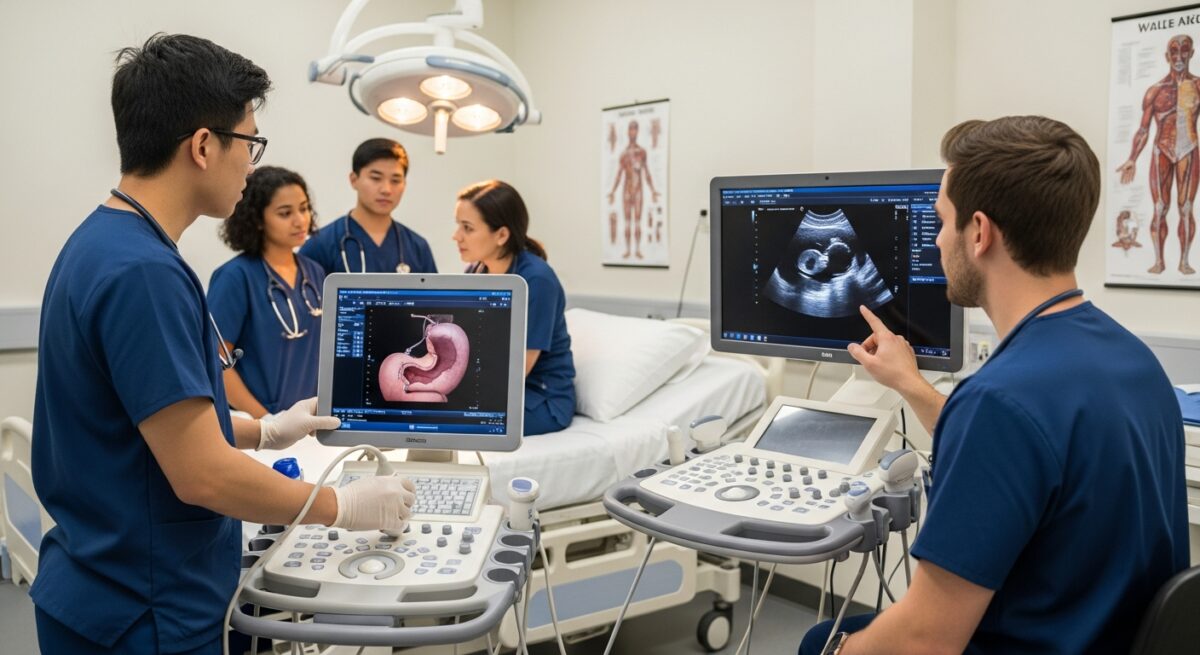
If you are considering a career in healthcare that combines direct patient care with advanced technology, diagnostic medical sonography offers a compelling path. An associate degree in ultrasound technology is often the most direct and cost-effective route to entering this growing field. This guide walks through everything from program requirements and accreditation to career outlook and financial aid options, helping you decide if this degree aligns with your professional goals.
What Is an Associate Degree in Ultrasound Technology?
An associate degree in ultrasound technology, sometimes called an ultrasound technician associate’s degree, is a two-year program that trains students to operate imaging equipment used to capture internal body structures. Sonographers use sound waves to produce images of organs, tissues, and blood flow, assisting physicians in diagnosing medical conditions. The curriculum blends classroom instruction in anatomy, physiology, and physics with hands-on clinical training in scanning techniques.
Most programs award an Associate of Applied Science (AAS) degree and require approximately 60 to 75 credit hours. Students learn to perform abdominal, obstetric, gynecologic, cardiac, and vascular sonography. The ultrasound associates degree prepares graduates for entry-level positions in hospitals, imaging centers, clinics, and physicians’ offices. Unlike a bachelor’s degree, which takes four years, the associate pathway allows you to start working sooner while still qualifying for professional certification.
Many accredited programs also include a clinical externship component. During this time, you apply classroom knowledge in real healthcare settings under the supervision of experienced sonographers. This hands-on training is essential for building confidence and meeting the requirements for national certification exams.
Program Prerequisites and Admission Requirements
Admission to an ultrasound tech associates degree program can be competitive. Most community colleges and technical schools require applicants to have a high school diploma or GED. Common prerequisites include completing courses in algebra, biology, and anatomy with a grade of C or better. Some programs also ask for scores from standardized placement tests like the SAT, ACT, or TEAS (Test of Essential Academic Skills).
In addition to academic requirements, schools often look for candidates with strong communication skills, empathy, and manual dexterity. Because sonographers spend much of their day on their feet and need to maneuver patients and equipment, physical stamina is also important. Many programs require a background check, drug screening, and proof of immunizations before clinical rotations begin.
Some institutions offer a competitive admissions process where applicants are ranked based on GPA, prerequisite grades, and a personal statement. It is wise to apply to multiple schools and check each program’s specific prerequisites early. If you lack certain prerequisites, consider taking those courses at a community college before applying.
Accreditation: Why It Matters for Your Career
Accreditation is one of the most critical factors when choosing an ultrasound associates degree program. The primary accrediting body for sonography programs in the United States is the Commission on Accreditation of Allied Health Education Programs (CAAHEP), working through its Joint Review Committee on Education in Diagnostic Medical Sonography (JRC-DMS). Graduating from a CAAHEP-accredited program is typically required to sit for the American Registry for Diagnostic Medical Sonography (ARDMS) certification exams.
Employers strongly prefer or even require candidates who are registered sonographers. ARDMS certification demonstrates that you have met national standards for knowledge and clinical competence. Without attending an accredited program, you may be ineligible for certification, which limits job opportunities and earning potential.
To verify accreditation, visit the CAAHEP website or the program’s institutional page. Regional accreditation of the college itself is also important because it affects the transferability of credits if you later decide to pursue a bachelor’s degree.
Core Curriculum and Skills You Will Develop
The curriculum for an associate degree in ultrasound technology guide covers both theoretical knowledge and practical skills. Typical courses include:
- Human Anatomy and Physiology: In-depth study of body systems, with emphasis on structures visualized through ultrasound.
- Medical Terminology: Language used in healthcare settings to describe conditions, procedures, and equipment.
- Physics of Ultrasound: Principles of sound wave propagation, image formation, and equipment operation.
- Abdominal Sonography: Techniques for imaging the liver, gallbladder, kidneys, spleen, and other abdominal organs.
- Obstetric and Gynecologic Sonography: Imaging of the female reproductive system and fetal development during pregnancy.
- Vascular Sonography: Evaluation of blood flow in arteries and veins using Doppler techniques.
- Patient Care and Ethics: Communication skills, patient positioning, infection control, and professional standards.
Throughout the program, you also develop critical thinking skills for recognizing normal versus abnormal anatomy and for adjusting scanning techniques based on patient conditions. Clinical rotations allow you to practice these skills under supervision, gaining competence in a variety of settings.
By the end of the program, you should be prepared to perform comprehensive ultrasound examinations, document findings, and communicate effectively with radiologists and other healthcare providers.
Career Outlook and Salary Expectations
The job market for diagnostic medical sonographers is strong. According to the U.S. Bureau of Labor Statistics, employment of sonographers is projected to grow 10 percent from 2023 to 2033, much faster than the average for all occupations. An aging population and increased use of ultrasound as a safe imaging alternative drive demand.
Median annual wages for diagnostic medical sonographers exceed $80,000, with top earners in hospitals and outpatient care centers. Geographic location, experience level, and specialization all affect salary. For example, cardiac or vascular sonographers often earn higher pay than general sonographers. Many sonographers also enjoy stable full-time positions with benefits, though part-time and travel assignments are available.
Graduates of an ultrasound technician associate’s degree often find work in general medical and surgical hospitals, followed by physician offices, medical and diagnostic laboratories, and outpatient care centers. Some sonographers eventually move into education, sales, or management roles after gaining experience.
Online and Hybrid Program Options
While the hands-on nature of sonography limits fully online programs, many schools offer hybrid options. In a hybrid ultrasound associates degree program, you complete lecture courses online and attend on-campus labs or clinical placements in your local area. This format provides flexibility for working adults or students who live far from campus.
Online components typically cover anatomy, physics, and patient care theory through video lectures, discussion boards, and virtual simulations. Clinical hours are arranged at affiliated hospitals or imaging centers near your home. Before enrolling, confirm that the program is CAAHEP-accredited and that clinical placement assistance is provided. Some programs require you to arrange your own clinical site, which can be challenging without existing connections.
If you are considering an online program, check the technology requirements and ensure you have reliable internet access and a suitable computer. Also, verify that the program meets your state’s licensure or certification requirements if you plan to work in a specific region.
Financial Aid and Affordability
An associate degree is generally more affordable than a bachelor’s degree, but costs still vary widely. Tuition for an ultrasound tech associates degree at a public community college can range from $5,000 to $20,000 total for in-state students, while private or out-of-state programs may cost more. Financial aid options include federal Pell Grants, federal student loans, state grants, and institutional scholarships.
To apply for federal aid, complete the Free Application for Federal Student Aid (FAFSA). Many community colleges also offer payment plans or tuition assistance for qualifying students. Some employers, especially hospitals, offer tuition reimbursement for employees pursuing healthcare degrees. Additionally, professional organizations such as the Society of Diagnostic Medical Sonographers (SDMS) provide scholarships for sonography students.
If cost is a concern, start by exploring programs at local community colleges, which often have the lowest tuition. You can also consider earning prerequisites at a community college before applying to a more expensive program, saving money on lower-division courses. For more resources on finding affordable education options and connecting with accredited programs, visit collegeandtuition.com to compare costs and financial aid opportunities.
Certification and Licensure After Graduation
After earning your associate degree in ultrasound technology, the next step is obtaining professional certification. The most widely recognized credential is the Registered Diagnostic Medical Sonographer (RDMS) from ARDMS. To qualify for the exam, you must graduate from a CAAHEP-accredited program. The exam covers general sonography principles and a specialty area such as abdomen or obstetrics and gynecology.
Some states, including Oregon and New Mexico, require state licensure for sonographers. Licensure typically involves passing the ARDMS exam or an equivalent. Even in states without licensure, employers almost always require ARDMS certification for hiring and advancement. Maintaining certification requires continuing education credits every few years.
In addition to RDMS, sonographers can pursue specialty certifications in areas like vascular technology (RVT) or cardiac sonography (RDCS). These credentials can open doors to higher-paying roles and specialized practice settings. Many sonographers earn multiple certifications over their careers.
Frequently Asked Questions
How long does it take to complete an associate degree in ultrasound technology?
Most programs take two years of full-time study, including general education courses and clinical hours. Some accelerated options may be completed in 18 to 20 months, while part-time students may take three years or longer.
Can I become a sonographer with an online degree?
Yes, but only if the program includes in-person clinical training. Fully online programs without clinical components are not CAAHEP-accredited and will not qualify you for certification. Look for hybrid programs that combine online coursework with local clinical placements.
What is the difference between an ultrasound technician and a diagnostic medical sonographer?
The terms are often used interchangeably. However, diagnostic medical sonographer is the official job title for professionals who perform ultrasound exams. Ultrasound technician is a more informal term that typically refers to the same role.
Is an associate degree enough to get a job?
Yes, an associate degree is the standard entry-level credential for diagnostic medical sonographers. Most employers hire graduates with an associate degree and ARDMS certification. A bachelor’s degree may be required for management, education, or research roles, but it is not necessary for clinical positions.
What skills are most important for success in this field?
Key skills include attention to detail, manual dexterity, strong communication, empathy, and the ability to work independently. Sonographers must also be comfortable with technology and able to adapt to different patient needs and clinical environments.
For more details on comparing educational pathways and finding accredited programs, read our Cyber Security Associate Degree Overview and Career Path for insights on how associate degrees in technical fields can lead to stable careers.
An associate degree in ultrasound technology is a practical, efficient gateway to a rewarding healthcare career. With strong job growth, competitive salaries, and opportunities for specialization, sonography offers a stable future for those willing to invest two years in focused training. By choosing an accredited program, preparing for certification, and leveraging financial aid resources, you can take a confident step toward becoming a skilled diagnostic medical sonographer.