

What Is a Civil Engineering Degree? Career Guide
A civil engineering degree teaches you to design and build infrastructure, with strong job growth and salaries. Explore curriculum, careers, and program choice.

By Ryan Taylor
Civil engineering is one of the oldest and most impactful branches of engineering, shaping the world around us through roads, bridges, buildings, and water systems. If you are considering an engineering career that combines math, design, and public service, a civil engineering degree can open doors to stable, well-paid roles in construction, government, and consulting. This guide explains what the degree involves, what you will study, how to choose a program, and what career paths await you after graduation.
The Core of a Civil Engineering Degree
At its heart, a civil engineering degree teaches you how to plan, design, build, and maintain the infrastructure that supports modern society. This includes transportation networks, water supply systems, buildings, and environmental protection structures. Civil engineers ensure these projects are safe, sustainable, and cost-effective, often balancing technical constraints with public needs.
The curriculum blends theoretical fundamentals with practical application. In the first two years, you will focus on mathematics, physics, and basic engineering principles. Later courses dive into specialized areas such as structural analysis, geotechnical engineering, transportation systems, and water resources. Many programs also require laboratory work, field projects, and a capstone design course where you apply everything you have learned to a real-world problem.
Specializations Within Civil Engineering
As you progress, you can choose electives or a formal concentration. Common specializations include:
- Structural engineering: designing buildings, bridges, and other load-bearing structures
- Transportation engineering: planning highways, railways, airports, and traffic systems
- Geotechnical engineering: analyzing soil and rock behavior for foundations and slopes
- Water resources engineering: managing water supply, flood control, and wastewater treatment
- Environmental engineering: developing solutions for pollution and sustainable development
- Construction engineering: focusing on project management, materials, and building methods
These specializations allow you to tailor your degree to your interests, but a broad foundation ensures you can adapt across sectors. Even if you choose one path, you will still understand how different disciplines interact on a project, a valuable skill for leadership roles.
What You Will Study: Civil Engineering Course Highlights
A civil engineering course sequence is rigorous but rewarding. Beyond core math and science, you will take courses that build your technical toolkit. Typical required classes include:
- Statics and dynamics
- Mechanics of materials
- Fluid mechanics
- Structural analysis
- Reinforced concrete design
- Steel design
- Soil mechanics
- Transportation engineering
- Hydrology and hydraulics
- Construction management
Most programs also emphasize professional skills such as communication, ethics, and project management, because civil engineers rarely work alone. You will collaborate with architects, urban planners, government officials, and other engineers, so being able to explain complex ideas clearly is essential.
In addition to lectures, you will spend time in computer labs using industry-standard software like AutoCAD, Civil 3D, and structural analysis tools. Hands-on projects, such as designing a small bridge or planning a water distribution network, help you connect theory to practice. By the time you graduate, you will have a portfolio of work that demonstrates your ability to solve real engineering problems.
Accreditation and Program Quality
When choosing a civil engineering degree, accreditation is non-negotiable. In the United States, the Accreditation Board for Engineering and Technology (ABET) accredits programs that meet rigorous academic standards. Graduating from an ABET-accredited program is often required for professional licensure and is strongly preferred by employers. As you compare schools, verify that each program you consider holds current ABET accreditation.
Accreditation also affects your ability to pursue graduate studies or obtain a Professional Engineer (PE) license. The PE license is a mark of expertise that allows you to sign off on public projects and advance to senior positions. Licensure typically requires a degree from an ABET-accredited program, passing the Fundamentals of Engineering exam, gaining four years of work experience, and then passing the Principles and Practice of Engineering exam.
Beyond accreditation, consider factors like faculty expertise, research opportunities, internship placement, and campus facilities. A program with strong industry ties can help you secure internships and job offers. If you prefer flexibility, many accredited online civil engineering degrees now offer the same curriculum with asynchronous coursework, making it easier for working adults to earn their degree.
Online and On-Campus Options
Civil engineering has traditionally been an on-campus discipline due to lab and field requirements, but online and hybrid programs are becoming more common. An online civil engineering degree can be a great fit if you are already working or have family commitments. These programs often use virtual labs, simulation software, and occasional on-campus intensives to deliver the same core content.
However, not all online programs are created equal. Look for programs that offer the same ABET-accredited curriculum as their on-campus counterparts. Also, check how they handle group projects and hands-on components. Some hybrid models require you to attend a weekend lab session once per semester, which can be a good compromise for students who need flexibility but still want practical experience.
If you are early in your career or prefer a traditional college experience, an on-campus program may offer more networking chances, student organizations, and direct access to professors. Both pathways can lead to the same job opportunities, so the choice depends on your learning style and life situation. Whichever you choose, make sure the program supports your long-term goals and fits your budget.
Career Paths and Salary Outlook
A civil engineering degree leads to a wide range of roles across the public and private sectors. Graduates often start as civil engineers, project engineers, or field engineers, working on design teams, construction sites, or government agencies. With experience, they move into project management, senior design, or specialized consulting. Some pursue graduate degrees in engineering management or business to accelerate their careers.
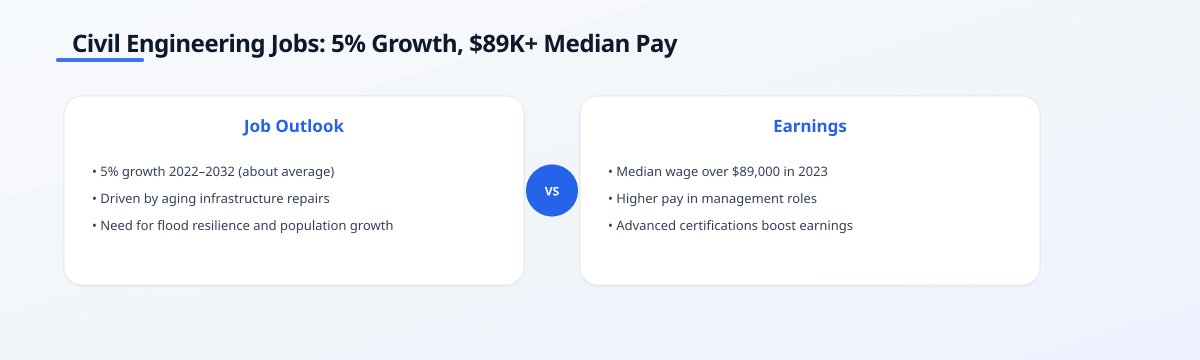
According to the U.S. Bureau of Labor Statistics, employment of civil engineers is projected to grow about 5% from 2022 to 2032, about as fast as the average for all occupations. This growth is driven by the need to repair aging infrastructure, improve flood resilience, and accommodate population growth. The median annual wage for civil engineers was over $89,000 in 2023, with higher pay for those in management or with advanced certifications.
Here are some common job titles and their typical duties:
- Design Engineer: creates plans and specifications for projects using software and analysis
- Project Engineer: oversees day-to-day operations, budgets, and schedules on a site
- Structural Engineer: focuses on the integrity of buildings and bridges
- Transportation Engineer: plans and optimizes road, rail, and transit systems
- Water Resources Engineer: designs systems for water supply, treatment, and flood control
Civil engineering is also a global profession, so opportunities exist with international firms, humanitarian organizations, and government agencies. The skills you learn, such as critical thinking, project coordination, and technical analysis, are transferable across industries, providing a strong safety net if you decide to pivot later.
How to Choose the Right Program
Selecting the right civil engineering degree program is a big decision. Start by identifying your career goals: do you want to work in design, construction, public policy, or research? Then evaluate programs based on their curriculum, faculty, facilities, and industry connections. If you know you want to specialize, look for programs with strong electives or research centers in that area.
Cost is another major factor. Public universities often offer lower tuition for in-state students, while private schools may provide more scholarships. Online programs can save on housing and commuting costs, but be sure to compare total tuition. You should also research financial aid and internship opportunities, since many civil engineering students gain valuable experience and income through co-op programs.
To simplify your search, use a matching service like CollegeDegree.Education to compare accredited programs side by side. They can help you filter by location, degree level, and specialization, and connect you with schools that fit your needs. This can save you hours of research and help you avoid missing out on programs you might not have found otherwise.
Professional Licensure and Continuing Education
While you can enter entry-level positions with a bachelor's degree, earning your Professional Engineer license is a key step for career advancement. The process starts with the Fundamentals of Engineering exam, which you can take in your final year of college. After passing, you become an Engineer in Training (EIT), and after four years of supervised experience, you can sit for the PE exam in your chosen discipline.
Many civil engineers also pursue certifications in areas like project management (PMP) or LEED for sustainable building. Continuing education is important because building codes, materials, and technologies evolve. Many state boards require ongoing professional development to renew your license, and some employers offer tuition reimbursement for advanced degrees or certifications.
If you are interested in management or specialized research, a master's degree in civil engineering or an MBA with an engineering focus can enhance your earning potential and open leadership roles. However, a bachelor's degree is sufficient for many well-paying jobs, so you can always start working and decide later if further education is worth it.
Real-World Impact and Job Satisfaction
One of the most rewarding aspects of a civil engineering career is seeing your work make a tangible difference. Whether it is a highway that eases traffic congestion, a water treatment plant that provides clean drinking water, or a bridge that safely connects communities, civil engineers contribute directly to public safety and quality of life. This sense of purpose often leads to high job satisfaction among professionals in the field.
Civil engineering also offers variety. Each project is unique, with different site conditions, budgets, and stakeholders. You might spend some days at a desk analyzing models and other days visiting construction sites. This mix of office and field work keeps the job interesting and helps you build a broad skill set. For those who enjoy problem-solving and collaborative teamwork, civil engineering can be a fulfilling long-term career.
If you are still exploring your options, consider how a civil engineering degree compares to related fields. For example, a BS in Mechanical Engineering focuses more on machines and manufacturing, while civil engineering deals with infrastructure and the built environment. Both are excellent, but they lead to different industries. Take time to reflect on which problems excite you most.
Making Your Decision
Deciding to pursue a civil engineering degree is a significant investment of time and money, but the rewards are substantial. The field offers strong job security, competitive salaries, and the chance to create lasting public value. By choosing an accredited program and gaining relevant experience, you set yourself up for a stable and meaningful career.
Start by researching programs that match your academic profile and career interests. Use tools like CollegeDegree.Education to compare options, and reach out to admissions advisors with questions about curriculum, financial aid, and transfer credits. If you are a working adult, explore online and hybrid formats that allow you to balance work and study. And if you are a veteran, check whether the program accepts military benefits and offers support services.
Remember that your first job after graduation may not define your entire career. Many civil engineers switch specializations or sectors as they gain experience. The fundamentals you learn, such as how to analyze structures, manage projects, and communicate with stakeholders, will serve you no matter where your path leads. With a civil engineering degree, you are not just building structures; you are building a resilient future. Learn more