

What Is a Civil Engineering Bachelor's Degree? Career Guide
Learn what a civil engineering bachelor's degree covers, from core courses to career paths, and how to choose the right program for your future.

By Lucas Martin
Civil engineering shapes the world around you, from the roads you drive on to the water systems that supply your home. If you are considering a bachelor's in civil engineering, you are looking at a degree that combines math, science, and creativity to solve real-world problems. But what exactly does this program involve, and where can it take you? This guide breaks down the curriculum, career paths, and benefits of earning a civil engineering bachelor degree, so you can decide if it is the right fit for your goals.
Understanding the Civil Engineering Bachelor's Degree
A civil engineering bachelor's degree is a four-year undergraduate program that prepares students to design, build, and maintain infrastructure. This includes structures like bridges, highways, dams, airports, and buildings, as well as systems for water supply and waste management. The degree blends theoretical knowledge with practical application, covering topics such as structural analysis, fluid mechanics, geotechnical engineering, and construction management.
Unlike some engineering fields that focus on a narrow specialty, civil engineering offers a broad foundation. Students learn how to plan projects, manage budgets, ensure safety standards, and collaborate with architects, contractors, and government officials. This versatility makes it one of the most popular engineering disciplines, with nearly 4,000 bachelor's degrees awarded annually in the United States alone.
Accreditation is a key factor to consider. Most employers and licensing boards require a degree from a program accredited by the Accreditation Board for Engineering and Technology (ABET). ABET accreditation ensures that the curriculum meets rigorous industry standards, which is essential if you plan to become a licensed Professional Engineer (PE) later in your career. When researching programs, always verify their accreditation status.
Core Curriculum and Specializations
During the first two years of a civil engineering bachelor's degree, you will focus on foundational courses in mathematics, physics, chemistry, and introductory engineering. These classes build the analytical skills you will need for advanced study. In your junior and senior years, the coursework becomes more specialized, with required classes in areas like:
- Structural analysis and design
- Fluid mechanics and hydraulics
- Geotechnical engineering (soil mechanics)
- Transportation engineering
- Environmental engineering
- Construction materials and methods
Many programs also require capstone design projects, where you work in teams to solve a real-world engineering problem. This hands-on experience is invaluable for building your portfolio and preparing for internships or entry-level roles.
Within the civil engineering field, you can choose electives to tailor your degree to a specific interest. Popular specializations include structural engineering, which focuses on buildings and bridges, and transportation engineering, which deals with highways and transit systems. Environmental engineering emphasizes water treatment and pollution control, while construction management blends engineering with business and project oversight. Choosing a specialization early can help you target your career goals and make your resume stand out.
What You Will Learn Beyond the Classroom
A civil engineering bachelor's degree is not just about formulas and blueprints. It also develops critical thinking, communication, and leadership skills. Engineers must explain complex concepts to clients, write clear reports, and coordinate with diverse teams. Many programs integrate professional practice courses that cover ethics, sustainability, and public policy, ensuring you understand the broader impact of your work.
Internships are a crucial part of the experience. While not always mandatory, most students complete at least one summer internship with a construction firm, government agency, or consulting company. These opportunities let you apply classroom knowledge to live projects, build professional networks, and often lead to job offers after graduation. If your program does not offer internship placement, use your university's career center to find positions independently.
Another key aspect is licensure. After earning your bachelor's in civil engineering, you typically start as an Engineer-in-Training (EIT) or Engineering Intern (EI). This requires passing the Fundamentals of Engineering (FE) exam, which is the first step toward becoming a licensed PE. After four years of supervised work experience, you can take the Principles and Practice of Engineering (PE) exam. Licensure is essential for roles that involve signing off on public projects, so plan your coursework and study schedule accordingly.
Career Paths and Salary Potential
Graduates with a civil engineering bachelor's degree enjoy strong job prospects. The U.S. Bureau of Labor Statistics projects about 6% growth for civil engineers from 2023 to 2033, which is faster than the average for all occupations. This demand is driven by aging infrastructure, population growth, and the need for climate-resilient designs.
Entry-level civil engineers often start in roles like project engineer, field engineer, or design engineer. With experience, you can advance to senior engineer, project manager, or department head. Many professionals also move into consulting, where they advise on large-scale developments, or into public service, managing municipal infrastructure. Some eventually start their own firms.
Salary expectations are competitive. According to the BLS, the median annual wage for civil engineers was $95,890 in May 2023. Your earning potential depends on factors like location, industry, and experience. For instance, engineers working in oil and gas extraction tend to earn higher salaries, while those in government roles may have lower pay but better benefits. If you are considering an online or part-time program, note that many employers value the degree itself, not the delivery format, as long as it is ABET-accredited.
Online and Flexible Options for Working Adults
If you are a working professional or have family commitments, you might wonder if a civil engineering bachelor's degree can be earned online. The answer is yes, but with some caveats. Several accredited universities offer online civil engineering programs, though they often require in-person labs or exams. For example, the University of North Dakota and Old Dominion University have ABET-accredited online programs that include virtual simulations and on-campus intensives.
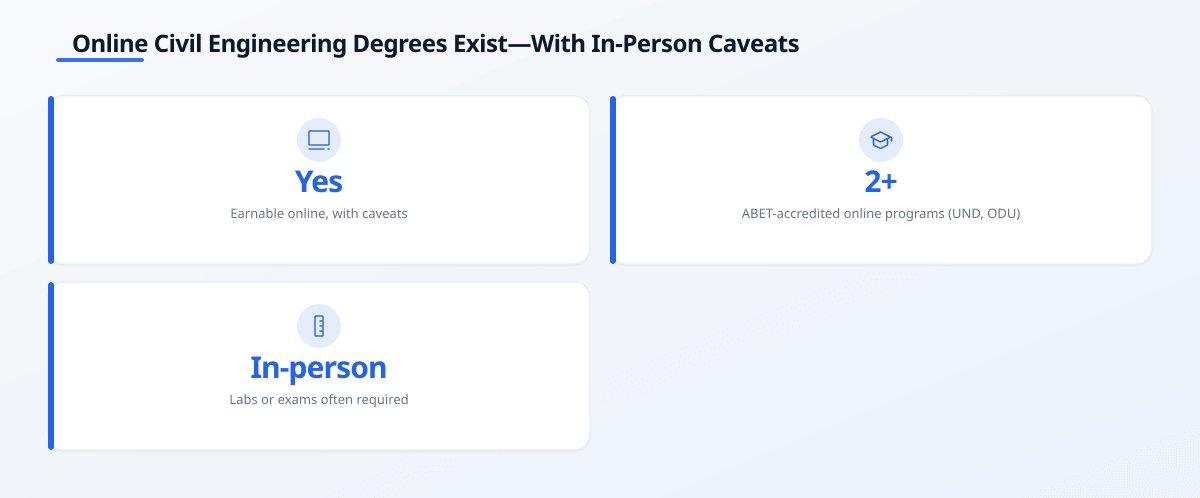
When considering an online bachelor's in civil engineering, check the program's accreditation and residency requirements. Some courses, like fluid mechanics labs, may need physical attendance. Also, look for programs that offer robust support services, such as academic advising, tutoring, and career counseling, to help you succeed remotely.
The flexibility of online learning is a major advantage. You can balance coursework with a current job, which is especially helpful if you are transitioning from a related field like construction or drafting. However, be prepared to be self-disciplined and proactive in seeking out networking opportunities, as you will not have the same face-to-face interactions as on-campus students.
How to Choose the Right Program for You
Selecting the best civil engineering bachelor degree requires careful research. Start by identifying your career goals. If you want to work in structural design, look for programs with strong electives in steel and concrete design. If you are interested in environmental issues, prioritize schools with dedicated environmental engineering tracks.
Next, evaluate the program's accreditation, faculty expertise, and internship connections. Speak with current students and alumni to get a sense of the program's culture and rigor. Also, consider the cost and financial aid options. Public universities typically offer lower tuition for in-state students, while private schools may provide more scholarships. Use resources like CollegeDegree.Education to compare sponsored programs across multiple institutions, making it easier to find one that fits your budget and needs.
Another factor is the program's reputation with employers. Some schools have strong ties to local engineering firms, which can lead to more internship and job opportunities. Research where recent graduates are employed and whether the program has a dedicated career fair for engineering students. If you plan to pursue a master's degree later, check if the program offers a combined bachelor's-to-master's pathway, which can save time and money.
Ultimately, the right choice balances academic quality, cost, location, and your personal circumstances. Remember that a civil engineering bachelor's degree is a significant investment, but one that pays off with stable, well-compensated career options. For more insights on how different degree levels compare, you can read our guide on associate vs bachelor's degree options to see if a four-year path is right for you.
What You Can Do With This Degree Beyond Traditional Roles
While many civil engineering graduates work in construction or consulting, the degree opens doors to other sectors. For instance, some move into project management in tech companies, overseeing the construction of data centers or corporate campuses. Others enter the public sector, working for agencies like the Federal Highway Administration or the Environmental Protection Agency, where they develop regulations and oversee infrastructure funding.
Entrepreneurship is another path. With the technical and business skills you gain, you might start a niche consulting firm specializing in sustainable design or disaster-resilient construction. The degree also provides a strong foundation for further study in law, business, or urban planning. Many successful lawyers in construction law hold an engineering background, and an MBA combined with a civil engineering degree is a powerful credential for executive roles in construction firms.
If you are drawn to global challenges, a civil engineering bachelor's degree can lead to international work. Organizations like Engineers Without Borders and the World Bank employ civil engineers to design water systems, roads, and schools in developing countries. This career path offers the chance to make a tangible difference in communities worldwide, which is a rewarding outcome for many graduates.
Next Steps to Get Started
If you are convinced that a civil engineering bachelor's degree is the right path, the next step is to narrow down your program options. Begin by requesting information from several schools to compare curricula, costs, and support services. Use the matching tool on CollegeDegree.Education to connect with accredited programs that align with your interests. Many universities also offer open houses or virtual info sessions, which are great opportunities to ask questions and see the campus (or online platform) firsthand.
Before you apply, make sure you meet the admission requirements. Most programs expect strong grades in math and science, and some may require SAT or ACT scores. If you lack prerequisites, consider enrolling in community college courses to build your foundation. Also, think about financial aid early. Fill out the FAFSA to see what federal grants and loans you qualify for, and research scholarships specific to engineering students.
Finally, connect with professionals in the field. Reach out to civil engineers on LinkedIn, join student chapters of organizations like the American Society of Civil Engineers (ASCE), and attend industry events. These connections can provide mentorship, internship leads, and valuable insights into the day-to-day work of a civil engineer. Building a network now will pay dividends throughout your career.
Earning a bachelor's in civil engineering is a demanding but highly rewarding journey. It equips you with the skills to build the future, offering stability, intellectual challenge, and the satisfaction of seeing your work in the world around you. As you explore your options, remember that scholarships and financial aid can significantly reduce the cost of your education. For a comprehensive list of funding opportunities, check out this resource on scholarships and financial aid to help you plan your budget. With careful planning and dedication, you can launch a successful career that makes a lasting impact.