
What Are the Core Courses in an Engineering Degree?
Explore the universal curriculum of math, science, and engineering principles that form the foundation of every accredited engineering degree. Understanding these core courses is key to career success.

By Ethan Clark
Embarking on an engineering degree is a commitment to mastering a rigorous and foundational curriculum designed to solve complex problems. While every engineering discipline, from civil to aerospace, has its specialized electives and upper-division classes, all accredited programs share a common bedrock of engineering degree core courses. These foundational classes are not arbitrary hurdles, they are the essential toolkit that transforms a student into a professional engineer. They provide the mathematical language, scientific principles, and analytical frameworks upon which all specialized knowledge is built. Understanding this core sequence is crucial for prospective students, as it demystifies the academic journey and highlights the universal skills, like systems thinking and quantitative analysis, that define the engineering profession regardless of the final specialization.
The Foundational Pillars: Mathematics and Basic Sciences
The journey through an engineering curriculum begins with intensive study in mathematics and the basic sciences. These are not merely prerequisites, they are the alphabet and grammar of the engineering language. Without a firm command of calculus, differential equations, and linear algebra, the models that predict bridge stresses, circuit behaviors, or chemical reaction rates are incomprehensible. Similarly, physics and chemistry provide the fundamental laws of nature that engineers must work within and leverage. A deep understanding of Newtonian mechanics, thermodynamics, electromagnetism, and material properties is non-negotiable. These courses train the mind to think in terms of variables, constants, forces, and energies, setting the stage for all applied work.
The typical sequence is deliberate and cumulative. It often starts with Calculus I, II, and III, covering differential and integral calculus of single and multiple variables. This is followed by Differential Equations, where students learn to model dynamic systems, a skill critical for controls, vibrations, and heat transfer analysis. Linear Algebra introduces concepts of matrices and vector spaces, essential for computer graphics, structural analysis, and machine learning algorithms in modern engineering. Concurrently, students take General Physics with calculus, typically a two-semester sequence covering mechanics, waves, thermodynamics, and electromagnetism. For many disciplines, General Chemistry is also a core requirement, providing the basis for materials science, environmental engineering, and chemical processes. The depth of this foundation cannot be overstated, it is what allows engineers to move from following recipes to creating novel solutions based on first principles.
The Engineering Sciences: Applying Theory to Systems
With the foundational pillars in place, students then progress to the engineering sciences. This is the crucial bridge between abstract theory and practical application. Here, the laws of physics and the tools of mathematics are directed toward understanding and designing engineered systems. These courses are often the first true “engineering” classes a student encounters, and they form the conceptual backbone of the profession. They teach how to analyze and synthesize components into a functioning whole, whether that whole is an electrical network, a mechanical device, or a chemical process.
Core engineering science courses vary slightly by discipline but share common themes. Almost all engineers will take Statics (analysis of forces in non-accelerating systems) and Dynamics (analysis of forces and motion). These are fundamental for civil, mechanical, aerospace, and even biomedical engineering. Strength of Materials or Mechanics of Materials follows, teaching how forces affect solid bodies and how to design components that won’t fail. Thermodynamics, the study of energy and its transformations, is core for mechanical, chemical, and aerospace engineers. Fluid Mechanics is essential for civil (water resources), mechanical (HVAC, aerodynamics), and chemical (process flow) disciplines. For electrical and computer engineers, the equivalent cornerstone is Circuit Analysis, which provides the framework for understanding all electronic systems. These courses are characterized by problem sets that require both conceptual understanding and meticulous calculation, forging the analytical rigor engineers are known for.
Discipline-Specific Core Courses and the Capstone Experience
After completing the shared engineering sciences, the path diverges into discipline-specific core courses. This is where a civil engineering student deepens into structural analysis and geotechnical engineering, while an electrical engineering student delves into digital systems design and electromagnetic fields. These courses apply the universal principles from the earlier core to the specific materials, systems, and challenges of a chosen field. They represent the final layer of specialized knowledge before entering elective topics or a concentration area.
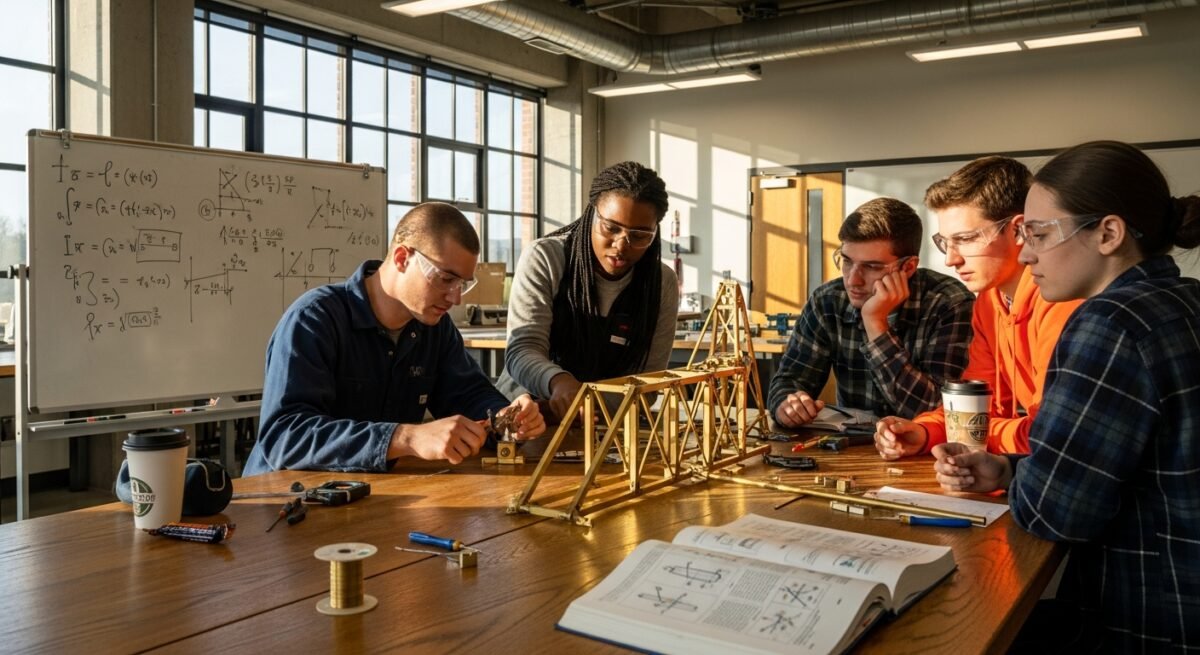
Regardless of the specialization, nearly every accredited engineering program culminates in a capstone design project. This is the ultimate synthesis and a critical component of the engineering degree core courses. Typically spanning a full academic year, the capstone requires students to work in teams to identify a problem, conceptualize a solution, design and model the system, build a prototype (or detailed plans), and present their work. This experience integrates everything learned: mathematics for modeling, science for constraints, engineering principles for design, and often economics for feasibility. It also hones vital professional skills like project management, teamwork, technical communication, and ethics. The capstone is the proof of competency, demonstrating that a student can function as an entry-level engineer. For those considering specialized paths, resources like our guide to the Top 5 Computer Engineering Degrees Online Programs detail how these core and specialized courses are structured in a digital learning environment.
The Role of Computing, Labs, and General Education
Interwoven with the theoretical and applied coursework are two other critical elements: computing and laboratory experience. Engineering in the 21st century is inseparable from computational tools. Therefore, a core course in programming, typically using languages like Python, MATLAB, or C++, is now standard. This skill is used for numerical analysis, data processing, simulation, and controlling automated systems. Laboratory courses accompany the science and engineering science lectures, providing hands-on verification of theory. Students learn measurement techniques, data analysis, instrumentation, and safety protocols. They see the difference between idealized equations and real-world systems, developing an intuition for experimental error and material behavior.
Finally, a well-rounded engineering education includes general education or “core curriculum” courses in humanities, social sciences, and communication. This is not filler material. Engineers design for people and within societal contexts. Courses in ethics, economics, technical writing, and psychology are essential for understanding the broader impact of engineering work, communicating effectively with stakeholders, and leading multidisciplinary teams. The ability to write a clear report, present a compelling proposal, or consider the ethical implications of a design is what separates a competent technician from a professional engineer. For comprehensive college degree guidance on how these components fit together across different institutions, prospective students should explore dedicated advisory services.
Frequently Asked Questions
Are engineering degree core courses the same at every university?
While the fundamental topics are remarkably consistent due to accreditation standards (ABET in the U.S.), the specific sequence, course titles, and credit hours can vary. The core pillars of math, science, engineering science, and design are universal, but one school might combine statics and dynamics, while another teaches them separately. Always review the curriculum of your target program.
Which core course is considered the most difficult?
This is subjective and depends on individual strengths. However, many students point to the sequence of Calculus II/III, Differential Equations, or core engineering science courses like Thermodynamics or Circuit Analysis as particularly challenging due to their high level of abstraction and cumulative nature. Success hinges on consistent practice and seeking help early.
Can I test out of any core courses?
Possibly. Many programs offer placement exams for introductory mathematics and chemistry courses. Advanced Placement (AP) or International Baccalaureate (IB) credits from high school are also widely accepted for first-year calculus, physics, and general education courses, allowing you to start at a more advanced level.
How important are the grades in these core courses for my future?
Very important. Core courses form your foundational GPA and are closely scrutinized by recruiters for internships and entry-level jobs, as well as by graduate admissions committees. They are the best indicator of your technical aptitude and ability to handle rigorous material. Strong performance here opens more doors.
Do online engineering degrees cover the same core courses?
Yes, accredited online engineering programs must cover the same core curriculum to meet accreditation standards. Lab components are delivered through at-home lab kits, virtual simulations, or required short-term campus residencies. For example, the structure of core courses in an online chemical engineering program is explored in our article on the Top 5 Benefits of Chemical Engineering Degrees Online.
Mastering the engineering degree core courses is a demanding but transformative process. This structured progression from abstract theory to applied design equips graduates with a versatile and powerful skill set. It builds not just knowledge, but the tenacity, problem-solving methodology, and systems-thinking mindset that are the hallmarks of the engineering profession. For anyone considering this path, a clear understanding of this core journey is the first step toward a successful and impactful career creating the technology and infrastructure of tomorrow.