
Diagnostic medical sonography, commonly known as ultrasound technology, is one of the fastest-growing allied health fields. For those seeking a direct path into this rewarding career, an associate degree is the most common and practical entry point. This article breaks down the essential sonography associate degree requirements and programs, helping you understand what it takes to enroll, what you will study, and how to choose the right program for your goals.
The demand for skilled sonographers continues to rise as medical imaging becomes a cornerstone of modern diagnostics. Whether you are a high school graduate, a career changer, or a military veteran exploring new opportunities, an associate degree in sonography can open doors to stable employment with a strong median salary. Unlike some healthcare roles that require four or more years of education, a sonography associate’s degree typically takes two years to complete, making it an efficient and affordable option for those eager to enter the workforce quickly.
What Is a Sonography Associate Degree?
A sonography associate degree, officially called an Associate of Applied Science (AAS) in Diagnostic Medical Sonography, is a two-year program designed to prepare students for entry-level positions as sonographers. These programs are offered by community colleges, technical schools, and some universities, with a heavy emphasis on hands-on clinical training. The curriculum blends classroom instruction in anatomy, physics, and patient care with supervised clinical rotations in hospitals or imaging centers.
Graduates are eligible to sit for certification exams offered by the American Registry for Diagnostic Medical Sonography (ARDMS). While certification is not always legally required, most employers strongly prefer or mandate it. Earning an ultrasound technology associate degree from an accredited program is the most reliable way to meet certification eligibility requirements.
Core Sonography Associate Degree Requirements
Admission to a sonography program is competitive. Programs receive many applications for limited seats, so meeting the minimum requirements is often just the starting point. Below are the typical prerequisites you must fulfill before applying.
Educational Prerequisites
Almost all accredited programs require a high school diploma or GED. Additionally, many programs require completion of specific college-level prerequisite courses. These often include:
- Human Anatomy and Physiology (with labs)
- College Algebra or higher mathematics
- General Physics (often with a lab component)
- Medical Terminology
- English Composition
Some programs require applicants to have already earned an associate degree or at least 30-60 college credits before applying. This is especially common for programs that offer a second-degree option for students who already hold a bachelor’s degree in another field. If you are starting from scratch, plan for one to two semesters of prerequisite coursework before you can formally apply to the sonography program.
Minimum GPA and Test Scores
Most programs set a minimum cumulative GPA of 2.5 to 3.0 on a 4.0 scale for both high school and any college coursework. Competitive applicants often have GPAs above 3.2. Some programs also require standardized test scores, such as the SAT, ACT, or the Test of Essential Academic Skills (TEAS). The TEAS is particularly common for allied health programs and assesses reading, math, science, and English skills.
Clinical Requirements
Before starting clinical rotations, you must complete several health and safety requirements. These typically include:
- Proof of immunizations (MMR, Hepatitis B, Varicella, Tdap, and annual flu shot)
- A negative tuberculosis (TB) skin test or chest X-ray
- Current CPR certification (BLS for Healthcare Providers)
- Background check and drug screening
- Health insurance coverage
These requirements protect both you and the patients you will serve. Failure to complete them can delay your clinical start date and extend your time to graduation.
Program Duration and Curriculum Structure
An accredited sonography associate’s degree program typically spans 18 to 24 months of full-time study after prerequisites are met. Some programs offer part-time or evening options, but these are less common and may extend the timeline to three years or more. The curriculum is divided into didactic (classroom) and clinical components.
Didactic Coursework
Classroom instruction covers the theoretical foundations of sonography. Core courses include:
- Sonographic Physics and Instrumentation
- Abdominal Sonography
- Obstetric and Gynecologic Sonography
- Vascular Sonography
- Echocardiography (in some programs)
- Pathophysiology
- Patient Care and Ethics
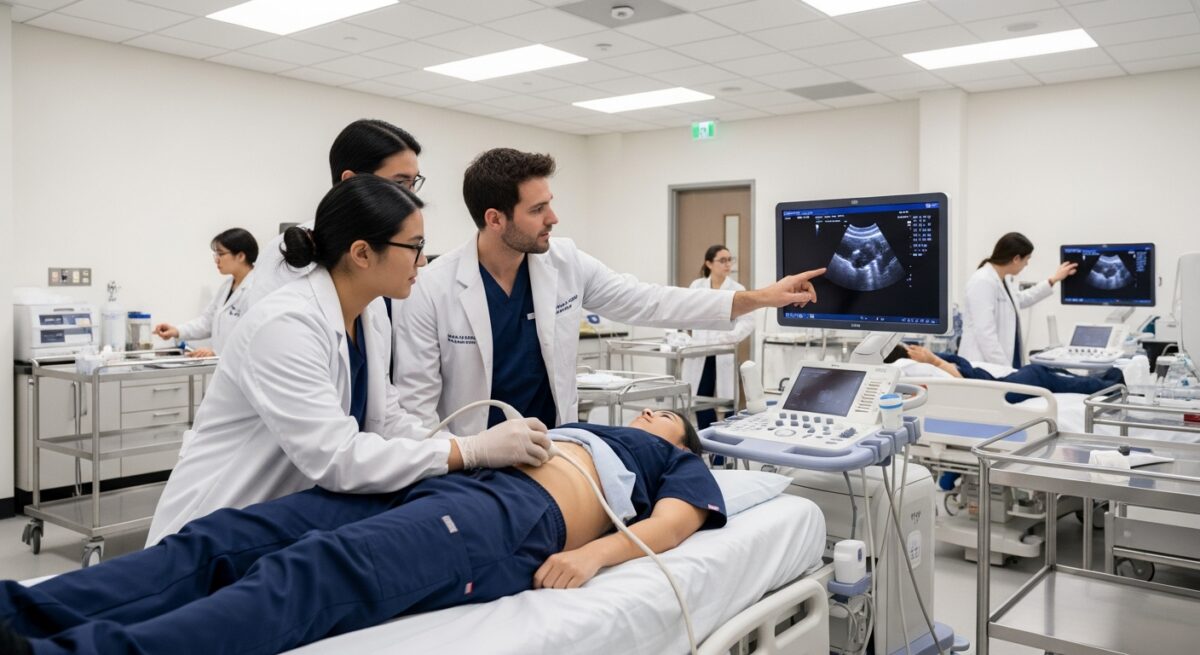
These courses are often delivered through lectures, online modules, and lab sessions where students practice scanning techniques on simulation mannequins and volunteer models.
Clinical Rotations
The clinical component is where you apply classroom knowledge in real healthcare settings. Students complete a minimum of 800 to 1,200 clinical hours under the supervision of experienced sonographers and radiologists. Rotations typically include:
- Hospital imaging departments
- Outpatient diagnostic centers
- Physician offices (OB/GYN, cardiology, vascular surgery)
During rotations, you will perform scans on actual patients, document images, and learn to recognize normal and abnormal anatomy. This hands-on experience is critical for building the scanning skills and clinical judgment needed for certification and employment.
Accreditation: Why It Matters
Accreditation is the single most important factor when choosing an ultrasound technology associate degree program. Graduation from a program accredited by the Commission on Accreditation of Allied Health Education Programs (CAAHEP) is required to sit for the ARDMS certification exams. Without CAAHEP accreditation, you may not be eligible for certification, which can severely limit your job prospects.
When researching programs, always verify their accreditation status on the CAAHEP website. Also check if the program has any additional programmatic accreditation from the Joint Review Committee on Education in Diagnostic Medical Sonography (JRC-DMS). Regional accreditation of the institution itself is also important for credit transfer and financial aid eligibility.
Online and Hybrid Program Options
While sonography is a hands-on field, some colleges offer hybrid programs that combine online didactic coursework with in-person lab and clinical requirements. These programs are ideal for working adults or those who live far from campus. The online portion typically covers lecture material through video modules, discussion boards, and virtual simulations. Labs and clinical rotations are completed at affiliated healthcare sites near the student’s home.
Fully online sonography programs are rare and often require students to arrange their own clinical preceptors. If you choose this route, ensure the program is CAAHEP-accredited and that clinical placement assistance is offered. Otherwise, you may struggle to find clinical sites willing to train you. For a deeper look at how associate degree structures work across different fields, see our guide on AA Degree Requirements and Program Structure Explained.
Cost and Financial Aid
Tuition for a sonography associate degree varies widely by institution and location. According to data from the College Board and program websites, you can expect to pay:
- Community colleges: $6,000 to $20,000 total (in-state tuition)
- Private technical schools: $20,000 to $45,000 total
- For-profit institutions: $30,000 to $60,000 total
Additional costs include textbooks, lab fees, uniforms, health screenings, certification exam fees, and travel to clinical sites. These can add $2,000 to $5,000 to the total cost over two years. Financial aid is available for eligible students through federal grants (Pell Grant), federal student loans, and institutional scholarships. Many community colleges offer payment plans to spread out tuition costs.
To explore affordable education options and connect with accredited programs, use a trusted resource like DegreesOnline.Education to compare schools and find financial aid opportunities that fit your budget.
Career Outlook After Graduation
The U.S. Bureau of Labor Statistics projects a 14% growth in employment for diagnostic medical sonographers from 2022 to 2032, much faster than the average for all occupations. This growth is driven by an aging population and the increased use of ultrasound as a safer alternative to radiation-based imaging. The median annual wage for sonographers was $81,350 in May 2023, with the top 10% earning over $105,000.
Graduates of accredited programs often find jobs in hospitals, outpatient clinics, physician offices, and diagnostic laboratories. Specializing in areas like cardiac sonography (echocardiography) or vascular sonography can lead to higher pay and more job opportunities. Many employers offer tuition reimbursement for sonographers who pursue advanced certifications or a bachelor’s degree later in their careers.
Frequently Asked Questions
Can I become a sonographer with just an associate degree?
Yes. An associate degree is the standard entry-level credential for diagnostic medical sonographers. Most employers require graduation from a CAAHEP-accredited program and ARDMS certification, both of which are achievable with an associate degree.
How long does it take to complete a sonography associate degree?
Most full-time programs take 18 to 24 months after completing prerequisite coursework. Including prerequisites, the total time from start to graduation is typically two to three years.
What is the difference between a certificate and an associate degree in sonography?
A certificate program is usually shorter (12 to 18 months) but is designed for individuals who already hold a degree in a related health field, such as nursing or radiography. An associate degree is a standalone program that includes general education courses and is suitable for students with no prior healthcare background.
Do I need to be certified to work as a sonographer?
Certification is not legally required in most states, but the vast majority of employers require it. ARDMS certification is the most widely recognized credential. Graduating from a CAAHEP-accredited program is the primary pathway to becoming eligible for the ARDMS exams.
Can I complete a sonography program online?
Fully online programs are rare and may not include the required clinical hours. Hybrid programs that combine online coursework with in-person labs and clinical rotations are more common. Always verify that any online or hybrid program holds CAAHEP accreditation.
Your Next Step Toward a Sonography Career
Pursuing a sonography associate degree is a strategic investment in a stable and rewarding healthcare career. The path requires dedication to rigorous coursework, clinical training, and certification exams. However, the payoff is clear: strong job growth, competitive pay, and the satisfaction of helping patients through noninvasive diagnostic imaging. Start by researching CAAHEP-accredited programs in your area, completing prerequisite courses, and applying to multiple programs to maximize your chances of acceptance. With the right preparation and a clear understanding of sonography associate degree requirements and programs, you can confidently take the first step toward becoming a diagnostic medical sonographer.