
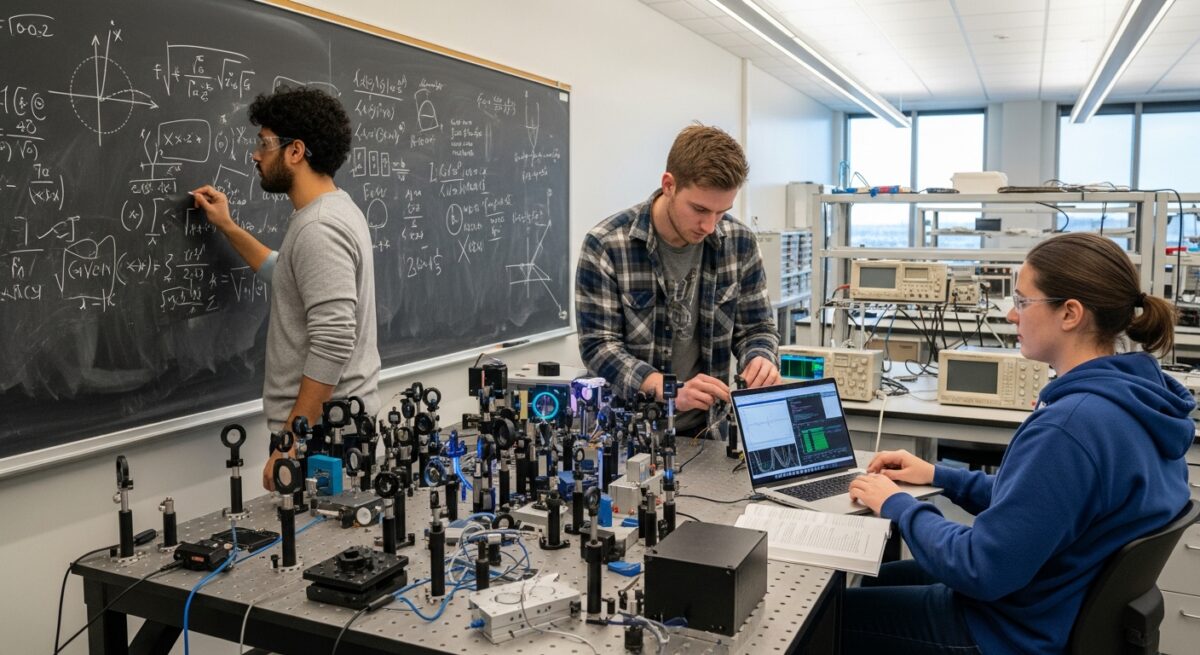
Pursuing a doctorate in physics is a transformative journey that demands intellectual rigor, patience, and a deep curiosity about the universe. A PhD in physics is not merely an advanced degree; it is a credential that opens doors to specialized research roles, high-level teaching positions, and leadership opportunities in technology and industry. For those considering a physics doctorate, understanding the landscape of research areas and the career paths that follow is essential for making informed decisions about their future.
This article explores the major research domains within a PhD in physics program, the skills you develop along the way, and the diverse career opportunities that await doctoral graduates. Whether you are drawn to theoretical physics, experimental condensed matter, or astrophysics, knowing what lies ahead helps you align your academic journey with your professional goals.
Core Research Areas in a Physics Doctorate
A physics doctorate typically begins with coursework and qualifying exams, followed by original research that culminates in a dissertation. The research area you choose defines your daily work and your long-term career trajectory. Below are the most prominent research fields within PhD in physics programs.
Condensed Matter Physics
Condensed matter physics is the largest subfield of physics, focusing on the properties of solid and liquid materials. Researchers in this area study phenomena such as superconductivity, magnetism, and topological insulators. Experimental condensed matter physicists often work in laboratories using techniques like scanning tunneling microscopy, neutron scattering, or spectroscopy. Theoretical condensed matter physicists develop models to explain and predict material behaviors. This field has direct applications in electronics, energy storage, and quantum computing, making it one of the most practical research areas for a physics doctorate.
Astrophysics and Cosmology
Astrophysics and cosmology attract students fascinated by the largest scales of the universe. Research topics include galaxy formation, dark matter, dark energy, black holes, and the cosmic microwave background. A PhD in physics with an astrophysics concentration often involves analyzing data from telescopes (radio, optical, or space-based) or developing simulations of cosmic phenomena. Graduates frequently move into academic research positions at observatories or universities, though data science and aerospace industries also value their analytical skills.
Particle Physics
Particle physics explores the fundamental constituents of matter and the forces that govern their interactions. Experimental particle physicists work at large-scale facilities like CERN, analyzing collision data from accelerators. Theoretical particle physicists develop frameworks such as the Standard Model and its extensions, including supersymmetry and string theory. A theoretical physics PhD in this area demands advanced mathematics and computational skills. Career paths include academic research, national laboratory positions, and quantitative roles in finance or data science.
Quantum Information and Atomic Physics
Quantum information science has grown rapidly in recent years, merging physics with computer science and engineering. Research areas include quantum computing, quantum cryptography, and quantum sensing. Atomic, molecular, and optical (AMO) physics provides the experimental foundation for many quantum technologies. A physics doctorate in this area often involves building and controlling laser systems, trapping atoms or ions, and measuring quantum states. Graduates are in high demand at technology companies developing quantum hardware and in national labs focused on quantum research.
Biophysics
Biophysics applies the principles and methods of physics to understand biological systems. Research topics range from protein folding and molecular motors to neural networks and tissue mechanics. A PhD in physics with a biophysics specialization requires cross-disciplinary knowledge of biology and chemistry. Career paths include academic research in biophysics departments, positions in pharmaceutical or biotechnology companies, and roles in medical physics where principles of physics are applied to diagnostic imaging and radiation therapy.
Skills Developed During a Physics Doctorate
Earning a physics doctorate builds a robust skill set that extends far beyond physics knowledge. Doctoral students develop strong problem-solving abilities, mathematical modeling skills, and proficiency in data analysis and computational methods. Experimental work teaches instrument design, troubleshooting, and laboratory safety. Theoretical work hones abstract reasoning and the ability to simplify complex systems. These skills are highly transferable, making physics PhDs valuable in many industries.
Communication skills also improve significantly through writing research papers, presenting at conferences, and teaching undergraduate courses. Time management and project planning become second nature as you balance coursework, research, and teaching responsibilities. For those considering a physics doctorate, recognizing that these skills are marketable can alleviate concerns about career prospects outside academia.
Career Paths for Physics Doctorate Graduates
The career options for holders of a PhD in physics are diverse and often lucrative. While many assume that a physics doctorate leads only to academia, the reality is that a majority of physics PhDs work in industry, government, or the private sector. Below are the primary career paths.
Academic Research and Teaching
Traditional academic careers involve tenure-track faculty positions at universities or research institutes. Faculty members teach courses, mentor graduate students, and conduct independent research funded by grants. Postdoctoral fellowships are typically required before securing a faculty position. Academic careers offer intellectual freedom and the opportunity to shape future scientists, but they are highly competitive and often require geographic mobility.
National Laboratories and Government Research
National laboratories such as Los Alamos, Argonne, and SLAC employ many physics PhDs to work on large-scale projects in energy, defense, and fundamental science. Government agencies like NASA, the Department of Defense, and the National Institute of Standards and Technology (NIST) also hire physics doctorates. These positions offer stable funding, state-of-the-art facilities, and the chance to work on problems of national importance.
Technology and Data Science
The technology sector has become a major employer of physics doctorates. Companies like Google, IBM, Microsoft, and Amazon hire physicists for roles in machine learning, algorithm development, and quantum computing. The quantitative and analytical skills developed during a theoretical physics PhD or experimental research make physicists excellent data scientists. Many physics PhDs transition into software engineering, financial modeling, or consulting. These roles often offer higher salaries than academic positions and are located in tech hubs across the country.
Medical Physics and Healthcare
Medical physics applies physics principles to medicine, particularly in radiation oncology, diagnostic imaging, and nuclear medicine. A physics doctorate with a specialization in medical physics can lead to clinical roles in hospitals or research positions in medical device companies. This career path requires additional certification but offers direct societal impact and job stability.
- Research scientist in corporate R&D labs focusing on materials, optics, or semiconductors.
- Quantitative analyst in finance, using modeling and statistical skills to price derivatives or manage risk.
- Science policy advisor for government agencies or non-profits, shaping funding priorities and regulations.
- Entrepreneur founding a startup based on a physics innovation, such as a new sensor or quantum technology.
- Educator at community colleges or high schools, teaching the next generation of scientists.
Each of these paths leverages the core strengths of a physics doctorate: deep analytical thinking, problem-solving under uncertainty, and the ability to learn complex systems quickly. Many graduates find that their PhD in physics prepares them for careers they never imagined during graduate school.
How to Choose the Right Research Area and Career Path
Selecting a research area for your physics doctorate is a personal decision influenced by your interests, skills, and career goals. If you enjoy hands-on laboratory work and building equipment, experimental condensed matter or AMO physics may be a good fit. If you prefer abstract reasoning and mathematical elegance, theoretical physics or particle physics could be more suitable. For those who want to see immediate applications, biophysics or medical physics offer clear societal benefits.
It is also wise to consider the job market for different specializations. Condensed matter physics and quantum information have strong industrial demand. Astrophysics and cosmology are more competitive for academic positions but offer excellent training in data analysis that translates to data science roles. Talking to current graduate students, attending research seminars, and doing summer research projects can help clarify your preferences. As you explore options, you may find it helpful to review broader educational pathways, such as the 5 Top Degrees I Can Get Online For Career Growth, to see how a physics doctorate compares with other advanced degrees in terms of flexibility and return on investment.
Additionally, networking with professionals in your target field is invaluable. Attend conferences, join professional societies like the American Physical Society, and seek informational interviews with physicists working in industry or academia. The connections you build can lead to postdoctoral positions, job offers, or collaborative research opportunities.
Frequently Asked Questions
Is a PhD in physics worth it?
Yes, for those passionate about research and problem-solving. A physics doctorate provides advanced skills in analysis, computation, and modeling that are highly valued in many sectors. While the time commitment (typically 5-7 years) is significant, the long-term career opportunities and earning potential often justify the investment. According to data from the American Institute of Physics, physics PhDs have low unemployment rates and competitive salaries.
What is the difference between a theoretical physics PhD and an experimental physics PhD?
A theoretical physics PhD focuses on developing mathematical models and theories to explain physical phenomena, often using pen-and-paper calculations or computer simulations. An experimental physics PhD involves designing and conducting experiments, collecting data, and building or modifying laboratory equipment. Both paths require deep understanding of physics, but the daily work differs significantly. Your choice should align with whether you prefer abstract reasoning or hands-on lab work.
Can I get a job in industry with a physics doctorate?
Absolutely. In fact, more than half of physics PhDs work outside academia. Industries such as technology, finance, energy, and healthcare actively recruit physicists for their analytical and quantitative skills. Many companies value the ability of physics doctorates to tackle complex, open-ended problems. With the rise of quantum computing and machine learning, demand for physics PhDs in industry is growing.
How long does it take to earn a PhD in physics?
Most students complete a physics doctorate in 5 to 7 years. The timeline depends on the research area, the advisor’s expectations, and the student’s progress. The first two years typically involve coursework and qualifying exams, followed by 3-5 years of original research and dissertation writing. Some programs offer accelerated paths for students entering with a master’s degree.
What are the admission requirements for a physics doctorate program?
Admission typically requires a bachelor’s degree in physics or a closely related field, strong GPA, competitive GRE scores (though many programs are moving away from the GRE), research experience, and letters of recommendation. A personal statement outlining your research interests and career goals is also important. International students must demonstrate English proficiency through tests like TOEFL or IELTS.
Final Thoughts on Your Physics Doctorate Journey
Earning a PhD in physics is a demanding but deeply rewarding endeavor. The research areas within a physics doctorate offer rich opportunities to explore fundamental questions and develop technologies that shape our world. Whether you aim for a career in academia, industry, or government, the skills you build during your doctoral training will serve you well. By understanding the landscape of research areas and career paths, you can make strategic choices that align with your passions and professional aspirations. As you consider this path, remember that a physics doctorate is not just a degree; it is a foundation for a lifetime of discovery and impact. For more guidance on matching your educational goals with accredited programs, visit DegreeOnline.Education to explore flexible learning options that fit your schedule and budget.