
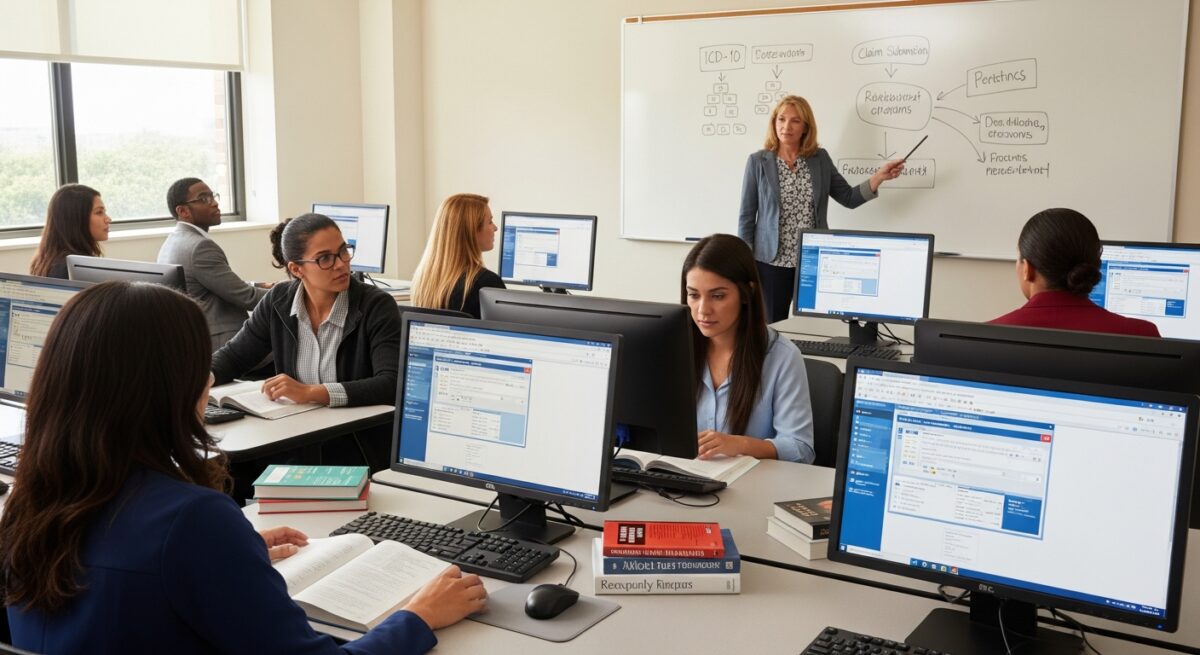
Healthcare organizations rely on accurate records and timely reimbursement to keep their doors open. Behind every clean claim and paid invoice stands a trained professional who understands complex diagnosis codes, procedure modifiers, and payer regulations. If you are looking for a stable career that does not require years of classroom time, the path forward starts with a solid medical billing and coding education. This complete guide walks you through program options, certification requirements, costs, and career outcomes so you can make an informed decision about your future.
What a Medical Billing and Coding Education Actually Covers
Many people assume that billing and coding are the same role, but they represent two distinct skill sets that work together. Coding involves translating a patient’s medical record into standardized alphanumeric codes using systems like ICD-10-CM, CPT, and HCPCS Level II. Billing takes those codes and submits claims to insurance companies, Medicare, or Medicaid, then follows up on payments and appeals denials. A comprehensive education for medical billing and coding teaches both sides of this workflow so graduates can handle the full revenue cycle.
Programs typically include coursework in anatomy and physiology, medical terminology, health data management, and healthcare law. Students also learn to use practice management software and electronic health record systems. The best curricula emphasize real-world application through case studies and simulated claim scenarios. For example, a student might review a patient encounter for a fractured wrist, assign the correct fracture code and surgical modifier, then generate a clean claim and track it through the adjudication process. This hands-on approach builds confidence and reduces the learning curve once you enter the workforce.
Types of Programs and Where to Find Them
You have several options when pursuing a medical billing coding education, ranging from short certificate courses to associate degrees. Certificate programs are the most common entry point and can be completed in 4 to 12 months. They focus exclusively on coding and billing skills without general education requirements. Associate degree programs take about two years and include broader coursework such as English composition, math, and social sciences. A degree can open doors to supervisory roles or positions in larger healthcare systems that prefer a more comprehensive academic background.
Delivery formats vary widely. Traditional classroom settings offer structure and face-to-face interaction with instructors. Online programs provide flexibility for working adults or parents who need to study around other commitments. Many accredited institutions now offer hybrid models that combine self-paced online modules with live virtual labs. When evaluating programs, look for accreditation from AHIMA or AAPC, as this ensures the curriculum meets industry standards and prepares you for certification exams. In our guide on accredited medical billing and coding schools, we explain how to vet program quality and avoid diploma mills.
Key Factors When Choosing a School
Not all programs deliver the same value. Start by checking whether the school holds regional or national accreditation and whether its billing and coding program carries programmatic approval. Review the pass rates for the CPC or CCA exams, as these numbers reflect how well the curriculum aligns with certification requirements. Compare tuition costs and factor in hidden expenses such as books, software subscriptions, and exam fees. Finally, ask about job placement assistance and alumni outcomes. A program that tracks graduate employment and shares those statistics openly demonstrates confidence in its training.
Certification: The Credential That Matters Most
Employers rarely hire uncertified coders. Certification validates your knowledge and signals to employers that you meet a national standard of competency. The two leading certifying bodies are the American Academy of Professional Coders (AAPC) and the American Health Information Management Association (AHIMA). The AAPC offers the Certified Professional Coder (CPC) credential, which is the most widely recognized for outpatient coding. AHIMA offers the Certified Coding Associate (CCA) and the more advanced Certified Coding Specialist (CCS) for inpatient and hospital settings.
To sit for these exams, you typically need to complete a training program or have equivalent work experience. Some certifications require an associate degree or a certain number of continuing education units to maintain active status. The exam itself is rigorous, often lasting four hours and covering multiple code sets, reimbursement methodologies, and compliance guidelines. Passing the exam demonstrates that you can apply coding rules accurately under pressure, a skill that directly affects a healthcare organization’s revenue integrity. Many employers offer salary differentials or bonuses for certified staff, making the credential a worthwhile investment.
Cost of Education and Financial Aid Options
The price of a medical billing and coding education ranges from roughly $1,000 for a self-paced online certificate to $15,000 or more for an associate degree at a private college. Community colleges often offer the best value, with tuition around $3,000 to $6,000 for a two-year program. Online providers like AAPC’s own training courses or CareerStep charge between $2,000 and $4,000 for comprehensive packages that include exam vouchers and practice tests. Before enrolling, request a detailed cost breakdown and ask about payment plans.
Financial aid is available for students who enroll in accredited programs. Federal Pell Grants, federal student loans, and work-study programs can offset tuition for eligible students. Some employers offer tuition reimbursement for employees pursuing healthcare credentials. Additionally, military veterans may use GI Bill benefits for approved programs. Scholarships from professional organizations like AHIMA or local healthcare foundations can further reduce out-of-pocket expenses. Always complete the Free Application for Federal Student Aid (FAFSA) to determine your eligibility, even if you think your income is too high.
Career Outlook and Earning Potential
The Bureau of Labor Statistics projects that employment for medical records specialists, which includes medical coders and billers, will grow 8 percent through 2032, much faster than the average for all occupations. This growth is driven by an aging population, increased use of electronic health records, and the shift to value-based care models that require precise documentation. Entry-level certified coders typically earn between $35,000 and $45,000 per year, while experienced coders with advanced certifications can earn $55,000 to $75,000. Coders who specialize in risk adjustment, oncology, or inpatient coding command higher salaries due to the complexity of the work.
Work settings vary. Hospitals, physician practices, nursing homes, and insurance companies all hire coding professionals. Remote work has become increasingly common, with many coders handling claims from home after a probationary period. Independent contractors and coding consultants can earn even more by taking on multiple clients or working on a per-chart basis. The flexibility of this career makes it attractive to parents, military spouses, and individuals who prefer nontraditional work arrangements.
Learning Medical Billing and Coding Through Self-Study vs. Structured Programs
Self-directed learners sometimes attempt to master coding through textbooks and free online resources. While it is possible to learn the code sets independently, most employers prefer candidates who have completed a formal program. Structured courses provide guided instruction, peer interaction, and access to instructors who can answer complex questions. They also offer practice exams and coding labs that mirror real-world scenarios. If you have prior healthcare experience, such as a nursing assistant or medical secretary background, self-study may be a viable path to certification. However, for most newcomers, a structured program offers a faster and more reliable route to competence.
Learning medical billing and coding through an accredited program also builds a professional network. Instructors often work in the field and can provide job leads or references. Classmates may become study partners or future colleagues. Many programs include an externship or practicum component that places students in a real healthcare setting for hands-on experience. This practical exposure is invaluable when applying for your first job and can sometimes lead directly to a full-time offer.
Common Challenges and How to Overcome Them
Medical coding requires attention to detail and a tolerance for ambiguity. Code sets update annually, and payer policies change frequently. Staying current demands ongoing education and a commitment to lifelong learning. Many new coders struggle with the specificity of ICD-10-CM, which requires coders to document laterality, severity, and encounter type. The best way to overcome this challenge is to practice daily with real or simulated charts and to join coding forums where experienced professionals share guidance.
Time management is another hurdle, especially for students balancing coursework with work and family. Create a dedicated study space and set a regular schedule. Break large tasks into smaller milestones, such as mastering one chapter per week. Use flashcards for medical terminology and code ranges. Take advantage of mobile apps that let you review codes during downtime. Persistence pays off, and most students who complete their program find that the initial difficulty gives way to confidence as patterns become familiar.
Frequently Asked Questions
How long does it take to complete a medical billing and coding program?
Certificate programs typically take 4 to 12 months, while associate degrees require about two years of full-time study. Online self-paced options allow you to finish faster if you dedicate more hours per week.
Do I need a college degree to become a medical coder?
No, a certificate from an accredited program plus passing a certification exam is sufficient for most entry-level positions. An associate degree can help you advance to supervisory or specialist roles.
Which certification should I get first?
The CPC from AAPC is the most common starting point for outpatient coding. If you plan to work in a hospital setting, consider the CCS from AHIMA. Both credentials are respected, and some coders eventually earn both.
Can I work from home as a medical coder?
Yes, remote work is common in this field. Many employers require an initial on-site training period before granting remote privileges. Independent contractors often work entirely from home.
Is medical billing and coding hard to learn?
The material requires memorization and attention to detail, but it is not inherently difficult. Most students succeed with consistent study habits and hands-on practice. Support from instructors and study groups makes the process easier.
Taking the Next Step
Entering the healthcare field through medical billing and coding offers a practical, affordable path to a stable career. The skills you gain are in demand across every type of healthcare setting, and the work provides a meaningful way to support patient care without direct clinical contact. By choosing an accredited program, earning a recognized certification, and committing to continuous learning, you position yourself for long-term success. Whether you enroll in a community college, an online platform, or a technical school, the investment in your education will pay dividends throughout your professional life. To explore schools that match your goals and budget, visit degreeonline.education and compare programs side by side. Start your journey today and build a future in one of healthcare’s most essential behind-the-scenes roles. Learn more