
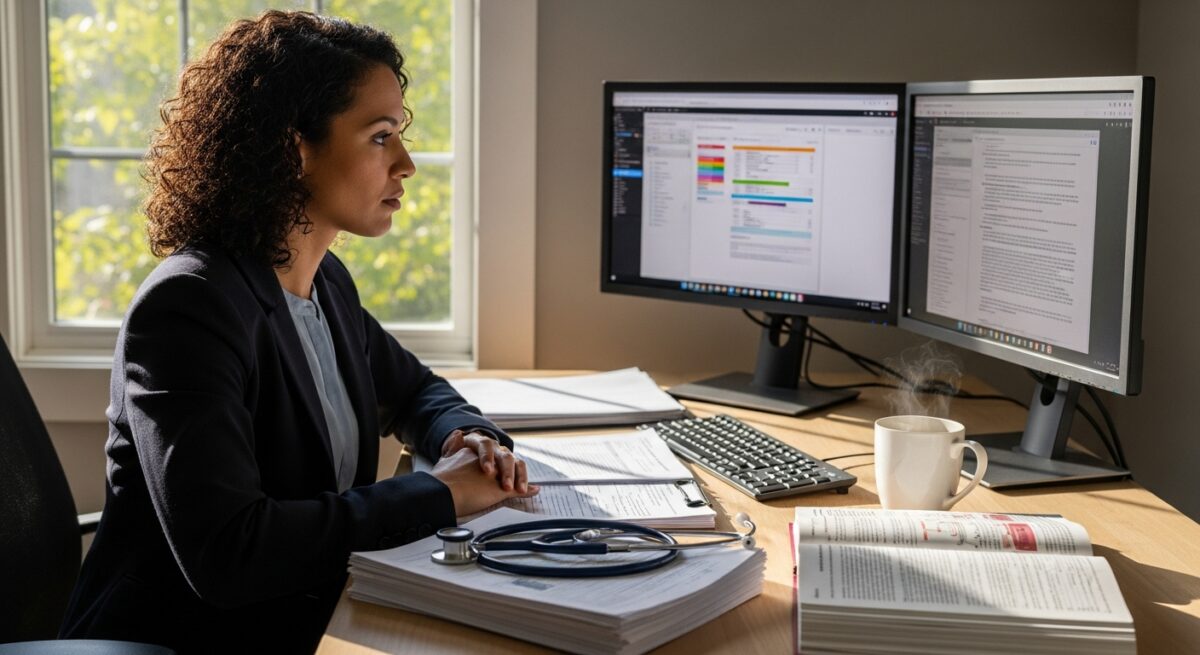
Healthcare providers rely on accurate billing and coding to keep their practices running, and the professionals who manage these systems are in high demand. If you are looking for a stable career that does not require years of medical school, earning a medical billing and coding certification is one of the most direct paths to a well-paying job in the healthcare industry. This guide walks you through everything you need to know about getting certified, the different credentials available, the exam process, and how to start your career with confidence.
What Is Medical Billing and Coding?
Medical billing and coding is the process of translating patient encounters into standardized codes used for insurance claims and billing. Coders review medical records and assign codes for diagnoses, procedures, and equipment. Billers take those codes and submit claims to insurance companies, track payments, and manage patient accounts. Together, they ensure that healthcare providers get paid for their services and that patient records remain accurate.
This field is often grouped together because the two roles overlap heavily. Many professionals handle both responsibilities, especially in smaller clinics or outpatient centers. The work is detail-oriented and requires a solid understanding of medical terminology, anatomy, and insurance regulations. It is also a role that can be performed remotely, making it attractive for working adults and parents seeking flexible employment.
Why Pursue a Certification?
While it is possible to work in medical billing and coding without a credential, most employers prefer or require certification. A certification proves that you have met a national standard of knowledge and competence. It also often leads to higher pay, better job security, and more opportunities for advancement. In our guide on accredited medical billing and coding schools guide, we explain how to find programs that align with your career goals and budget.
Certification also opens doors to specialized roles. For example, you might work exclusively in a hospital’s emergency department, a dermatology practice, or a large insurance company. Each setting requires a slightly different skill set, but a foundational certification gives you the flexibility to move between them.
Types of Medical Billing and Coding Certifications
Several organizations offer nationally recognized certifications. The most respected credentials come from the American Academy of Professional Coders (AAPC) and the American Health Information Management Association (AHIMA). Below are the most common options.
Certified Professional Coder (CPC)
The CPC credential is the most popular certification for medical coders. It is offered by the AAPC and focuses on physician-based coding. The exam covers CPT, ICD-10-CM, and HCPCS Level II codes. Many employers consider the CPC the gold standard for outpatient coding. To qualify, you need to pass the exam and have at least two years of professional coding experience, or you can complete an approved training program to waive the experience requirement.
Certified Coding Specialist (CCS)
The CCS credential is offered by AHIMA and is more focused on hospital inpatient coding. It requires a deeper understanding of complex coding scenarios, including diagnoses and procedures for acute care settings. The CCS is ideal if you plan to work in a hospital or a large health system. The exam is rigorous and typically requires completion of a coding program or equivalent work experience.
Certified Billing and Coding Specialist (CBCS)
The CBCS credential is offered by the National Healthcareer Association (NHA). It is a good entry-level option for people who want to get certified quickly. The exam covers both billing and coding topics, making it suitable for roles where you handle both functions. Many vocational schools and community colleges prepare students for the CBCS as part of a short-term certificate program.
Other Notable Credentials
- Certified Inpatient Coder (CIC): For coders specializing in inpatient hospital records, offered by AAPC.
- Certified Outpatient Coder (COC): For coding in outpatient hospital settings, also from AAPC.
- Registered Health Information Technician (RHIT): A broader credential that includes coding, data analysis, and information management, offered by AHIMA.
Each certification has its own exam fee, renewal requirements, and continuing education units (CEUs). You do not need to earn all of them. Choose the one that aligns with the type of facility where you want to work and the specific duties you want to perform.
Steps to Get Certified in Medical Billing and Coding
The path to certification is straightforward but requires planning and dedication. Here is a step-by-step process to help you get started.
- Research certification options. Review the credentials listed above and decide which one matches your career goals. Consider factors like cost, exam difficulty, and employer preferences in your area.
- Complete a training program. While some people self-study, most candidates benefit from a structured program. Many community colleges, vocational schools, and online platforms offer medical coding certification classes. These programs typically take four to twelve months to complete and cover medical terminology, anatomy, coding guidelines, and reimbursement methods.
- Prepare for the exam. Use official study guides, practice exams, and coding manuals. Many organizations offer exam prep packages that include sample questions and timed tests. Plan to study for several weeks or months depending on your background.
- Register for the exam. Visit the certifying body’s website to register. Exams are offered at testing centers or online with remote proctoring. Pay the exam fee and schedule your test date.
- Pass the exam. On exam day, bring approved materials (such as code books) and arrive early. Most exams are multiple choice and last several hours. You will receive your score immediately or within a few weeks.
- Apply for your credential. After passing, you will receive your official certification. Keep your certificate and wallet card in a safe place. You will need to renew your certification every two years by earning CEUs and paying a renewal fee.
If you are wondering how to get medical billing and coding certification as quickly as possible, consider an accelerated online program that prepares you for the CPC or CBCS exam in under six months. Many of these programs include the exam fee in the tuition cost, which simplifies the process.
Training and Education Options
You have several routes to get the education you need to pass the certification exam. The best choice depends on your learning style, budget, and timeline.
Online programs are the most popular option. They offer flexibility for working adults and parents. You can study at your own pace, watch recorded lectures, and access digital textbooks. Many online programs also include virtual labs and practice coding exercises. When choosing a program, verify that it is accredited and that its curriculum aligns with the certification you want.
Community colleges and vocational schools offer in-person or hybrid options. These programs often include hands-on practice with real-world scenarios and may offer job placement assistance. They tend to cost more than online-only options but provide more direct support from instructors. Some programs also offer medical coding certification classes that can be completed in as little as three months.
If you are on a tight budget, you can self-study using textbooks, online resources, and free practice exams. However, self-study requires strong discipline and may leave gaps in your knowledge. Many people find that a structured program gives them the confidence and accountability they need to pass the exam on their first attempt.
Exam Preparation Tips
Passing a certification exam requires more than just memorizing codes. You need to understand the logic behind code selection and the guidelines that govern each code set. Here are some tips to maximize your chances of success.
- Use official study materials. The AAPC and AHIMA offer official study guides, practice exams, and webinars. These materials are designed to mirror the actual exam format and content.
- Practice with code books. Even though many exams are now digital, you will still use physical code books during the test. Practice flipping through the tabs and finding codes quickly.
- Take timed practice exams. Simulate the real exam environment by timing yourself. This helps you manage your pace and reduces test-day anxiety.
- Join a study group. Online forums and local study groups can help you clarify difficult concepts and stay motivated. Many candidates find that discussing cases with peers deepens their understanding.
Remember that the exam is not just about speed. Accuracy matters more than speed. Focus on reading each question carefully and applying the correct guidelines. If you get stuck on a question, mark it and move on. You can return to it later if time allows.
Career Outlook and Salary
The demand for medical billing and coding professionals is strong and expected to grow. According to the Bureau of Labor Statistics, employment for medical records and health information specialists is projected to grow faster than the average for all occupations. An aging population and the continued shift toward electronic health records drive this demand.
Salaries vary based on certification, experience, location, and work setting. Entry-level certified coders typically earn between $35,000 and $45,000 per year. With experience and advanced certifications, salaries can exceed $65,000. Remote positions often pay competitively and offer better work-life balance. Hospitals and large health systems tend to pay more than small clinics, but they also require more specialized knowledge.
Certification also makes you eligible for contract or per-diem work, which can increase your earning potential. Many professionals work multiple part-time contracts to build a full-time income without being tied to a single employer. This flexibility is one of the biggest advantages of the field.
Frequently Asked Questions
How long does it take to get certified in medical billing and coding?
Most people complete a training program in four to twelve months and then pass the exam within a few weeks of finishing. If you study full-time, you could be certified in as little as three months. Part-time study typically takes six to nine months.
Can I get certified without going to school?
Yes. You can self-study and take a certification exam without completing a formal program. However, most candidates find that a structured program helps them pass the exam more quickly and with higher scores. Many employers also prefer candidates who have completed an accredited program.
Which certification is best for beginners?
The Certified Professional Coder (CPC) and the Certified Billing and Coding Specialist (CBCS) are both excellent choices for beginners. The CPC is more widely recognized, while the CBCS is often easier and cheaper to obtain. Consider your local job market and employer preferences when deciding.
Do I need to renew my certification?
Yes. Most certifications must be renewed every two years. Renewal requires earning continuing education units (CEUs) and paying a fee. Many employers cover the cost of CEUs as part of their professional development programs.
Is medical billing and coding a good remote job?
Yes. Many medical billing and coding positions are fully remote. As long as you have a secure internet connection and the right software, you can work from home. This makes the field especially attractive for parents, caregivers, and people who prefer to avoid commuting.
If you are ready to take the next step, start by researching programs that fit your schedule and budget. Many schools offer payment plans or financial aid to help you afford the training. You can also explore the resources available through scholarship.education to find funding opportunities that reduce your out-of-pocket costs. With the right preparation and a recognized certification, you can build a rewarding career in one of healthcare’s most essential support roles.