
How Long Does a College Degree Take? A Complete Timeline Guide
A college degree can take 2 to 8+ years depending on level, pace, and format. Learn the key factors that determine your personal timeline to graduation.

By Alex Jordan
You are ready to invest in your future, but you need to know the commitment. The question “how long does a college degree take?” is fundamental, yet the answer is far from one-size-fits-all. While the iconic four-year bachelor’s timeline is deeply ingrained in our culture, the reality of modern higher education offers a spectrum of pathways, each with its own schedule. Your timeline is influenced by your degree level, enrollment status, prior credits, and even the specific structure of your chosen program. Understanding these variables is the first step in crafting an educational plan that aligns with your career goals and life circumstances.
The Standard Timelines for Common Degree Types
At its core, the duration of a college degree is primarily defined by its level and the number of credit hours required for completion. Credits represent the academic workload, with one credit typically equating to about one hour of classroom instruction and two to three hours of outside study per week over a semester. This system creates a general framework, but it is essential to remember that these are averages. Accelerated options, part-time study, and transfer credits can all significantly alter these standard timelines.
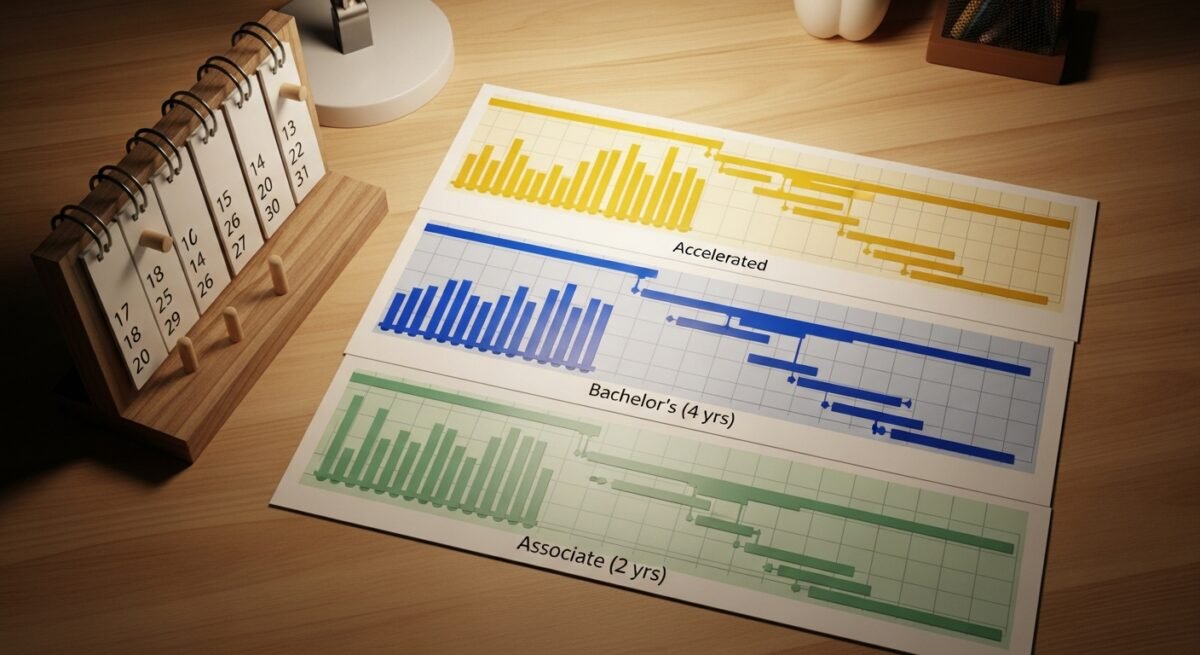
An associate degree is generally considered a two-year program if pursued full-time. It requires approximately 60 semester credits and is often offered by community colleges. This degree serves multiple purposes: it can be a terminal credential for entering fields like nursing, paralegal studies, or information technology, or it can be a stepping stone, with credits designed to transfer toward a bachelor’s degree. The bachelor’s degree is the most common undergraduate credential. The standard “four-year degree” typically demands 120 semester credits. This timeline assumes a full-time course load of 15 credits per semester over eight semesters (fall and spring). Majors in engineering, architecture, or certain sciences may require up to 150 credits, extending the timeline to five years.
Graduate degrees introduce more specialization. A master’s degree usually requires 30 to 60 credits beyond the bachelor’s. For a full-time student, this translates to one to two years. Programs like an MBA or a Master of Social Work (MSW) often fall on the longer end of that spectrum. Doctoral degrees, such as a Ph.D. or an Ed.D., are the most variable. They involve advanced coursework, comprehensive exams, and a lengthy dissertation or capstone project. While the coursework phase may take two to three years, the entire process from start to finish often spans four to eight years, heavily dependent on the research topic and the student’s progress.
Key Factors That Accelerate or Extend Your Timeline
Beyond the printed curriculum, your personal journey will be shaped by several practical factors. Your enrollment status is the most direct lever. Full-time enrollment (usually 12+ credits per semester) is the fastest route to graduation. Part-time study (often 6-11 credits) provides flexibility for working adults but can double or triple the time to degree completion. Many students blend both, shifting between full and part-time loads as life demands change.
Your starting point matters immensely. Students who enter college with Advanced Placement (AP) credits, International Baccalaureate (IB) credits, or credits earned through dual enrollment in high school can shave a semester or more off their timeline. Similarly, transferring from a community college with an associate degree that articulates to a four-year program can lock in two years of credit, leaving only the final two years at the university. Conversely, students who need remedial coursework in math or English to meet college-level standards may have a longer path before they even begin earning degree-applicable credits.
Your choice of major and its specific requirements is a major determinant. Some degrees have highly structured, sequential curricula where courses must be taken in a specific order. A delay or failure in one prerequisite course can cascade, pushing back graduation. Cohorts, common in nursing or education programs, move through a locked schedule as a group, offering little flexibility. Other majors offer more elective freedom, allowing students to adjust their schedules more easily. Furthermore, programs with mandatory internships, clinical rotations, or student teaching placements add essential experience but also fixed time commitments that extend the calendar.
The Impact of Summer and Winter Sessions
One of the most effective strategies for accelerating a degree is to utilize intersessions. Summer and winter terms are no longer just for catching up or retaking a failed class. They are strategic tools. By taking one or two courses each summer, a student can accumulate an extra 6-12 credits per year. Over the course of a bachelor’s degree, this consistent effort can allow a student to graduate a full semester or even a year early, translating to significant savings on tuition and an earlier entry into the workforce. It is a disciplined approach, but for goal-oriented students, it is a powerful way to control the answer to “how long does a college degree take?”
The Rise of Accelerated and Competency-Based Programs
The traditional semester model is being challenged by innovative formats designed for efficiency. Accelerated programs are intensive, often featuring shorter terms (e.g., 5-8 weeks instead of 15) with students taking one or two courses at a time in rapid succession. This allows for year-round progression without the heavy simultaneous workload of a traditional semester. Many online degrees use this model, enabling dedicated students to complete a bachelor’s degree in as little as 2-3 years.
Competency-Based Education (CBE) is perhaps the most radical departure from the credit-hour clock. In CBE programs, progress is measured by demonstrating mastery of specific skills and knowledge, not by time spent in a classroom. If you have prior experience or are a quick learner, you can move through material as fast as you can prove competency. This model is ideal for self-motivated adults with professional experience, as it directly ties learning to tangible abilities and can drastically reduce time to completion. When evaluating these options, it is crucial to verify their standing with accredited college degrees to ensure quality and employer recognition.
Online Degrees: Flexibility With Variable Pacing
Online education has fundamentally reshaped the time-to-degree landscape. The primary benefit is scheduling flexibility, which allows students to maintain employment or family responsibilities while studying. This often enables continuous enrollment year-round, bypassing the long summer break of traditional colleges. However, this flexibility requires exceptional self-discipline. Without the structure of physical classes, the onus is on the student to maintain a consistent pace. Some online programs are self-paced within a term, offering maximum speed for some and potential procrastination pitfalls for others. Most follow a structured term schedule similar to on-campus programs, but with the added benefit of accessing course materials at any hour. Prospective students should thoroughly research and utilize reputable online education resources to compare program formats, support services, and expected commitments before enrolling.
Financial and Life Considerations
The clock is not just academic, it is financial. The cost of extending your education can be substantial. Additional semesters mean more tuition, fees, and often, continued living expenses. They also delay your entry into a professional salary. This cost-benefit analysis is a critical part of planning. Conversely, rushing through a program at an unsustainable pace can lead to burnout, lower grades, and a poor learning experience. Finding the right balance is key.
Life events inevitably intervene. Changing majors, taking a leave of absence for health or family reasons, or reducing course load to work more hours are all common realities. These decisions extend the timeline, and that is perfectly acceptable. The modern student body is diverse: according to the National Center for Education Statistics, a significant percentage of undergraduates are over 25, work part- or full-time, or have dependents. For these students, the question of how long a college degree takes is answered in years of persistent, part-time effort, not a straight four-year sprint. The goal is completion, regardless of the path.
Creating Your Personal Degree Completion Plan
Taking control of your timeline requires proactive planning. Start by meticulously mapping your degree requirements with an academic advisor. Identify prerequisites, sequences, and any “bottleneck” courses that are only offered once a year. Develop a semester-by-semester plan, but build in contingency for the unexpected. Actively seek out opportunities to earn credit for prior learning. Many colleges offer portfolio assessments or challenge exams for a fee that is far less than tuition for a full course. Consistently utilize summer sessions to get ahead or stay on track after a lighter fall or spring load.
Finally, maintain a relentless focus on the return on your educational investment. Every semester added has an opportunity cost. To make informed decisions, it is valuable to research which credentials offer the strongest financial payoff. Our analysis of which college degrees deliver the highest return on investment can help you align your time commitment with your long-term earning potential. By strategically managing these elements, you transition from asking “how long does a college degree take?” to declaring, “I will complete my degree on a timeline that works for my life and my goals.”
The journey to a college degree is a significant investment of time, money, and effort. While the traditional benchmarks provide a useful framework, your personal timeline will be uniquely yours, shaped by your choices, circumstances, and the innovative formats available in today’s educational landscape. By understanding the variables at play, from credit systems and enrollment status to accelerated online programs, you can move forward with clarity and confidence, building a plan that leads not just to a diploma, but to your future career.