
Geology/Earth Science Bachelor's at Amherst College
Explore Amherst College's 4-year Geology/Earth Science bachelor's program, featuring field camps, research, and strong career outcomes.

By Mason Reed
For students drawn to the physical world, from the formation of mountain ranges to the behavior of groundwater, a Geology/Earth Science, General Bachelor's degree, usually 4 years In-person at Amherst College offers an intellectually rigorous and hands-on foundation. Amherst's location in the Connecticut River Valley of western Massachusetts provides a natural laboratory of diverse geological features, making the program particularly immersive. This guide explores what makes the geosciences at Amherst distinctive, what you will study, the research opportunities available, and how this degree translates into meaningful careers.
Why Study Geology and Earth Science at Amherst?
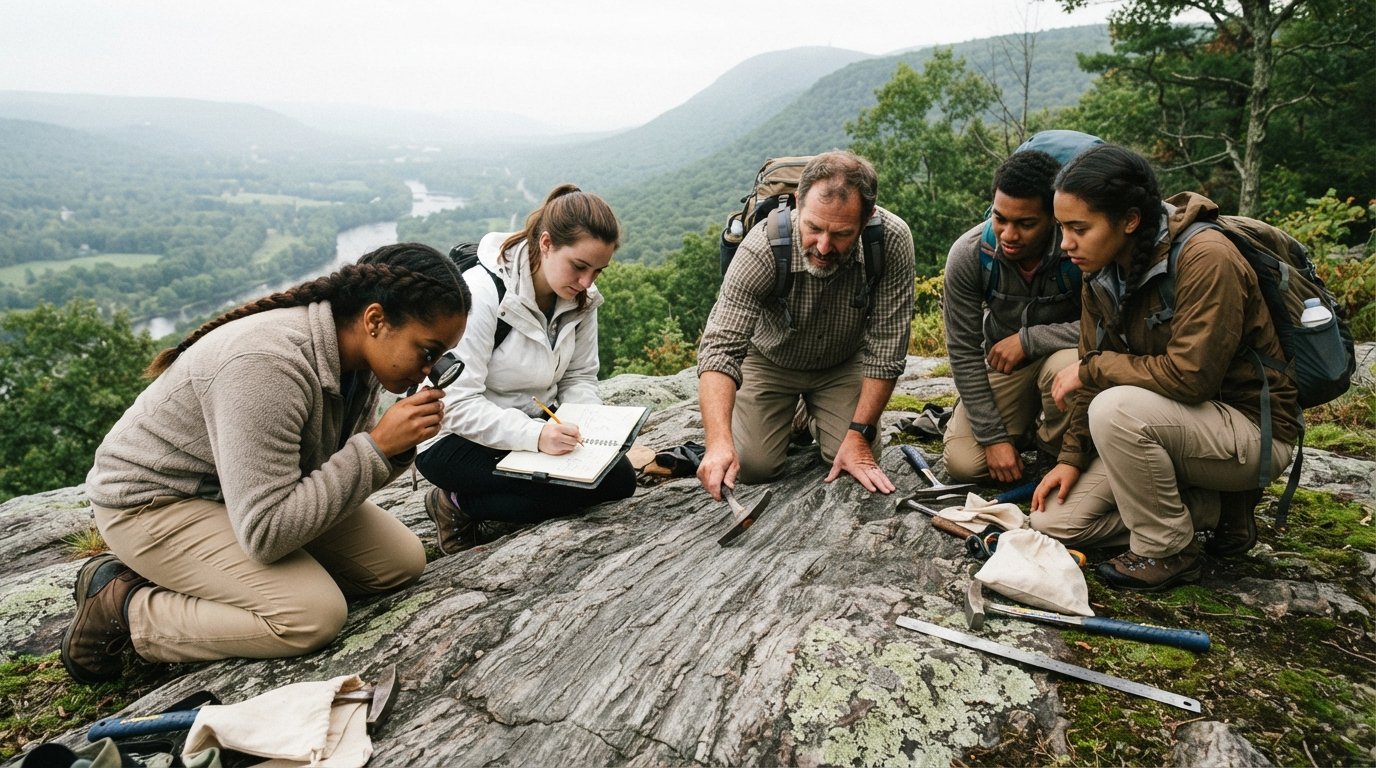
Amherst College is a private liberal arts institution renowned for its small class sizes and close faculty mentorship. In the Department of Earth Sciences, undergraduates work directly with professors who are active researchers in fields like tectonics, climate change, and geochemistry. The department emphasizes field-based learning, with courses that often include local excursions to the Pioneer Valley's bedrock exposures, glacial deposits, and the nearby Holyoke Range. This approach ensures that students do not just memorize textbook concepts but apply them to real landscapes.
The program is structured as a four-year, in-person bachelor's degree, typically culminating in a senior thesis. Because Amherst is part of the Five College Consortium, which includes Smith, Mount Holyoke, Hampshire, and UMass Amherst, students can cross-register for specialized earth science courses and access a wider array of laboratory equipment and faculty expertise. This collaborative environment enriches the Geology/Earth Science, General Bachelor's degree, usually 4 years In-person at Amherst College, offering both depth and breadth.
Core Curriculum and Learning Outcomes
The major is designed to build a comprehensive understanding of the Earth as an integrated system. During the first two years, students typically complete foundational courses that introduce them to the major subdisciplines. A typical sequence might include:
- Physical Geology: The study of rocks, minerals, plate tectonics, and Earth's internal processes.
- Historical Geology: An examination of Earth's 4.6-billion-year history, including the evolution of life and past climates.
- Mineralogy and Petrology: Hands-on identification and analysis of minerals and rock types using polarizing microscopes and geochemical tools.
- Structural Geology and Geophysics: Understanding deformation, faulting, and the physical properties of the Earth's crust.
Upper-level courses allow for specialization in areas such as hydrogeology, paleoclimatology, geobiology, or planetary science. For instance, a course on Quaternary geology might explore the glacial history of New England, while a seminar on stable isotopes could investigate past ocean temperatures. The curriculum is intentionally flexible, encouraging students to design a path that aligns with their specific interests, whether they lean toward environmental consulting, academic research, or policy.
A distinctive feature of the Amherst program is the emphasis on quantitative and analytical skills. Students learn to use Geographic Information Systems (GIS), remote sensing data, and statistical modeling to interpret geological data. These technical competencies are invaluable, not just in graduate school but in any career involving data analysis. The department also stresses written and oral communication, requiring students to produce detailed reports and present findings, mirroring the expectations of professional geoscientists.
Field Camps and Research Opportunities
Fieldwork is the heart of geoscience education, and Amherst ensures that every major gets ample exposure. The department runs a required summer field camp, often held in the western United States, where students spend weeks mapping rock formations and constructing cross-sections. This intensive experience is a rite of passage for geology majors and is highly regarded by graduate programs and employers. In addition, many courses include weekend field trips to sites like the Connecticut River's dinosaur tracks, the Berkshire Mountains, or the coastal cliffs of Cape Cod.
Undergraduate research is a pillar of the Amherst experience. With the guidance of a faculty advisor, students can initiate original projects as early as their sophomore year. Recent thesis topics have included analyzing sediment cores from local lakes to reconstruct past vegetation, measuring the geochemistry of spring waters to assess aquifer contamination, and modeling the thermal history of metamorphic rocks in the Appalachians. The college provides funding for summer research stipends, allowing students to devote themselves fully to their projects without the pressure of outside employment. These experiences not only deepen technical knowledge but also build confidence and problem-solving skills, which are essential for graduate school applications.
Career Pathways and Graduate Study
Graduates of the Geology/Earth Science, General Bachelor's degree, usually 4 years In-person at Amherst College are exceptionally well prepared for a variety of careers. While some enter the workforce immediately, the majority pursue advanced degrees in geology, environmental science, or oceanography. The rigorous quantitative training and research experience make Amherst alumni competitive candidates for leading doctoral programs. For those who choose to work directly after graduation, common entry-level positions include roles as environmental consultants, geotechnical assistants, or field technicians with government agencies like the U.S. Geological Survey or state environmental departments.
The skills learned are more versatile than many students realize, and this is where a resource like DegreesOnline.Education can be useful for exploring how your geoscience foundation might complement online graduate certificates in data science or project management. Even within traditional geology careers, the job outlook is steady. The U.S. Bureau of Labor Statistics projects that employment for geoscientists will grow about 5 percent from 2023 to 2033, driven by the need for energy resources, environmental protection, and infrastructure planning. Amherst's strong alumni network and career center provide robust support for job placement, including internship connections with firms in the Northeast.
For students considering a more interdisciplinary path, the program's connection to the Five College Consortium allows for coursework in related fields such as environmental studies, public policy, or economics. This is particularly useful for roles that involve natural resource management or climate change adaptation. The ability to communicate complex scientific issues to non-specialists is a skill that Amherst's liberal arts environment cultivates, and it is a differentiator in any career.
Financial Aid and the Value Proposition
Amherst College is committed to need-blind admission and meets 100 percent of demonstrated financial need for all admitted students, including international students. This policy means that the cost of attendance is not a barrier for qualified applicants, and the aid packages do not require student loans. The college's endowment supports generous financial aid, ensuring that a high-quality education remains accessible. When comparing the cost, it is also important to consider the exceptional resources available, such as the Beneski Museum of Natural History on campus, which houses extensive mineral and fossil collections used in teaching and research.
The return on investment for an Amherst degree is significant. According to data from the U.S. Department of Education's College Scorecard, alumni of Amherst have median earnings well above the national average, and the college ranks highly in measures of social mobility. The close-knit community and rigorous academic environment foster a lifelong network of peers who go on to become leaders in science, business, and academia. While the sticker price may appear high, the combination of generous aid and strong career outcomes makes the four-year investment a sound one for many families.
How to Strengthen Your Application
Admission to Amherst is highly selective, and prospective geology majors should craft an application that demonstrates both intellectual curiosity and a passion for the Earth sciences. While a formal research experience is not required, showing evidence of self-directed exploration can be advantageous. For example, a student might spend a summer volunteering at a local nature center, participating in a citizen science project, or simply maintaining a detailed journal of geological observations from family trips. In the "Why Amherst" essay, it is wise to mention specific courses or professors you hope to work with, showing that you have done your homework.
Strong preparation in mathematics and the physical sciences is essential. Amherst's admission committee looks for applicants who have excelled in challenging high school courses, including calculus, chemistry, and physics, in addition to earth science or environmental science. Standardized test scores are optional through the 2025-2026 cycle, but if you have taken the SAT or ACT and your scores are strong, submitting them can still be helpful. Letters of recommendation from science teachers who can speak to your analytical skills and work ethic carry considerable weight.
For transfer students or those considering a change of major once on campus, Amherst's introductory earth science courses are designed to be accessible to students with no prior geology background. The department is small and welcoming, and many majors discover their passion after taking a single elective. This makes the program an excellent choice for students who are curious but uncertain about their ultimate direction.
Life After Amherst: Alumni Perspectives
Alumni of the program often cite the close mentoring relationships and the emphasis on independent thinking as the most transformative aspects of their education. One recent graduate, now a Ph.D. student in geophysics at a large research university, noted that the senior thesis taught them how to manage a long-term project from start to finish, a skill that set them apart from their peers. Another alumna working as an environmental scientist for a consulting firm in Boston appreciated the strong writing and presentation skills she developed at Amherst, which have helped her excel in client-facing roles.
The geology department at Amherst also maintains a strong alumni network that can be invaluable when seeking internships or jobs. Annual events and mentorship programs connect current students with graduates working in fields as diverse as oil exploration, museum curation, and science journalism. This network, combined with the college's career center, provides a supportive launchpad for students as they navigate their post-graduate plans. Whether a student chooses to pursue a traditional research path or apply their geological knowledge to other domains, the foundation is solid.
Making the Final Decision
Choosing a college is a deeply personal decision, and for students passionate about the Earth, Amherst offers a unique combination of rigorous science, intimate scale, and generous financial support. The four-year, in-person format allows for the deep, sustained engagement that is critical for developing as a scientist. The opportunity to conduct original research as an undergraduate, not as a helper but as a lead investigator, is a powerful accelerant for future success. If you are considering a Geology/Earth Science, General Bachelor's degree, usually 4 years In-person at Amherst College, visiting the campus and sitting in on a class can be an eye-opening experience.
To see if Amherst's program aligns with your broader educational and career aspirations, it is helpful to compare it with other types of institutions, including larger research universities and online programs. In our guide on health science degrees, we discuss a similar decision-making process for a different field, but the underlying principles of evaluating curriculum, research access, and career outcomes are the same. Ultimately, the best choice is the one that offers the strongest fit for your unique goals and learning style.
For those ready to take the next step, Amherst's admissions website provides detailed information on application deadlines and financial aid forms. The geology faculty are also happy to answer questions from prospective students via email. Taking the initiative to reach out can not only demonstrate your interest but also help you determine if the department's culture is a good match. With careful planning and a clear sense of purpose, a degree in geology and earth science from Amherst can be a transformative and rewarding achievement, opening doors to a lifetime of discovery and contribution.