
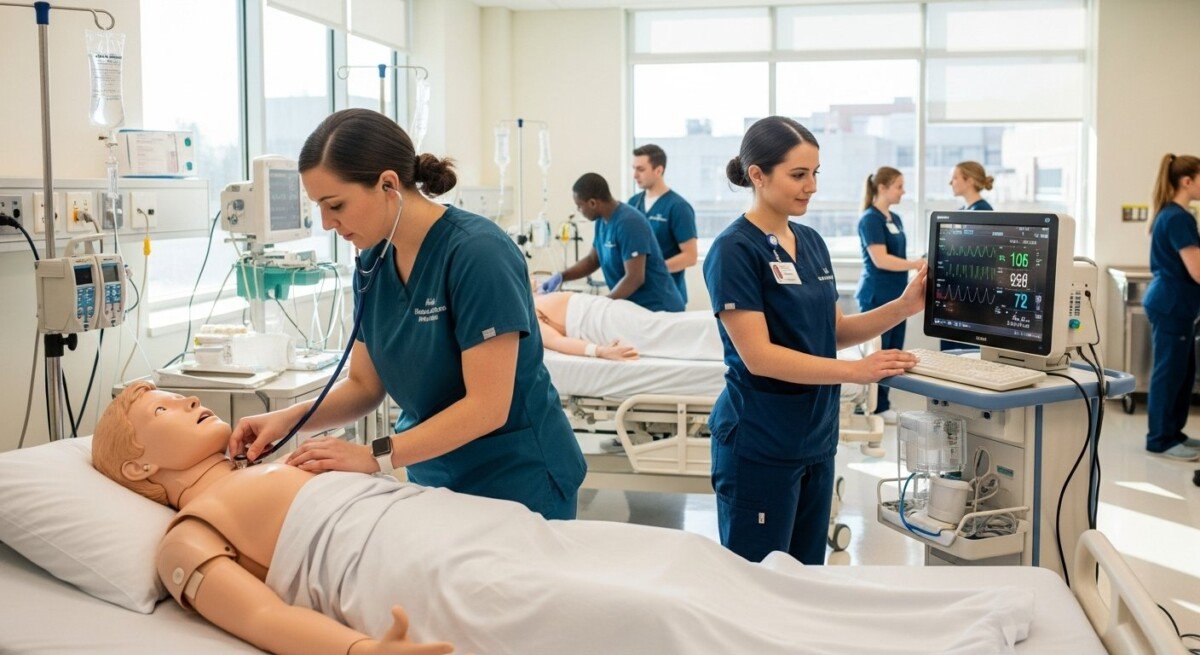
Earn Your Associate Degree in Nursing in Kansas
An Associate Degree in Nursing in Kansas provides a fast, affordable path to becoming a Registered Nurse, with high demand across the state’s healthcare facilities.

By Alex Jordan
For many aspiring healthcare professionals in the Sunflower State, the most direct and efficient path to becoming a Registered Nurse (RN) is through an Associate Degree in Nursing (ADN) program. These programs, offered at community colleges and technical schools across Kansas, provide a focused, practical education designed to prepare students for the NCLEX-RN licensure exam and a rewarding career at the bedside. With a strong emphasis on clinical skills and foundational nursing knowledge, an ADN can be completed in as little as two years, offering a faster entry into the high-demand nursing field compared to a four-year bachelor’s degree. This guide will explore the specifics of pursuing an associate degree in nursing in Kansas, from program selection and admission to licensure and career advancement.
Understanding the ADN Pathway in Kansas
The Associate of Applied Science (AAS) in Nursing or Associate Degree in Nursing (ADN) is a career-focused educational track. Kansas Board of Nursing-approved ADN programs blend classroom instruction in sciences and nursing theory with hands-on clinical rotations in hospital and community settings. This combination ensures graduates are “practice-ready” nurses. The curriculum is rigorous, covering subjects like anatomy, physiology, microbiology, pharmacology, adult health nursing, pediatric nursing, maternal-newborn nursing, and mental health nursing. Successful completion makes the graduate eligible to sit for the National Council Licensure Examination for Registered Nurses (NCLEX-RN), which is mandatory for practice in Kansas and all other states.
Choosing an ADN program in Kansas requires careful consideration of several factors. Prospective students should prioritize programs that hold full approval from the Kansas State Board of Nursing, as this is non-negotiable for licensure eligibility. Accreditation from a national body like the Accreditation Commission for Education in Nursing (ACEN) is also a strong indicator of program quality and can be important for future educational pursuits. Other practical considerations include program length (typically 4-5 semesters), schedule format (day, evening, or hybrid options), campus location, and the program’s historical NCLEX-RN pass rates, which are publicly reported by the Board of Nursing.
Admission Requirements and Program Costs
Admission to ADN programs in Kansas is competitive. While specific prerequisites vary by institution, most programs share a common set of baseline requirements designed to ensure student preparedness for a demanding course of study. Applicants typically must have a high school diploma or GED and must complete prerequisite college courses with a minimum grade point average, often a “C” or better.
Common prerequisites and requirements include:
- Completion of college-level anatomy & physiology, microbiology, and English composition.
- A minimum cumulative GPA on all college coursework, often between 2.5 and 3.0.
- Satisfactory scores on a pre-admission exam, such as the TEAS (Test of Essential Academic Skills).
- Current certification in Basic Life Support (BLS) for Healthcare Providers.
- Clearance of a criminal background check and drug screening.
- Submission of health records and immunizations.
The financial investment in an ADN is a key consideration. Tuition at Kansas community colleges is significantly lower than at four-year universities, making it a cost-effective pathway. However, students must budget for additional expenses like textbooks, uniforms, lab fees, testing fees, and clinical supplies. Total program costs can range from approximately $10,000 to $20,000 for in-state residents. Financial aid, including federal grants, student loans, and scholarships specifically for nursing students, is widely available. Many Kansas healthcare systems also offer tuition reimbursement or scholarship-for-service programs to attract future nurses. For comprehensive college degree guidance on navigating these financial options, prospective students should consult with program advisors.
Top ADN Programs and Kansas Institutions
Kansas is home to numerous high-quality ADN programs at public community colleges and private institutions. These programs are distributed across the state, providing access in both urban and rural areas. Some of the well-regarded public institutions include Johnson County Community College in Overland Park, which boasts a strong reputation and high NCLEX pass rates, and Hutchinson Community College, known for its comprehensive program. In the Wichita area, Wichita State University’s College of Applied Studies offers an ADN pathway, while Butler Community College serves the south-central region. In western Kansas, colleges like Dodge City Community College and Colby Community College provide critical nursing education to support rural healthcare needs.
When evaluating programs, students should look beyond just the name of the institution. It is crucial to examine recent NCLEX-RN first-time pass rates, which are a key metric of program effectiveness. A consistently high pass rate (well above the national average) suggests strong curriculum alignment and student preparation. Furthermore, students should investigate the program’s relationships with clinical sites. Diverse and high-quality clinical placements in medical-surgical units, pediatrics, obstetrics, and mental health facilities provide invaluable real-world experience. Speaking with current students and alumni can offer insights into faculty support, schedule flexibility, and overall student satisfaction.
Licensure and Career Outlook for Kansas ADN Graduates
Upon graduating from an approved ADN program, the next critical step is obtaining Kansas RN licensure. The process is administered by the Kansas State Board of Nursing (KSBN). Graduates must submit an application for licensure by examination, which includes providing official transcripts and passing a criminal background check. Once the application is approved, the graduate receives an Authorization to Test (ATT) and can schedule the NCLEX-RN exam. Passing this computer-adaptive exam grants the individual an RN license to practice in Kansas. The career outlook for RNs in Kansas is exceptionally strong, driven by an aging population, nurse retirements, and expanding healthcare services. The U.S. Bureau of Labor Statistics projects steady growth for RNs nationwide, and Kansas mirrors this demand, particularly in hospitals, long-term care facilities, and clinics in both metropolitan and rural areas.
ADN-prepared RNs in Kansas enjoy competitive starting salaries, though wages can vary based on geographic location, healthcare setting, and shift differentials. Entry-level RNs can expect salaries that provide a solid return on the educational investment. The ADN is not a dead-end degree, it is a launchpad. Many nurses begin their careers with an ADN to gain experience and income, then pursue an RN-to-BSN (Bachelor of Science in Nursing) completion program while working. Kansas has multiple online and part-time RN-to-BSN options designed for working nurses, often supported by employer tuition benefits. This seamless pathway allows nurses to advance their education, qualify for leadership roles, and meet the growing preference for BSN-prepared nurses in the workforce without interrupting their careers.
Frequently Asked Questions
Can I complete an ADN program in Kansas online?
While ADN programs require extensive hands-on clinical hours that must be completed in person, many programs offer hybrid formats. This means that some theoretical coursework can be completed online, providing flexibility for scheduling. However, the lab and clinical components are always in-person at approved healthcare facilities.
How long does it take to become an RN through an ADN program in Kansas?
A full-time student can typically complete an ADN program in four semesters (two academic years). This timeline assumes the student has already completed the necessary prerequisite courses before entering the nursing program core. Part-time options may extend the timeline to three or more years.
Is an ADN from Kansas recognized in other states?
Yes. Kansas is part of the Nurse Licensure Compact (NLC). This means that a nurse who holds a multistate license from Kansas (their primary state of residence) can practice physically or via telehealth in other NLC member states without obtaining additional licenses. It is crucial to check the current NLC status and rules on the KSBN website.
What is the main difference between an ADN and a BSN in Kansas?
Both degrees lead to RN licensure and prepare nurses for direct patient care. The ADN is a two-year degree focused intensely on clinical skills and foundational knowledge for bedside nursing. The BSN is a four-year degree that includes the same core nursing education but adds more coursework in leadership, community health, research, and public policy, preparing nurses for a wider scope of practice and advancement.
What are the biggest challenges in an ADN program?
Students commonly cite the intensity and volume of the coursework, the need for excellent time management to balance theory, lab, and clinical hours, and the emotional demands of clinical rotations. Success requires dedication, strong study habits, and a reliable support system. The process in other states shares similar challenges, as detailed in our guide on how to become an RN in Nevada through an ADN program.
Pursuing an associate degree in nursing in Kansas represents a strategic and achievable goal for dedicated individuals seeking a stable, impactful career in healthcare. By carefully researching approved programs, understanding the financial and time commitments, and preparing thoroughly for the rigors of nursing school, students can position themselves for success. The journey from prospective student to licensed RN demands perseverance, but the reward, a profession dedicated to caring for others, is immense. With Kansas facing a consistent need for skilled nurses, there has never been a better time to embark on this educational path and join the frontline of patient care.