
Dental Hygiene Programs: Your Guide to Degrees and Careers
A dental hygiene program provides the degree and clinical training required for a stable, in-demand healthcare career. Learn what these programs entail and how they lead to licensure.

By Janet Wilson
Imagine a career where you are a vital part of a healthcare team, directly improving patients’ health and confidence, with strong job security and the potential for a flexible schedule. This is the reality for dental hygienists, professionals whose journey begins with a specialized educational path. Understanding what a dental hygiene program and degree entails is the crucial first step for anyone considering this rewarding field. It’s more than just learning to clean teeth, it’s a comprehensive education in oral health science, patient care, and clinical practice that opens the door to a stable and fulfilling profession.
The Core of Dental Hygiene Education
A dental hygiene program is a post-secondary educational course of study designed to prepare students to become licensed dental hygienists. These programs, offered at community colleges, technical schools, and universities, combine rigorous academic coursework in the sciences with extensive hands-on clinical training. The goal is to equip graduates with the knowledge, skills, and clinical judgment required to perform preventive oral care, assess patient health, and educate the public, all under the supervision of a dentist. The degree you earn, typically an Associate of Applied Science (AAS) in Dental Hygiene, is the minimum educational requirement to sit for national and regional board exams to obtain licensure.
The curriculum is intentionally demanding, reflecting the significant responsibility hygienists hold in patient care. Students dive deep into subjects like anatomy and physiology, pharmacology, radiography, periodontology (the study of gum disease), and dental materials. This scientific foundation is essential for understanding the ‘why’ behind clinical procedures. For instance, a hygienist must know how systemic conditions like diabetes can manifest in the mouth, or how certain medications affect oral tissues. This integrated knowledge allows for more than just procedural competence, it enables critical thinking and comprehensive patient assessment.
Types of Dental Hygiene Degrees and Programs
Prospective students have several educational pathways to choose from, each with different time commitments and career implications. The most common entry point into the profession is the Associate Degree in Dental Hygiene. This is typically a two-year, full-time program (following completion of prerequisite courses) that provides the essential education and clinical hours needed for licensure. It is the most direct and cost-effective route to entering the workforce and is offered by countless community colleges and dental hygiene schools nationwide.
For those seeking advanced opportunities, a Bachelor of Science (BS) in Dental Hygiene is a four-year degree. This path may be chosen from the outset or pursued by associate degree holders looking to advance. A bachelor’s degree opens doors to roles in public health, education, research, or corporate sales for dental product companies. Some states are also exploring or have implemented requirements for a bachelor’s degree for certain expanded functions or advanced practice licensure. Finally, Master’s Degree programs in Dental Hygiene are available for those aiming for leadership positions in education, administration, or public health policy. These programs focus on advanced theory, research methods, and educational pedagogy.
When researching dental hygienist programs, you will also encounter different learning formats. Traditional on-campus programs provide the classic college experience with direct access to labs and clinics. However, the landscape of education is evolving. Many schools now offer hybrid or blended programs, where didactic coursework is completed online, but all clinical and lab components are performed in person at an approved facility. This flexibility can be invaluable for adult learners or those balancing other commitments. It’s important to note that while you can explore college degree programs online, the clinical component of dental hygiene education is irreplaceable and must be completed in person under direct supervision.
Key Components of a Quality Dental Hygiene Program
Not all dental hygiene schools are created equal. Accreditation is the single most critical factor to consider. A program must be accredited by the Commission on Dental Accreditation (CODA) for its graduates to be eligible to take the National Board Dental Hygiene Examination, a universal step for licensure. Attending a non-accredited program is a dead end for your career. Beyond accreditation, look for programs with a strong reputation, experienced faculty who are still clinically active, and modern facilities. Up-to-date simulation labs, digital radiography equipment, and electronic health record systems mirror the real-world clinical environment you will enter.
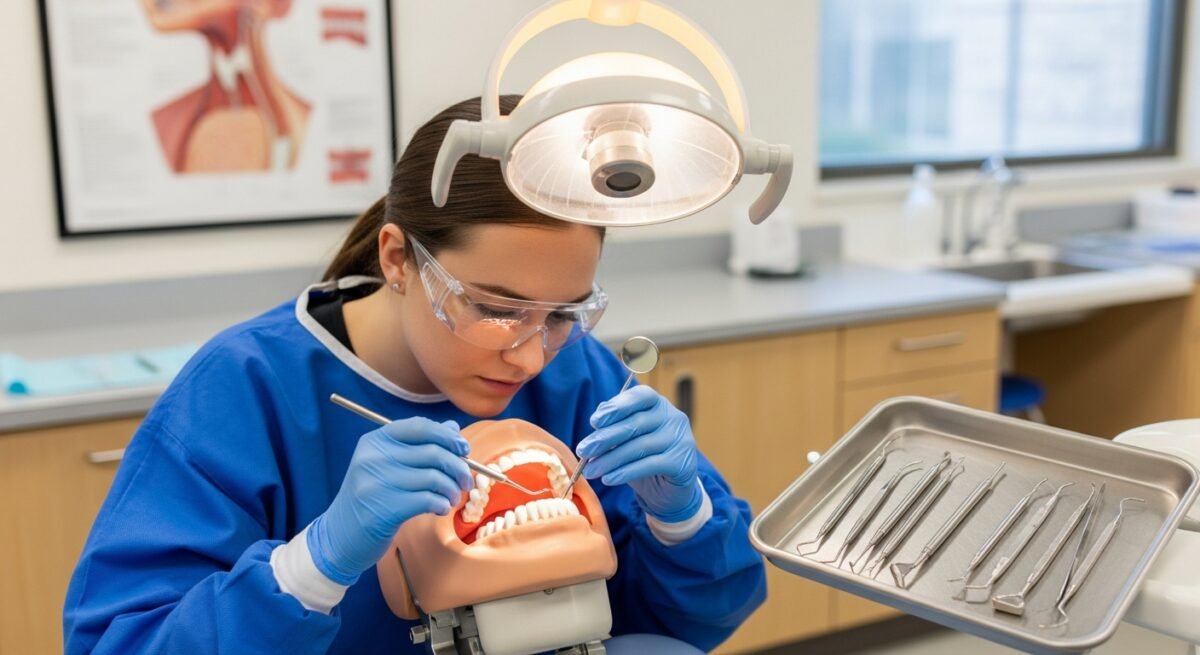
The clinical experience is the heart of the program. A quality curriculum will provide a high number of direct patient care hours in a variety of settings. This often begins with peer practice in pre-clinical labs before advancing to treating patients in an on-campus clinic. Many programs also include valuable externships or rotations in public health clinics, hospitals, or private practices, exposing students to diverse patient populations and specialized care. The goal is to graduate a competent, confident clinician ready for the challenges of a busy dental office.
Here are the essential elements to verify when evaluating any dental hygiene program:
- CODA Accreditation: Non-negotiable for licensure eligibility.
- High National Board Pass Rates: Indicates effective curriculum and preparation.
- Strong Clinical Hour Requirements: Look for programs exceeding the minimum standards.
- Experienced Faculty: Instructors with current clinical experience provide relevant insights.
- Modern Facilities and Technology: Ensures training on equipment used in today’s practices.
The Career Path After Graduation
Upon successful completion of an accredited dental hygiene program and degree, graduates are not yet ready to practice. They must pass a series of examinations to become licensed in their state. This process almost always includes the National Board Dental Hygiene Examination (a written test) and a state or regional clinical board examination, such as the Central Regional Dental Testing Service (CRDTS) or the Western Regional Examining Board (WREB). These clinical exams test competency on live patients or simulated environments. Additionally, most states require a jurisprudence exam covering state dental laws and regulations.
Once licensed, the primary and most common work setting is a private dental practice. Here, hygienists perform core duties like periodontal charting, taking radiographs (x-rays), applying preventive materials like sealants and fluoride, and providing thorough patient education on oral hygiene techniques. The role is highly collaborative, working directly with dentists and dental assistants. However, career opportunities extend far beyond the general practice. Hygienists can work in public health settings, school systems, corporate wellness programs, or for insurance companies. Some specialize in areas like periodontics (gum disease treatment) or pediatrics. Others with bachelor’s or master’s degrees may move into education, teaching the next generation of hygienists, much like educators in other specialized health fields, such as those detailed in our guide on how to become a radiation therapist.
The career outlook for dental hygienists remains exceptionally strong. The U.S. Bureau of Labor Statistics consistently projects much faster-than-average growth, driven by an aging population retaining more natural teeth and ongoing research linking oral health to overall systemic health. This increasing awareness expands the preventive role of the hygienist. Furthermore, many hygienists enjoy flexible work schedules, including part-time opportunities, which can be ideal for achieving work-life balance.
Frequently Asked Questions
How long does it take to become a dental hygienist?
The fastest path is a two-year associate degree program, but this often requires 1-2 years of prerequisite college courses in biology, chemistry, and anatomy beforehand. Therefore, the total time from starting college to licensure is typically 3-4 years for an associate degree and 4-5 years for a bachelor’s degree.
Is dental hygiene school difficult to get into?
Yes, accredited dental hygienist programs are highly competitive. They often have rigorous prerequisite course requirements (with minimum GPA standards), and may require scores from tests like the Test of Essential Academic Skills (TEAS). Many programs use a selective admissions process that evaluates academic history, interviews, and observation hours in a dental setting.
What is the cost of a dental hygiene program?
Costs vary widely. Public community college associate degree programs offer the most affordable route, often costing between $15,000 and $30,000 for the entire program. Bachelor’s degrees at public universities are more expensive, and private institutions can cost significantly more. Financial aid, scholarships, and grants are widely available.
Can I complete a dental hygiene degree entirely online?
No. Due to the extensive hands-on clinical and laboratory requirements, no program can be completed 100% online. However, many schools offer hybrid formats where the lecture-based theoretical coursework is delivered online, while all clinical and lab components are completed in person at designated times and locations.
What is the difference between a dental assistant and a dental hygienist?
The roles are distinct. Dental assistants primarily aid the dentist during procedures, sterilize instruments, take impressions, and handle office tasks. Their education is shorter, often a 9-12 month certificate program. Dental hygienists perform more advanced, independent clinical procedures focused on preventive care and patient education, requiring a longer, more in-depth degree and a separate license.
Embarking on a dental hygiene program is a commitment to a challenging yet immensely rewarding educational journey. It is a path that leads to a career defined by autonomy, patient interaction, and continuous learning. By thoroughly researching accredited dental hygiene schools, understanding the degree requirements, and preparing for the rigors of the curriculum, you lay a solid foundation for a profession that plays a critical role in healthcare. The demand for skilled, compassionate dental hygienists ensures that this investment in your education is one that pays dividends in job satisfaction and stability for years to come.