
Dallas College CNA Certificate: 1-Year Patient Care Path
The Dallas College patient care certificate trains you for CNA and PCT roles in under two years. Call 8772187081 for program guidance.

By Mia Roberts
Launching a healthcare career does not always require a four-year degree. For thousands of students across North Texas, the fastest route to patient-facing work runs through the Nursing Assistant/Aide and Patient Care Assistant/Aide Certificate, 1 year to less than 2 years In-person at Dallas College. This program sits at the intersection of affordability, hands-on training, and real demand: hospitals, nursing homes, assisted living communities, and home health agencies across the Dallas-Fort Worth metroplex hire entry-level patient care staff continuously, and they prioritize candidates who have completed a formal, accredited certificate rather than informal on-the-job training alone. If you are a career changer, a recent high school graduate, a veteran, or a parent re-entering the workforce, this pathway deserves a serious look.
What makes this certificate distinctive is its structure. It is not a weekend crash course or a purely online theory program. It is an in-person, multi-term credential delivered through one of the largest community college systems in Texas, with clinical rotations embedded in the curriculum. That combination matters because employers and state regulators both expect verified hands-on competency before a graduate can sit for the Texas Nurse Aide Competency Exam and appear on the state registry. Below, we break down what the program covers, what it costs, how admission works, and how the credential fits into longer-term career moves such as an associate degree in nursing.
Why Patient Care Certificates Are in Demand Across Texas
Texas has one of the fastest-growing populations in the country, and its healthcare infrastructure is expanding to match. Skilled nursing facilities, rehabilitation centers, memory care units, and hospital med-surg floors all rely on nursing assistants and patient care technicians to handle the daily essentials: bathing, dressing, feeding, mobility support, vital sign monitoring, and documentation. These roles free up registered nurses to focus on assessment, medication administration, and care planning, which is why facilities treat aides as core staff rather than extras.
Demand is also shaped by demographics. As the baby boomer generation ages, the number of Texans needing long-term care rises every year, and workforce shortages in nursing have pushed health systems to build stronger pipelines of support personnel. A certificate that can be completed in under two years, with a clinical component, positions graduates to enter that pipeline quickly rather than waiting through a lengthy degree program.
There is a second layer of value here: the certificate is stackable. Many graduates work as aides while pursuing further credentials, and a common next step is an associate degree in nursing, which opens the door to registered nurse licensure. Starting with a patient care certificate lets you earn while you learn, which reduces the debt burden of the longer degree.
What the Certificate Program Covers
The Nursing Assistant/Aide and Patient Care Assistant/Aide Certificate at Dallas College is designed to move students from foundational knowledge to supervised clinical practice in a structured sequence. Coursework typically blends classroom instruction, laboratory skills practice, and off-site clinical hours at partner facilities. Students learn infection control, patient rights, safety and emergency procedures, communication techniques, nutrition and hydration support, and the proper use of equipment such as gait belts, mechanical lifts, and blood pressure cuffs.
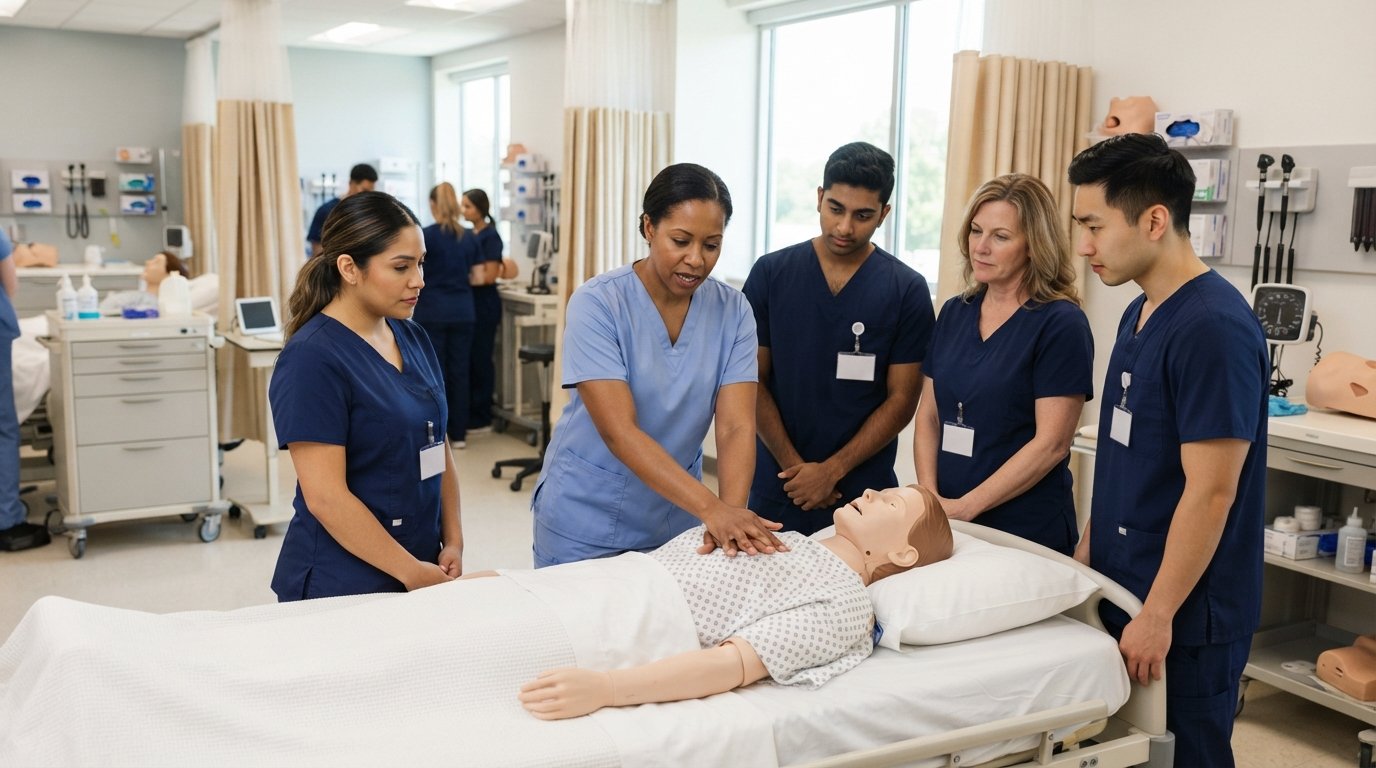
Because the program is delivered in person, students get repeated chances to practice skills with instructor feedback before they ever touch a real patient. That repetition is what separates a competent aide from someone who has only read about the tasks. Lab sessions also build the professional habits employers look for: punctuality, teamwork, patient confidentiality, and clear handoff communication at shift change.
Clinical rotations are where the classroom becomes real. Under supervision, students work alongside licensed staff in settings such as nursing homes, rehabilitation units, or hospital floors, performing the same duties they will perform after graduation. This is also where many students secure their first job offer, since clinical sites frequently hire from their own rotation pools.
Core Skills You Will Practice
While exact course titles vary by term, the skill set covered in a patient care assistant certificate program generally includes the following competencies, each of which appears on the state competency exam:
- Personal care tasks such as bathing, grooming, oral hygiene, and toileting assistance
- Mobility support including transfers, ambulation, range-of-motion exercises, and fall prevention
- Vital sign measurement and basic documentation in patient charts
- Infection prevention, hand hygiene protocols, and proper use of personal protective equipment
- Observation and reporting of changes in a patient's condition to supervising nurses
Each of these areas is tested both in the written portion of the certification exam and in the skills demonstration portion, so students should expect to practice them repeatedly during lab and clinical sessions. Instructors typically provide checklists that mirror the exam scoring criteria, which makes preparation more predictable.
Admission Requirements and How to Enroll
Community college certificate programs tend to have accessible entry requirements, but there are still steps that trip up unprepared applicants. At Dallas College, prospective students generally need to complete the college application, submit proof of high school graduation or equivalent, and complete any required placement or readiness assessments. Some healthcare programs also require a background check, immunizations, and a drug screen before clinical placement, since partner facilities set their own compliance standards.
Because the program is in person, scheduling matters. Students should review the academic calendar carefully and plan for daytime or evening lab sessions depending on the campus offering. Financial aid, workforce grants, and employer tuition assistance can often be applied, and advisors can help map out a term-by-term plan that fits around work or family obligations.
The enrollment sequence usually looks like this:
- Submit the college application and any required transcripts or test scores
- Meet with a health sciences advisor to confirm program eligibility and term start dates
- Complete background check, immunization, and health screening requirements
- Register for the first-term courses and attend orientation
- Begin classroom and lab instruction, then transition into supervised clinical hours
Following this order reduces the risk of last-minute delays, which are common when students leave compliance paperwork until the week before clinicals begin. Advisors at the college can clarify which documents are needed and when they expire, since some immunizations require a full series that takes weeks to complete.
Cost, Financial Aid, and Return on Investment
One of the strongest arguments for a community college certificate is cost. Compared with private vocational schools, public college tuition for a one-year to under-two-year certificate is typically far lower, and Dallas College students may qualify for federal Pell Grants, Texas workforce grants, and institutional scholarships. For veterans, VA education benefits can often be applied to approved certificate programs, and working adults should ask their employer about tuition reimbursement, which many healthcare employers offer for patient care staff.
The return on investment calculation is straightforward: a short, low-cost credential that qualifies you for entry-level positions with benefits, shift differentials, and overtime potential. Many aides use the income from their first job to fund the next step in their education, whether that is a patient care technician specialization, a licensed vocational nursing program, or an RN associate degree. Because the certificate is stackable, none of the coursework is wasted.
Prospective students who want to compare costs across multiple schools and program formats can use a degree matching service to see sponsored programs side by side, review financial aid options, and request information without obligation. Platforms like CollegeDegrees.School help students filter by academic level, field of study, and delivery format, which is useful when you are weighing an in-person certificate against a hybrid or fully online alternative in a different city.
Career Outcomes After Earning the Certificate
Graduates of patient care certificate programs typically pursue roles with titles such as certified nursing assistant (CNA), patient care technician (PCT), nurse aide, or home health aide. Work settings include skilled nursing facilities, hospitals, assisted living communities, rehabilitation centers, hospice organizations, and private home care agencies. Many of these employers offer flexible scheduling, including 12-hour shifts and weekend options, which appeals to students who are continuing their education.
Advancement within the field is realistic. Experienced aides can move into team lead or unit clerk roles, specialize in areas such as dialysis, behavioral health, or pediatrics, or use the credential as a stepping stone into nursing, respiratory therapy, or medical assisting. Some pursue additional certifications, such as medication aide or EKG technician, that increase earning potential without requiring a full degree.
It is worth noting that certification and registry requirements vary by state. In Texas, nurse aides must complete an approved training program, pass the competency exam, and maintain active registry status, which includes periodic renewals and in-service training hours. Students should confirm current requirements with their program advisor and the state licensing body before relying on any single source of information.
How to Strengthen Your Application and Job Search
Even before graduation, students can take steps that improve their odds of landing a strong first position. Building relationships during clinical rotations is the single most effective strategy, since supervising nurses often recommend strong performers to hiring managers. Beyond that, keeping a clean record, maintaining perfect attendance during clinicals, and earning CPR certification early can set a candidate apart.
During the job search, focus on facilities that offer orientation programs, mentorship, and tuition assistance. Ask about patient ratios, shift differentials, and opportunities to cross-train into specialty units. A first job is not just a paycheck; it is a platform for the next credential, so choose an employer that supports your long-term goals.
Is This Pathway Right for You?
The Nursing Assistant/Aide and Patient Care Assistant/Aide Certificate, 1 year to less than 2 years In-person at Dallas College is a practical fit for anyone who wants to enter healthcare quickly, values hands-on training over purely theoretical coursework, and prefers a public college price point over a private school tuition bill. It is also a smart choice for students who intend to continue into nursing or another allied health field, because it generates income and clinical experience while you prepare for the next step.
Before committing, visit the campus, speak with an advisor, and confirm the clinical site schedule against your other responsibilities. Ask about exam pass rates, job placement support, and articulation agreements with four-year institutions if you plan to continue your education. With clear expectations and a realistic plan, this certificate can be the first rung of a stable, meaningful healthcare career in one of the fastest-growing regions in the country.