
Cox College Medical Assistant Associate's Degree Guide
Earn your Medical/Clinical Assistant Associate's degree in about 2 years with a mix of in-person and online classes at Cox College Of Nursinghealth Sciences. Gain skills for a growing healthcare career.

By Lucas Lucas
Choosing a healthcare career path that balances quick entry into the workforce with meaningful patient interaction leads many students to the medical assisting field. Among the standout options in the Midwest, the Medical/Clinical Assistant Associate's degree, usually 2 years Mix of in-person and online at Cox College Of Nursinghealth Sciences offers a structured, accredited route to a stable and in-demand profession. This program blends the clinical skills employers expect with the flexibility working adults need, making it a compelling choice for anyone ready to step into healthcare without committing to a four-year degree.
Why the Cox College Medical Assisting Program Stands Out
Cox College of Nursing and Health Sciences, located in Springfield, Missouri, has built a reputation for producing job-ready healthcare professionals. Its Medical/Clinical Assistant Associate's degree, usually 2 years Mix of in-person and online at Cox College Of Nursinghealth Sciences, is designed to prepare students for both administrative and clinical roles in physicians' offices, clinics, hospitals, and other healthcare settings. The program's hybrid format allows students to complete coursework online while attending hands-on labs and clinical rotations in person, a combination that mirrors the realities of modern healthcare education.
What makes this program particularly attractive is its alignment with employer expectations. Graduates are trained in everything from taking vital signs and drawing blood to managing electronic health records and scheduling appointments. The curriculum also covers medical law and ethics, pharmacology, and patient communication, ensuring that students leave with a well-rounded skill set. Because Cox College is affiliated with CoxHealth, one of the region's largest healthcare systems, students often benefit from clinical placements within that network, gaining real-world experience that can translate directly into job offers after graduation.
Accreditation is another critical factor. Cox College's medical assisting program holds accreditation from the Commission on Accreditation of Allied Health Education Programs (CAAHEP), which means graduates are eligible to sit for national certification exams such as the Certified Medical Assistant (CMA) credential. That certification can significantly boost employability and earning potential. If you are exploring fast-track options as well, our guide on accelerated Medical Assistant programs explained can help you compare timelines and decide what fits your schedule.
Program Format: Blending Online Flexibility with In-Person Training
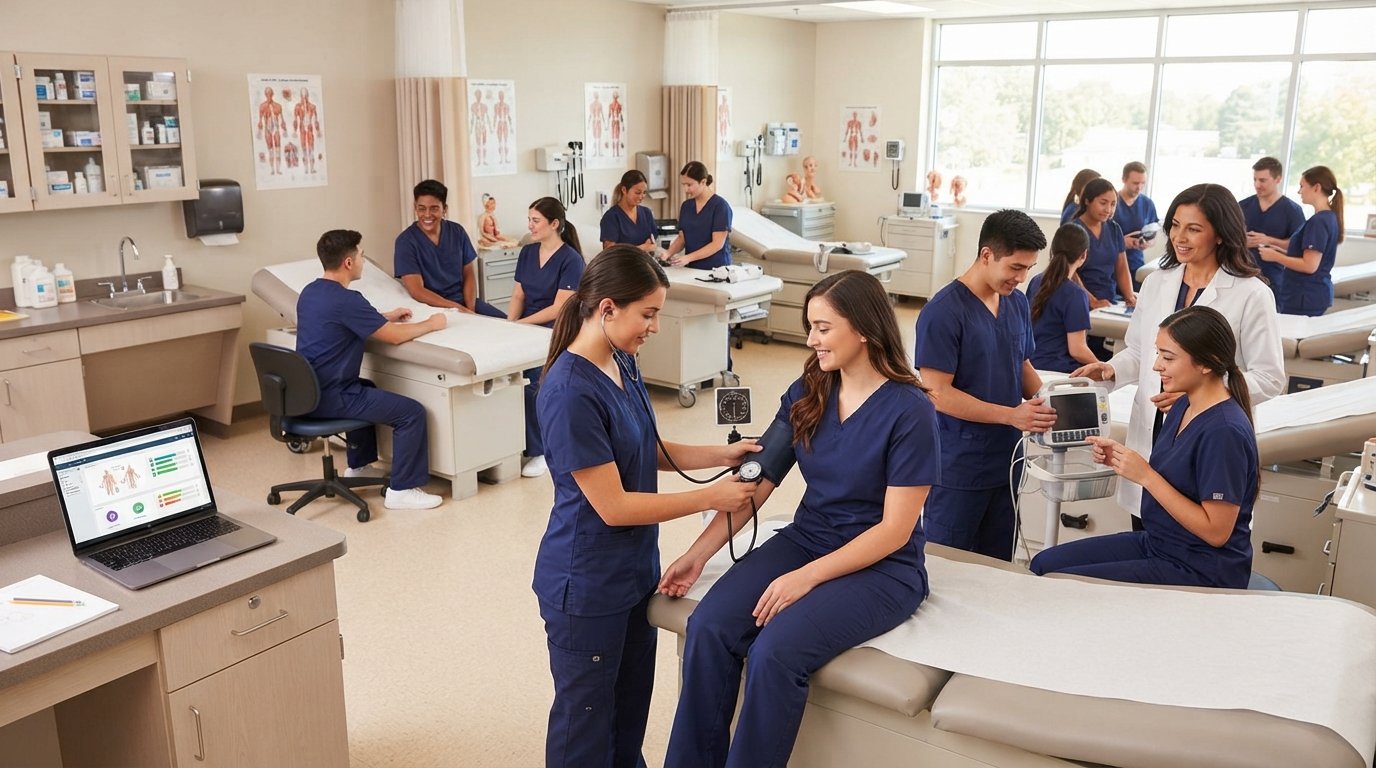
The hybrid structure of the Medical/Clinical Assistant Associate's degree, usually 2 years Mix of in-person and online at Cox College Of Nursinghealth Sciences is one of its most practical features. Online courses cover theoretical material such as anatomy, physiology, medical terminology, and insurance billing. These can often be completed at times that fit around work or family obligations. In-person sessions, meanwhile, focus on hands-on skills: injections, venipuncture, EKG administration, and patient preparation. Clinical rotations typically take place in actual healthcare facilities, giving students supervised experience with real patients.
This mix is not just a convenience; it is a pedagogical choice. Research in allied health education consistently shows that blended learning improves both knowledge retention and clinical competence. Students who learn theory online and then practice in person tend to perform better on certification exams and adapt more quickly to the workplace. For working adults, the format also reduces the number of trips to campus, which can lower transportation costs and ease scheduling conflicts.
Prospective students should be aware that the program requires a certain number of on-campus or clinical hours, so it is not a fully online degree. That is an important distinction for anyone comparing programs. A fully online medical assisting program may lack the hands-on rigor that employers and accreditors expect. The Cox College model ensures that graduates are not just book-smart but also practice-ready.
Admission Requirements and Application Steps
Getting into the program involves a straightforward but structured process. Applicants typically need a high school diploma or GED, and some may need to complete prerequisite courses in math, English, and biology. Because healthcare programs often have limited seats, meeting the minimum requirements does not guarantee admission; early application is strongly advised.
Here is a general overview of the steps involved:
- Submit an online application to Cox College and pay any required application fee.
- Provide official high school and college transcripts.
- Complete any prerequisite coursework with a satisfactory grade.
- Attend an information session or interview if requested.
- Submit proof of immunizations and complete a background check before clinical placements.
Each of these steps is designed to ensure that students are prepared for the demands of healthcare education and clinical work. Background checks and immunization records are standard across accredited programs because patients' safety is paramount. Once accepted, students can often begin coursework in the fall, spring, or summer, depending on cohort availability.
Curriculum and Skills You Will Gain
The curriculum for the Medical/Clinical Assistant Associate's degree, usually 2 years Mix of in-person and online at Cox College Of Nursinghealth Sciences covers a broad range of competencies. On the administrative side, students learn medical coding, billing, electronic health records, and front-office management. On the clinical side, they study anatomy, medical terminology, pharmacology, and clinical procedures. Courses in professionalism and communication help students navigate the interpersonal demands of healthcare, from calming anxious patients to coordinating with physicians and nurses.
By the end of the program, graduates should be able to perform the following tasks, among others:
- Record patient histories and vital signs accurately.
- Assist physicians during exams and minor procedures.
- Perform venipuncture, EKGs, and basic laboratory tests.
- Manage patient scheduling, billing, and insurance claims.
- Maintain electronic health records in compliance with privacy laws.
These skills are not just boxes to check; they are the daily responsibilities of medical assistants in clinics and hospitals across the country. Employers value graduates who can step in without extensive on-the-job training, and Cox College's emphasis on hands-on practice helps ensure that outcome.
Career Outcomes and Certification
Graduates of the program are prepared for roles such as clinical medical assistant, administrative medical assistant, podiatric medical assistant, and optometric assistant. According to the U.S. Bureau of Labor Statistics, employment of medical assistants is projected to grow much faster than the average for all occupations over the next decade, driven by an aging population and the increasing use of preventive care. That growth translates into strong job security and opportunities for advancement.
Certification is a key differentiator. While not always required by law, the Certified Medical Assistant (CMA) or Registered Medical Assistant (RMA) credential signals to employers that a candidate has met rigorous standards. Cox College's accredited program qualifies graduates to sit for these exams. Many employers offer higher starting pay to certified assistants, and certification can also open doors to specialized roles in cardiology, dermatology, or pediatrics.
For those who want to explore a broader range of degree options or compare programs across different schools, resources like CollegeDegrees.School provide useful directories and guides. These tools can help you weigh factors such as cost, location, and program length before making a decision.
Cost, Financial Aid, and Return on Investment
Tuition for the Medical/Clinical Assistant Associate's degree at Cox College is competitive with other accredited programs in the region, and financial aid is available for eligible students. Prospective students should complete the Free Application for Federal Student Aid (FAFSA) to determine eligibility for grants, loans, and work-study opportunities. Cox College also offers institutional scholarships and payment plans that can ease the financial burden.
When evaluating return on investment, consider both the cost of the program and the earning potential after graduation. Medical assistants in Missouri earn a median annual wage that is above the national average for the field, and certified assistants often earn more. Because the program takes about two years to complete, graduates can enter the workforce relatively quickly and begin recouping their educational investment. Many students also work part-time while enrolled, thanks to the flexible online component.
It is also worth noting that some employers offer tuition reimbursement or partnership discounts for employees who pursue healthcare degrees. If you are already working in a related role, such as a medical receptionist or nursing assistant, check with your employer about educational benefits before assuming you will pay full price.
Is This Program Right for You?
The Medical/Clinical Assistant Associate's degree, usually 2 years Mix of in-person and online at Cox College Of Nursinghealth Sciences is a strong fit for individuals who want a hands-on healthcare career without the time and expense of a bachelor's degree. It suits career changers, recent high school graduates, and working adults who need flexibility. If you thrive in fast-paced environments, enjoy interacting with patients, and are comfortable with both technology and direct care, this path could be an excellent match.
Before enrolling, consider your learning style and logistical constraints. The hybrid format requires some in-person attendance, so you will need reliable transportation and a schedule that accommodates clinical rotations. If you prefer a fully online program, you may need to look elsewhere, but be aware that fully online medical assisting programs may not meet certification eligibility requirements in all states. The Cox College program's blended approach is designed to satisfy both educational standards and employer expectations.
Finally, think about your long-term goals. Some medical assistants eventually pursue further education to become registered nurses, physician assistants, or healthcare administrators. The associate's degree provides a solid foundation for those pathways, and the clinical experience you gain can strengthen your application to advanced programs. Whether you see medical assisting as a lifelong career or a stepping stone, the skills and credentials you earn at Cox College can serve you well.
Taking the first step toward a healthcare career can feel daunting, but programs like the one at Cox College are designed to make the journey manageable. With a mix of online coursework, in-person training, and clinical placements, you can gain the skills employers need while balancing the rest of your life. If you are ready to explore your options, request information from Cox College or use a matching service to compare similar programs in your area.