
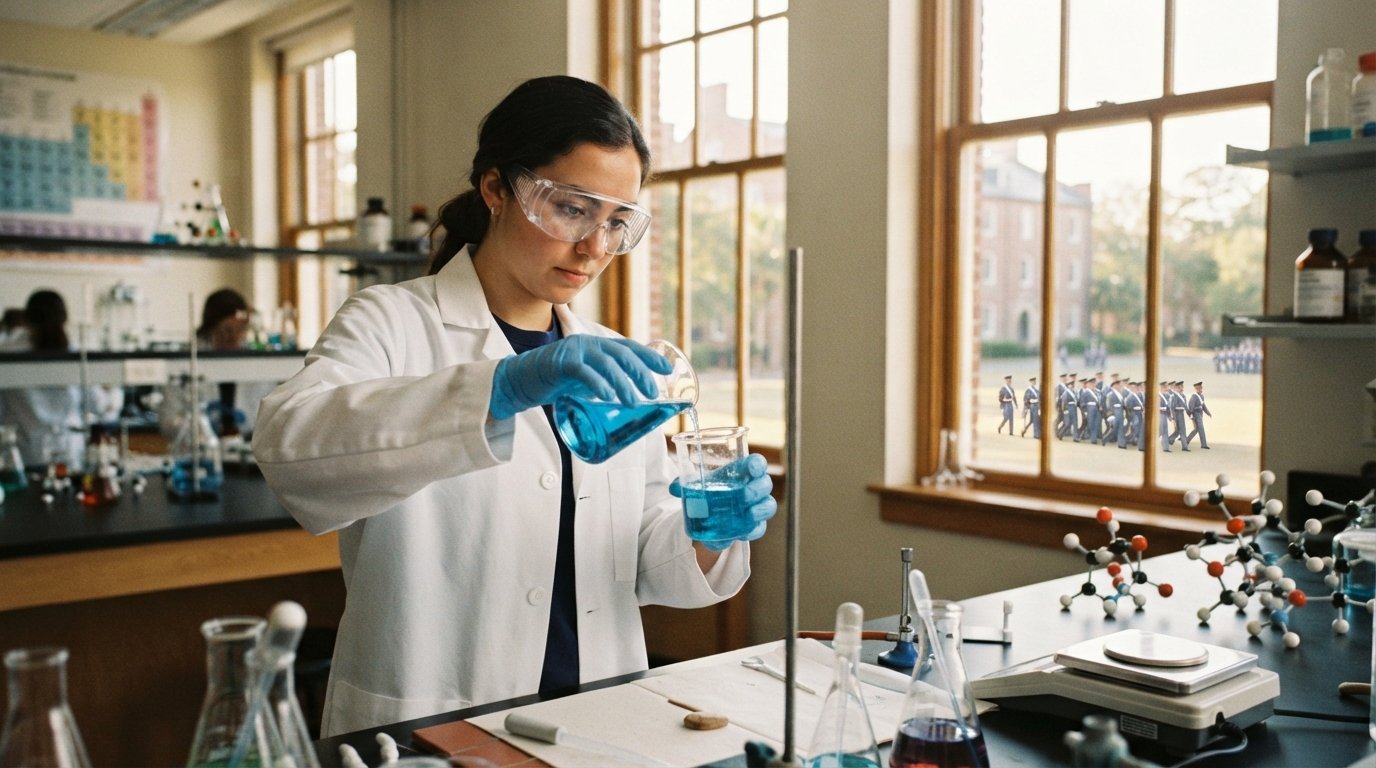
Citadel Chemistry Degree: 4-Year In-Person Program
Explore the Chemistry, General Bachelor's degree, usually 4 years In-person at Citadel Military College of South Carolina. Call 8772187081 for guidance.

By Lucas Martin
Choosing a chemistry major means stepping into a field that touches nearly every part of modern life, from the medicines that keep people healthy to the materials that build safer cars and cleaner energy systems. For students who want that scientific foundation paired with a structured, disciplined campus environment, the Chemistry, General Bachelor's degree, usually 4 years In-person at Citadel Military College of South Carolina stands out as a distinctive option. The Citadel, located in Charleston, South Carolina, is one of the nation's few senior military colleges, and its residential undergraduate experience blends rigorous academics with a leadership-focused culture that few traditional campuses can match.
This article explains what the general chemistry degree involves, how the Citadel's in-person format shapes the student experience, what courses and skills you can expect, and how the program connects to careers, graduate school, and professional paths. It also covers admissions, costs, and the kind of student who thrives in this setting. If you are comparing chemistry programs and want to understand whether a military college environment is right for you, this guide gives you the detail you need to make a confident decision.
Why the Citadel's Chemistry Program Deserves a Closer Look
The Citadel has been educating students in Charleston since 1842, and its reputation rests on a combination of academic rigor, small class sizes, and a cadet lifestyle built around accountability. The Chemistry, General Bachelor's degree, usually 4 years In-person at Citadel Military College of South Carolina fits that mold: it is a full-time, face-to-face program completed over four years, with students living and learning inside a structured corps environment. For learners who want more than a commuter experience, the residential model offers built-in mentorship, study discipline, and a tight-knit peer network.
Chemistry at The Citadel is housed within the Department of Chemistry, which offers both a general chemistry track and a certified track approved by the American Chemical Society (ACS). The general track provides a broad foundation across the major subfields of chemistry, while the ACS-certified option adds depth for students aiming at graduate study or industry research roles. Both paths include substantial laboratory work, which is one of the strongest selling points of an in-person chemistry degree: you spend real time at the bench, not just watching simulations.
The military college setting also creates conditions that support STEM success. Cadets follow a daily structure, wear uniforms, and participate in leadership training alongside their coursework. That rhythm can be a major advantage for students who benefit from accountability. At the same time, the academic program itself is civilian in content and rigor; the chemistry faculty hold doctorates and conduct research, and graduates move into the same careers as chemistry majors from any strong liberal arts or technical college.
What the General Chemistry Curriculum Covers
A general chemistry bachelor's degree is designed to give you breadth first and specialization second. In the first two years, you build a foundation in the core areas that every chemist needs: general chemistry, organic chemistry, analytical chemistry, physical chemistry, and calculus-based mathematics. By junior and senior year, you add advanced coursework, electives, and a capstone or research experience. The Citadel's four-year, in-person structure makes it possible to sequence laboratory courses carefully, so you develop hands-on skills progressively rather than in isolated bursts.
Typical coursework in this program includes general chemistry with lab, organic chemistry with lab, quantitative analysis, instrumental analysis, physical chemistry, inorganic chemistry, biochemistry, and calculus through at least the second level, plus physics. Students also take general education courses in the humanities, social sciences, and communication, which round out the degree and sharpen writing and speaking skills that employers value. Because the program is completed in person, lab time is scheduled regularly, and students often work in small teams, mirroring how chemistry is practiced in industry and research settings.
Beyond the classroom, the degree emphasizes transferable skills that apply far beyond the lab bench. These include:
- Experimental design and data analysis using modern instrumentation
- Technical writing and documentation for lab reports and research papers
- Problem-solving under time pressure, a direct benefit of the cadet schedule
- Team collaboration and leadership developed through corps activities
- Safety protocols and responsible chemical handling, essential in any lab career
These competencies matter because employers in pharmaceuticals, materials science, environmental testing, and government labs consistently report that they want graduates who can both run experiments and communicate results clearly. A four-year in-person program with a strong lab component is well positioned to deliver exactly that combination. If you are also exploring engineering-adjacent fields, our guide on what a civil engineering bachelor's degree involves offers a useful comparison for how technical programs differ in structure and career focus.
The In-Person Advantage at a Military College
Online chemistry degrees exist, but they are rare at the bachelor's level for a simple reason: chemistry is a laboratory science. You cannot fully learn titration, spectroscopy, or synthesis through a screen. The Chemistry, General Bachelor's degree, usually 4 years In-person at Citadel Military College of South Carolina solves that problem by design. Students get consistent access to labs, instrumentation, faculty office hours, and research mentors, all of which are harder to replicate in a remote format.
The in-person format also builds professional habits. At The Citadel, cadets manage early mornings, physical training, inspections, and a full academic load. That combination forces time management and resilience, traits that translate directly into graduate school and workplace success. Faculty members see students daily, which means struggling students get noticed and helped quickly rather than fading into the background of an online discussion board.
Another advantage is the alumni network. The Citadel's graduates are known for loyalty and mutual support, and that network extends into science, engineering, medicine, and the military. A chemistry graduate can tap into this community when applying to graduate programs, seeking internships, or changing careers later. For students who value structure, mentorship, and a sense of belonging, the residential military college model can be far more motivating than a flexible but impersonal online program.
Admissions, Costs, and Financial Aid
Admission to The Citadel is competitive but not out of reach for a motivated student. Applicants typically submit high school transcripts, standardized test scores (though policies can change, so confirm current requirements), and evidence of character and leadership. Because the college is military in structure, physical fitness and conduct standards apply to cadets. Prospective chemistry majors should have a strong background in math and science, ideally including pre-calculus or calculus, chemistry, and physics in high school.
Cost is a major consideration for any four-year residential program. The Citadel publishes tuition, fees, room, and board rates each year, and those figures vary depending on whether a student is from South Carolina or another state. Fortunately, several funding pathways exist:
- Federal and state financial aid, including Pell Grants and South Carolina need-based programs
- Merit scholarships offered by The Citadel for academic achievement and leadership
- ROTC scholarships, which can cover tuition in exchange for a service commitment
- Veterans benefits such as the GI Bill for eligible military-connected students
- Private scholarships from professional chemistry organizations and community groups
Students should complete the FAFSA early and apply for institutional scholarships well before deadlines. It also helps to compare the net price of several schools rather than sticker price alone. Tools that match students with accredited programs and financial aid options can simplify this process considerably. For adult learners and career changers weighing flexible alternatives, resources like DegreesOnline.Education provide guidance on accredited online degree programs, which can be a useful benchmark when comparing costs and formats.
Careers and Graduate Study After Graduation
A general chemistry bachelor's degree opens a wide range of entry points. Graduates work as laboratory technicians, quality control analysts, research assistants, environmental scientists, and production chemists in industries such as pharmaceuticals, food and beverage, petrochemicals, consumer products, and materials manufacturing. Government agencies, forensic labs, and public health departments also hire chemistry graduates. Starting salaries vary by region and industry, but chemistry majors generally enjoy solid employment prospects because their skills apply across so many sectors.
Many graduates continue to graduate or professional school. A chemistry bachelor's is excellent preparation for master's and doctoral programs in chemistry, biochemistry, materials science, and environmental science. It also serves as a strong pre-health pathway, since medical, dental, veterinary, and pharmacy schools all require substantial chemistry coursework. The Citadel's structure, with its emphasis on discipline and academic accountability, can give applicants a compelling story when competing for seats in competitive graduate programs.
Students who want to strengthen their candidacy should pursue research with faculty, complete internships during summers, and present at conferences. The in-person format makes these opportunities easier to find, because professors know students personally and can recommend them for positions. Over four years, a student can build a resume that includes lab research, leadership roles, and professional presentations, which is exactly what graduate committees and employers look for.
Is This Program Right for You?
The Chemistry, General Bachelor's degree, usually 4 years In-person at Citadel Military College of South Carolina is an excellent fit for students who want a serious science education inside a structured, values-driven community. If you thrive with routine, respond well to mentorship, and want to spend real time in laboratories rather than learning entirely online, this program deserves a place on your shortlist. It is also a strong choice for students interested in military service, ROTC, or leadership development alongside their science training.
It may be less ideal for students who need maximum schedule flexibility, who cannot relocate to Charleston, or who prefer a completely unstructured campus life. Those students might be better served by a part-time or online pathway, though they should verify that any online chemistry program includes adequate lab requirements. The key is to match the format to your learning style and life circumstances, not to chase prestige alone.
Before applying, visit the campus if possible, talk to current cadets and faculty, and review the course catalog in detail. Ask about lab access, research opportunities, and how the general track differs from the ACS-certified track. With clear information and a realistic sense of the daily routine, you can decide whether this distinctive four-year, in-person chemistry program aligns with your goals.
Ultimately, a chemistry degree is a launchpad. Whether you aim for a lab career, graduate research, medical school, or industry leadership, the foundation you build in four years will shape what comes next. The Citadel's combination of rigorous science and disciplined community offers one compelling route to that future, and for the right student, it can be a transformative one.