
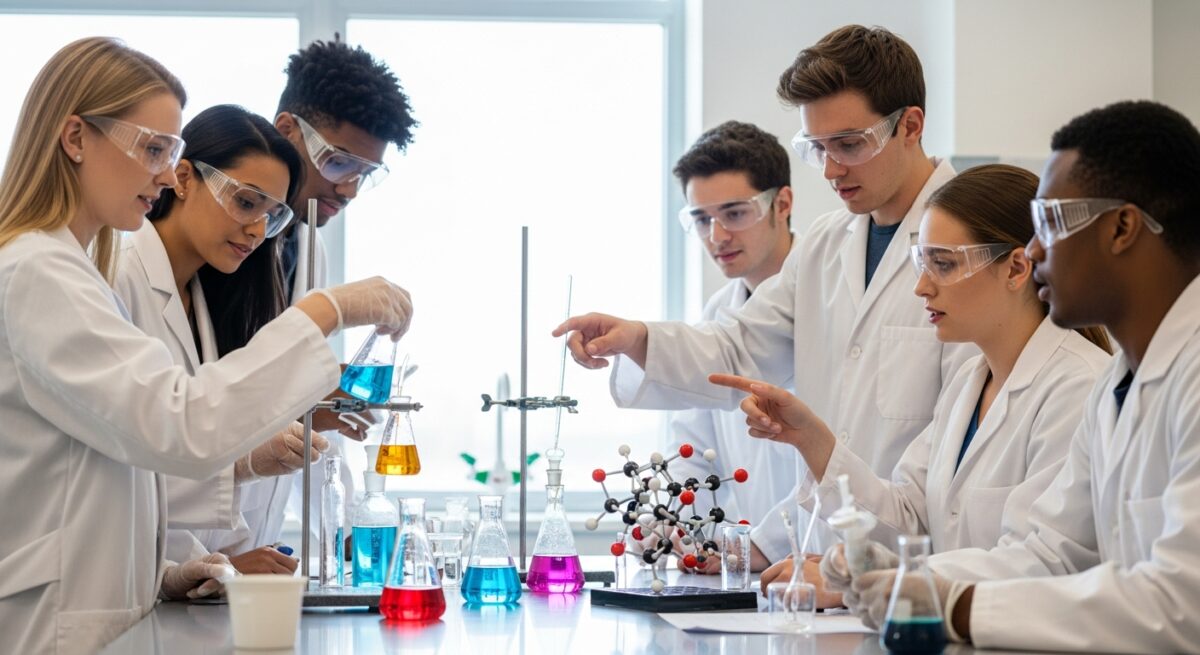
Chemistry is often called the central science for good reason. It bridges physics and biology, explaining how matter behaves at the atomic and molecular level. For students who enjoy problem-solving, laboratory work, and understanding the composition of the world around them, a Bachelor of Science in Chemistry offers a rigorous and versatile foundation. This guide explores the structure of the degree, the skills you will develop, and the wide range of career paths available to graduates. Whether you are a high school student planning your next step or a working adult considering a return to school, understanding the full scope of a BS in Chemistry can help you make an informed decision.
What Is a BS in Chemistry Degree?
A BS in Chemistry is an undergraduate degree that focuses on the study of matter, its properties, how substances interact, and the energy changes that accompany these interactions. Unlike a BA in Chemistry, which often includes more liberal arts requirements and fewer laboratory hours, the BS track is designed for students who want a deep, technically intensive education. Most programs require 120 to 130 credit hours and include extensive lab work, research projects, and advanced coursework in organic, inorganic, physical, analytical, and biochemistry.
This degree is accredited by the American Chemical Society (ACS) at many institutions. Graduating from an ACS-approved program signals to employers and graduate schools that you have met rigorous national standards. The curriculum typically starts with general chemistry and calculus, then advances to thermodynamics, quantum mechanics, spectroscopy, and instrumental analysis. Students also complete a capstone research project or thesis, which provides hands-on experience with scientific inquiry.
Core Curriculum and Specializations
Foundation Courses
The first two years of a bachelor chemistry program build a strong foundation in the sciences and mathematics. You will take general chemistry I and II with labs, organic chemistry I and II with labs, calculus through multivariable calculus, and introductory physics. These courses develop quantitative reasoning and the ability to design experiments, analyze data, and draw evidence-based conclusions.
Advanced Coursework
The upper-division years dive deeper into the major subdisciplines of chemistry. Typical courses include:
- Physical Chemistry: Covers thermodynamics, kinetics, quantum mechanics, and statistical mechanics. This course requires a solid grasp of calculus and physics.
- Inorganic Chemistry: Focuses on the properties and reactions of elements and their compounds, including coordination chemistry and organometallics.
- Analytical Chemistry: Teaches separation techniques, spectroscopy, electrochemistry, and statistical analysis of data.
- Biochemistry: Explores the chemical processes within living organisms, including enzyme kinetics, metabolism, and molecular biology.
- Instrumental Analysis: Provides hands-on training with advanced equipment such as NMR, mass spectrometry, HPLC, and IR spectroscopy.
Many programs also allow students to choose electives or a formal concentration. Common specializations include forensic chemistry, materials chemistry, environmental chemistry, and pre-medical studies. Choosing a specialization early can help you tailor your coursework to specific career goals.
Skills You Develop in a BS in Chemistry Program
Beyond learning chemical theories, a BS in Chemistry builds a versatile skill set that is valuable in many industries. These skills include:
- Analytical thinking: You learn to break down complex problems, identify variables, and design experiments to test hypotheses.
- Laboratory techniques: Proficiency in using equipment like spectrophotometers, chromatographs, and titration apparatus is a core outcome.
- Data analysis and interpretation: You become comfortable with statistical software and mathematical modeling to make sense of experimental results.
- Written and oral communication: Writing lab reports, research papers, and presenting findings to peers and professors prepares you for collaborative work environments.
- Safety and ethics: Understanding laboratory safety protocols and the ethical implications of chemical research is a key component of the curriculum.
These competencies make chemistry graduates attractive to employers in research, manufacturing, healthcare, and government. For those considering further education, these skills also provide a strong foundation for graduate studies in chemistry, pharmacy, medicine, or materials science.
Career Scope for BS in Chemistry Graduates
The career options for chemistry degree holders are broad and often well-compensated. Many graduates find work in industries where chemical knowledge is essential for product development, quality control, or regulatory compliance. Below are some of the most common career paths.
Research and Development Chemist
R&D chemists work in laboratories to discover new compounds, improve existing products, or develop manufacturing processes. They are employed by pharmaceutical companies, chemical manufacturers, consumer goods companies, and biotechnology firms. Entry-level positions typically require a BS in Chemistry, though advancement to senior scientist roles often requires a master’s or PhD. According to the Bureau of Labor Statistics (BLS), the median annual wage for chemists was $80,680 in 2023, with the highest concentrations of employment in pharmaceutical and medicine manufacturing.
Quality Control and Quality Assurance
Quality control (QC) chemists test raw materials and finished products to ensure they meet specifications and regulatory standards. This role is critical in industries such as food and beverage, cosmetics, and pharmaceuticals. QA chemists focus on the systems and processes that prevent defects. Both roles offer stable employment and opportunities for advancement into management positions.
Environmental Chemist
Environmental chemists analyze soil, water, and air samples to detect pollutants and assess environmental impact. They work for government agencies like the Environmental Protection Agency (EPA), consulting firms, and non-profit organizations. This career is particularly rewarding for those passionate about sustainability and public health. The BLS projects a 5% growth in environmental science and protection technician roles over the next decade.
Forensic Chemist
Forensic chemists analyze evidence from crime scenes, such as drugs, explosives, and trace materials. They work for law enforcement agencies, crime laboratories, and private forensic labs. The work is detail-oriented and requires meticulous documentation to support legal proceedings. A BS in Chemistry with coursework in forensic science is the typical entry requirement.
Chemical Technician
Chemical technicians assist chemists and chemical engineers in research, development, and production. They set up and maintain lab equipment, conduct experiments, and record data. This role is a common entry point for graduates who want hands-on experience before pursuing advanced degrees. The median annual wage for chemical technicians was $52,860 in 2023.
Pharmaceutical Sales Representative
Graduates with a BS in Chemistry can leverage their scientific knowledge in sales roles. Pharmaceutical sales representatives explain product benefits to healthcare professionals and build relationships with doctors and hospitals. Strong communication skills and a solid understanding of chemistry are essential for success in this competitive field.
Graduate and Professional School
Many chemistry graduates choose to continue their education. A master’s or PhD in chemistry opens doors to academic research, teaching, and leadership roles in industry. Additionally, a BS in Chemistry is excellent preparation for medical school, dental school, pharmacy school, or law school (especially patent law). The analytical and problem-solving skills you develop are highly valued in these advanced programs.
To explore how your chemistry degree can connect with different institutions and programs, you can use CollegeDegree.Education to compare accredited schools that offer chemistry majors and related degrees. The platform provides tools to help you find programs that match your interests, budget, and schedule.
Job Outlook and Salary Expectations
The overall employment of chemists is projected to grow by 6% from 2022 to 2032, about as fast as the average for all occupations. Demand will be driven by the need for research in pharmaceuticals, biotechnology, and environmental protection. However, competition for basic research positions is strong, and candidates with a master’s or PhD will have the best prospects.
Salary varies by industry and location. The highest-paying industries for chemists include pharmaceutical manufacturing, scientific research and development services, and federal government. Geographically, states with strong pharmaceutical and chemical manufacturing sectors, such as New Jersey, California, and Pennsylvania, tend to offer higher wages. For those with a BS in Chemistry, starting salaries typically range from $45,000 to $65,000, with experienced chemists earning over $100,000 annually.
Frequently Asked Questions
What is the difference between a BA and a BS in Chemistry?
A BA in Chemistry typically requires fewer laboratory hours and more liberal arts coursework. It is often chosen by students who plan to pursue careers in teaching, science writing, or law. A BS in Chemistry is more intensive, with more lab work and advanced science courses. It is the standard choice for students aiming for research, graduate school, or professional programs like medicine or pharmacy.
Can I get a good job with just a BS in Chemistry?
Yes. Many entry-level positions in quality control, environmental testing, and chemical sales are open to graduates with a bachelor’s degree. However, advancement to senior research roles often requires a graduate degree. A BS in Chemistry also provides a strong foundation for further education in related fields.
Is a BS in Chemistry difficult?
The degree is challenging, particularly in the areas of physical chemistry and advanced mathematics. Students who succeed are typically strong in math and science and are willing to dedicate significant time to laboratory work and problem-solving. Support services like tutoring and study groups are available at most universities.
What industries hire the most chemistry graduates?
The largest employers include pharmaceutical and medicine manufacturing, chemical manufacturing, scientific research and development services, and government agencies. Healthcare, food processing, and environmental consulting also hire chemistry graduates in significant numbers.
Can I earn a BS in Chemistry online?
Yes, several accredited universities offer online chemistry degrees. However, laboratory requirements are often fulfilled through on-campus intensive sessions or at-home lab kits. It is important to verify that the program is accredited by a recognized agency and, if possible, by the American Chemical Society.
Making the Most of Your Chemistry Degree
To maximize the value of a BS in Chemistry, consider gaining practical experience during your undergraduate years. Internships at pharmaceutical companies, government labs, or environmental firms provide real-world skills and professional connections. Participating in undergraduate research with a faculty mentor can also strengthen your resume and clarify your career interests. Many students present their research at conferences or publish in undergraduate journals, which builds credibility for graduate school applications.
Networking is equally important. Join the American Chemical Society student chapter at your university, attend career fairs, and connect with alumni working in fields you find interesting. The combination of a strong academic record, hands-on experience, and a professional network will position you well for a successful career.
The BS in Chemistry degree complete guide and career scope outlined here shows that this degree is more than a pathway to a lab coat. It is a versatile credential that opens doors to science, healthcare, law, business, and education. By understanding the curriculum, skills, and opportunities, you can make confident decisions about your education and future career. Learn more