
Brookdale Police Science Associate Degree Guide
Brookdale's 2-year Criminal Justice/Police Science associate degree blends hands-on training with transfer credits for police and public safety careers.

By Elena Markova
Choosing a path into law enforcement or the broader criminal justice system often starts with one practical question: which credential gives you the fastest, most affordable route to a sworn officer role or a related public safety career? For thousands of students in New Jersey, the answer runs through a Criminal Justice/Police Science Associate's degree, usually 2 years In-person at Brookdale Community College. The program blends general education requirements with hands-on police science coursework, and it is designed to move graduates toward entry-level positions or a smooth transfer into a four-year bachelor's program.
Brookdale Community College, located in Lincroft, New Jersey, has built its Police Science track around the realities of local and regional hiring. That means coursework in criminal law, patrol procedures, evidence handling, and community relations, taught in person so students can practice scenarios, use lab equipment, and build the communication skills that police academy instructors and department interview panels look for. This guide breaks down what the degree covers, who it is for, how to apply, what it costs, and how to decide whether this in-person format fits your life.
What the Criminal Justice/Police Science Associate's Degree at Brookdale Covers
At its core, this is a two-year Associate of Science or Associate of Applied Science style program that combines roughly 60 credits of coursework. About half of those credits come from general education: English composition, mathematics, social sciences, and humanities. The other half focuses directly on the criminal justice system. Students typically take Introduction to Criminal Justice, Criminal Law, Criminal Procedure, Criminology, Police Organization and Administration, and courses in corrections and juvenile justice.
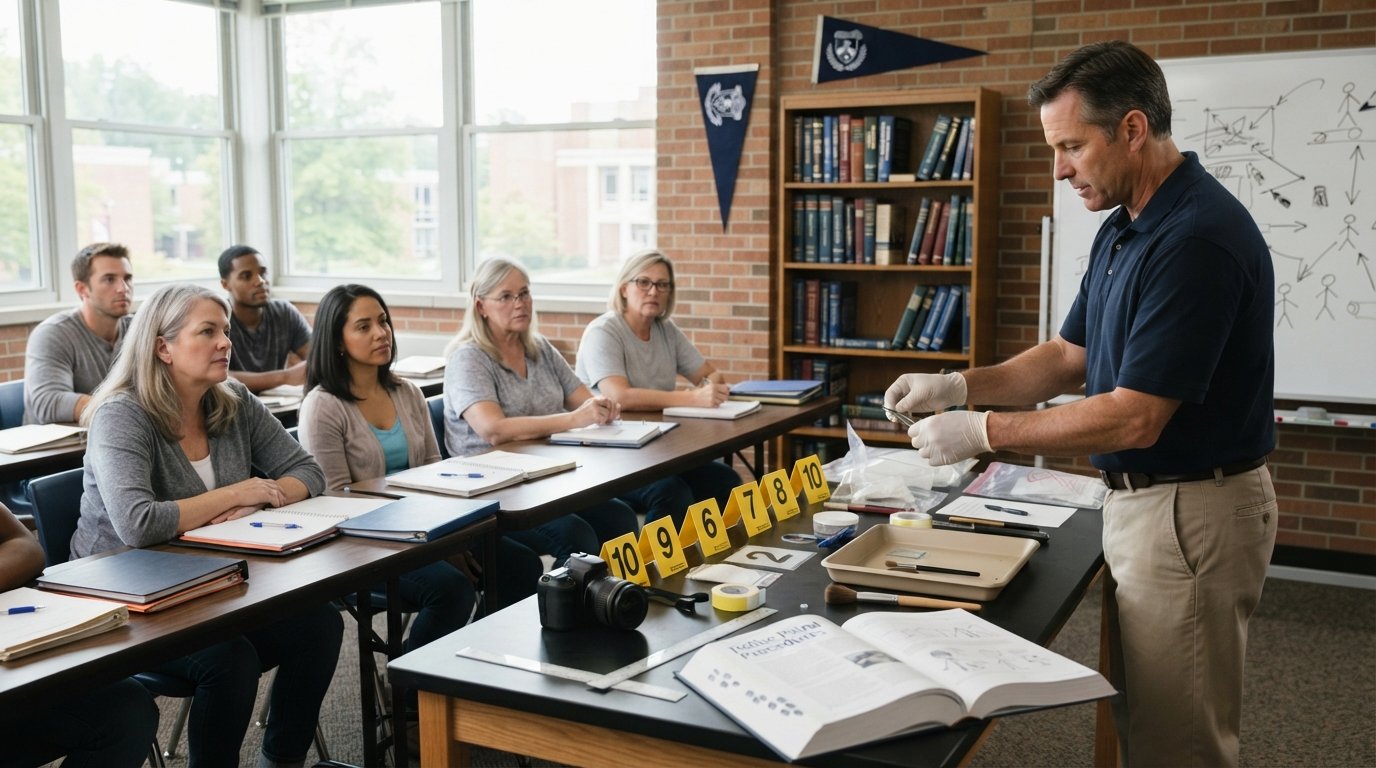
Because the program is delivered in person, lab-style and scenario-based learning plays a bigger role than it would in a fully online format. Students may participate in mock traffic stops, courtroom simulations, evidence collection exercises, and interview and interrogation role-plays. These activities matter because police hiring boards and academy instructors consistently report that recruits who have already practiced verbal de-escalation, report writing, and chain-of-custody procedures adjust faster to academy life.
The degree also satisfies a practical requirement for many New Jersey police departments: a certain number of college credits before or during the hiring process. Earning an associate's degree can place candidates above the minimum threshold and, in some departments, qualify them for higher starting pay or advanced standing. For students who want to continue toward a bachelor's degree, the credits generally transfer to four-year criminal justice programs, especially within New Jersey's public college system. If you want to see how that next step looks, our guide on the Bachelor of Science in Criminal Justice degree guide walks through the upper-division coursework and career options that follow.
One more point about the in-person format: it is not just a delivery method, it is part of the value. Criminal justice is a people-facing field. Learning to read a room, speak clearly under pressure, and work through a chain of command are skills best developed face to face. Brookdale's format puts students in the same room with instructors who often have real police, corrections, or legal experience, and that networking can translate directly into internship leads and recommendation letters.
Who This Program Is Built For
The typical student in this program is not a single profile. Brookdale serves a mix of recent high school graduates, working adults, career changers, and military veterans. What they share is a goal: enter public safety or the legal system without spending four years and tens of thousands of dollars before earning a paycheck.
Recent high school graduates often choose the two-year route because it lets them test the field early. If they discover that policing is not the right fit, they have still earned a transferable degree. If they love it, they can apply to departments or continue to a bachelor's program with momentum. Working adults and career changers usually come in with a different calculation: they need a credential that employers recognize, but they also need to keep working while they study. The in-person schedule at Brookdale includes day, evening, and some weekend options, which helps, though it does require more fixed time commitments than an online degree.
Military veterans are another strong fit. Many have already developed discipline, physical fitness, and familiarity with chain-of-command culture. The associate's degree formalizes that experience and can help veterans qualify for advanced hiring lists or specialized units. Parents and advisors supporting a student should note that this program is also a practical first step for anyone interested in probation, parole, corrections, private security, loss prevention, or court administration, not just sworn police work.
Here is a quick look at the groups that tend to get the most out of the program:
- High school graduates who want a fast, affordable entry into law enforcement or criminal justice
- Working adults seeking a career change with a recognized two-year credential
- Military veterans translating service experience into a civilian public safety role
- Current security or corrections employees who need a degree for promotion
- Students planning to transfer to a four-year criminal justice bachelor's program
If you fall into any of these groups, the next question is not whether the degree is useful, but whether the in-person requirement at Brookdale is workable for your schedule and location. That is a logistics decision as much as an academic one.
Admission Steps and Enrollment Timeline
Brookdale's admission process for this program is designed to be accessible. There is no competitive audition or police academy physical test to enter the degree itself. Instead, applicants complete the college's general admission requirements, which usually include an application, high school transcript or equivalent, and placement testing in math and English. Some students may need to take developmental courses before starting college-level work, which can extend the timeline slightly.
Because the program is in person, prospective students should also plan for campus visits, parking, and commute time. Brookdale's Lincroft campus is the primary location, and students should confirm whether any required courses are offered at regional locations or satellite sites. Advising matters here: a criminal justice advisor can map out a two-year sequence that keeps prerequisites in order and avoids wasted credits.
A practical enrollment timeline looks like this:
- Submit the Brookdale application and official transcripts several months before the term starts.
- Complete placement testing or submit SAT, ACT, or prior college credits for exemption.
- Meet with a criminal justice advisor to build a two-year course plan.
- Apply for financial aid using the FAFSA, and check for New Jersey state aid programs.
- Register for first-semester courses early, since in-person sections can fill quickly.
Students who follow this sequence generally start in the fall with a clear map. Spring starts are possible but can require careful scheduling because some courses are offered only once per year. The key is to treat advising as a required step, not an optional one.
Cost, Financial Aid, and Return on Investment
Community college tuition is one of the strongest arguments for this path. Brookdale's per-credit rates for in-county residents are significantly lower than four-year public or private university rates. For a roughly 60-credit associate's degree, in-county students can often complete the program for a fraction of the cost of a bachelor's degree, especially if they commute from home and buy used textbooks.
Financial aid options include federal Pell Grants, New Jersey Tuition Aid Grants, work-study, and student loans. Many law enforcement agencies also offer tuition reimbursement or educational incentives for officers who earn degrees while employed. That means a student could start with the associate's degree, get hired, and then use employer benefits to fund a bachelor's degree later. This staged approach lowers debt and keeps earning power moving forward.
When weighing return on investment, consider more than tuition. In-person attendance adds transportation and possibly childcare costs. However, it also opens access to internships, ride-alongs, and direct recruiter visits that online programs struggle to match. For many students, the in-person format is what turns a degree into a job offer. If cost is the main barrier, resources like CollegeDegrees.School can help you compare affordable degree pathways and financial aid strategies before you commit.
It also helps to compare this program against a four-year bachelor's degree in criminal justice. The bachelor's degree offers broader promotion potential and access to federal or specialized roles, but it costs more and takes longer. The associate's degree gets you into the workforce faster, and you can always add the bachelor's later. For a detailed comparison of degree levels, career outcomes, and transfer options, CollegeDegree.Education's matching tools and program guides are built for exactly this kind of decision.
Career Outcomes and Transfer Pathways
Graduates of the Criminal Justice/Police Science Associate's degree, usually 2 years In-person at Brookdale Community College, pursue a range of roles. The most direct path is municipal or county police officer, but the degree also supports careers in corrections, probation, parole, court administration, private security, loss prevention, and emergency management. Some graduates use the degree to enter the military as an officer candidate or to qualify for federal technician roles.
Hiring in New Jersey and similar states often involves a written exam, physical fitness test, background investigation, psychological evaluation, and interview. The associate's degree does not replace those steps, but it can satisfy college credit requirements and improve your standing in the applicant pool. Some departments offer preference points or higher starting salaries for candidates with a degree, which can add up over a career.
For students who want to keep studying, transfer pathways are well established. New Jersey has articulation agreements that allow associate's degree holders to enter bachelor's programs as juniors, provided they choose courses carefully. A criminal justice advisor can identify which general education and elective courses transfer most cleanly. Common bachelor's majors include Criminal Justice, Criminology, Public Administration, Sociology, and Homeland Security.
It is also worth noting that the degree is not a guarantee of employment. Hiring depends on background checks, fitness, interviews, and department needs. But the credential removes a common barrier and signals commitment to the field. That signal matters, especially in competitive hiring cycles.
How to Decide If the In-Person Brookdale Program Fits You
The in-person requirement is the biggest practical difference between this program and online alternatives. If you live near Lincroft, have reliable transportation, and can commit to daytime or evening classes, the format is a strength. You get labs, scenario training, face time with instructors who have field experience, and a cohort of peers who may become professional contacts.
If you are balancing a full-time job, frequent travel, or caregiving responsibilities, an online criminal justice associate's degree may be more realistic. Online programs offer flexibility, but they often lack the hands-on practice and local networking that in-person programs provide. The right choice depends on your priorities: speed and flexibility versus immersion and local connections.
A simple decision framework can help:
- Choose Brookdale in person if you want hands-on training, local recruiter access, and a structured campus schedule.
- Choose an online program if you need maximum flexibility and can arrange your own internship or field experience.
- Choose a bachelor's degree directly if you want federal, specialized, or leadership roles and can invest four years.
- Choose a hybrid path if you start at Brookdale and transfer to a four-year school after earning the associate's degree.
Whichever route you choose, verify accreditation and confirm that the program meets the hiring standards of the departments you are targeting. Requirements vary by state and agency, so a quick call to a recruiter can save months of misdirected effort.
For prospective students who want to compare multiple degree levels, formats, and fields before committing, CollegeDegree.Education offers a matching service that connects you with accredited colleges and universities. You can explore criminal justice programs, request information from schools, and compare costs and schedules without pressure. The platform is compensated by featured schools, so placements are influenced by partnerships, but the tools still give you a practical starting point.
A Criminal Justice/Police Science Associate's degree, usually 2 years In-person at Brookdale Community College, is more than a credential. It is a structured on-ramp to a public safety career, built around the skills, credits, and connections that hiring departments actually value. If the in-person format matches your life right now, it can be one of the most efficient steps you take toward a badge, a courtroom role, or a four-year degree. If it does not, the same field offers flexible alternatives. The important move is to choose deliberately, verify the details, and start with a plan rather than a guess.