
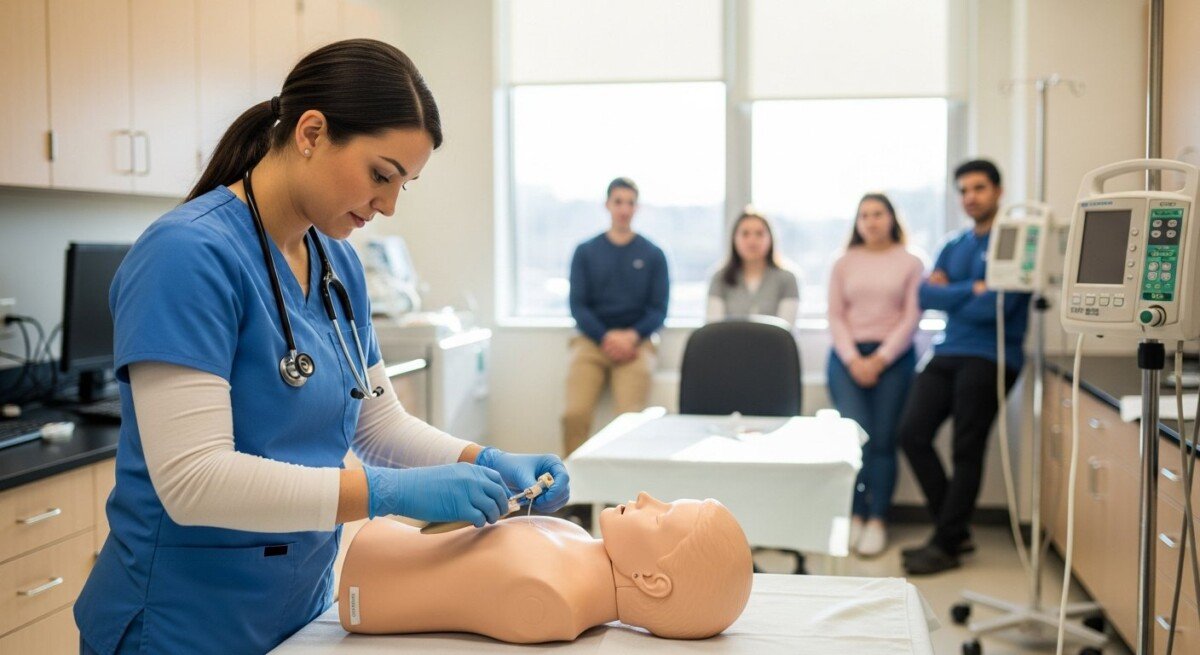
Become a Nurse in Alaska: Your Associate Degree in Nursing Guide
Launch a stable, high-demand nursing career in Alaska with a two-year Associate Degree in Nursing (ADN). This guide details programs, salaries, and state-specific scholarships.

By Alex Jordan
Alaska’s vast and rugged landscape presents unique healthcare challenges, creating a consistent and pressing demand for skilled nurses. For those seeking a direct, efficient, and respected pathway into this vital profession, an Associate Degree in Nursing (ADN) in Alaska stands as a powerful launchpad. This two-year degree program, offered at community colleges and technical schools across the state, equips students with the clinical knowledge and hands-on skills required to sit for the NCLEX-RN licensure exam and begin a rewarding career as a Registered Nurse (RN). With Alaska facing specific healthcare provider shortages, particularly in rural and remote communities, ADN graduates are positioned not just for employment, but for meaningful, impactful work in a state that deeply values its healthcare workforce.
Why Choose an ADN Program in Alaska?
Choosing to pursue an associate degree in nursing in Alaska is a strategic decision influenced by the state’s distinct demographics, employment landscape, and educational opportunities. Unlike more populous states, Alaska’s healthcare system relies heavily on a robust pipeline of practical, ready-to-work nurses who can adapt to diverse settings, from large hospitals in Anchorage to small clinics in the Bush. The ADN pathway is particularly attractive for its balance of speed, affordability, and focused curriculum. It provides the essential nursing competencies without the extended timeline and general education requirements of a four-year Bachelor of Science in Nursing (BSN). For career-changers, military veterans, and those with family obligations, the shorter duration is a significant advantage, allowing a quicker transition into the workforce and the ability to start earning a competitive RN salary sooner.
Furthermore, Alaska’s educational institutions design their ADN programs with state-specific needs in mind. Coursework and clinical rotations often include considerations for rural health, cross-cultural communication with Alaska Native populations, and the logistical realities of providing care in isolated environments. This localized focus ensures graduates are not just nationally-licensed nurses, but Alaskan-ready healthcare professionals. The financial aspect is also critical. Community colleges typically offer lower tuition rates than universities, and when combined with Alaska’s various scholarship and loan repayment programs for healthcare workers, especially those willing to work in underserved areas, the ADN becomes an economically savvy choice for launching a stable, well-compensated career.
Top ADN Programs and Schools in Alaska
Prospective students have several excellent options for obtaining an associate degree in nursing in Alaska. Each program is accredited by the Accreditation Commission for Education in Nursing (ACEN) or the Commission on Collegiate Nursing Education (CCNE), a non-negotiable requirement for licensure. The University of Alaska system hosts the most prominent programs. The University of Alaska Anchorage (UAA) offers a highly regarded ADN program at its main campus and through its community campuses, providing both traditional and flexible scheduling options to accommodate different student needs. Similarly, the University of Alaska Fairbanks (UAF) and the University of Alaska Southeast (UAS) in Juneau provide pathways, though program availability may vary by semester and campus.
Beyond the UA system, other institutions play a key role. Charter College, with campuses in Anchorage and Wasilla, offers an accelerated ADN program designed for faster completion. Ilisagvik College in Utqiaġvik (Barrow) is a tribal college that provides culturally resonant education and is crucial for developing a local nursing workforce for the North Slope region. When selecting a program, students should scrutinize several factors beyond accreditation. NCLEX-RN first-time pass rates are a paramount indicator of program quality and effectiveness. High pass rates suggest strong preparation. Clinical placement opportunities and partnerships with local healthcare facilities are equally important, as they determine the breadth and quality of hands-on experience. Finally, program format is key; many students, especially working adults, seek hybrid or online-friendly ADN programs that deliver theory online while coordinating in-person clinicals locally, a model that is expanding access across the state.
Admissions Requirements and Curriculum Overview
Gaining entry into an Alaska ADN program is competitive, requiring careful preparation. While specific prerequisites vary, a common set of requirements forms the baseline. Programs typically mandate a high school diploma or GED, completion of specific college-level prerequisite courses with a minimum GPA (often a 2.5 or higher), and a satisfactory score on an entrance exam like the TEAS (Test of Essential Academic Skills). Prerequisite courses almost always include anatomy & physiology, microbiology, English composition, and psychology. Many programs have a selective admissions process that points applicants based on GPA, TEAS scores, and sometimes healthcare experience or other criteria.
The ADN curriculum itself is an intensive blend of classroom theory, laboratory simulation, and supervised clinical practice. Over four to five semesters, students progress through a structured sequence of courses. The core nursing coursework covers fundamental topics that build upon each other.
- Foundations of Nursing: Introduces core principles, nursing process, basic skills, and professional ethics.
- Adult Health Nursing (Medical-Surgical): The cornerstone of the curriculum, focusing on caring for adults with various medical and surgical conditions.
- Mental Health Nursing: Addresses psychiatric nursing principles and therapeutic communication.
- Leadership and Management: Prepares students for the RN role, covering delegation, prioritization, and healthcare systems.
Maternal-Child Health Nursing: Covers care through pregnancy, childbirth, postpartum, and pediatric nursing.
Clinical rotations are integrated throughout, allowing students to apply knowledge in real-world settings such as hospitals, long-term care facilities, community clinics, and sometimes public health departments. This rigorous curriculum is designed to culminate in a comprehensive capstone or preceptorship, where students work one-on-one with an RN, solidifying their readiness for practice and the NCLEX-RN exam.
Career Outlook and Salary for ADN Nurses in Alaska
The career outlook for ADN-prepared Registered Nurses in Alaska is exceptionally strong, driven by an aging population, high rates of chronic disease, and the geographic isolation of many communities. The Alaska Department of Labor and Workforce Development consistently projects RN jobs among the top occupations for growth. This demand translates into high job security and competitive salaries. According to data from the U.S. Bureau of Labor Statistics, the mean annual wage for Registered Nurses in Alaska is significantly higher than the national average, often ranking among the top states for RN pay. This is due in part to the state’s high cost of living and the critical need to attract and retain healthcare talent.
ADN graduates can find immediate employment in a wide array of settings. Major hospitals in Anchorage, Fairbanks, and Juneau are primary employers, offering positions in medical-surgical units, emergency departments, operating rooms, and more. Beyond urban centers, opportunities abound in rural health clinics, tribal health organizations like the Alaska Native Tribal Health Consortium (ANTHC), long-term care facilities, public health nursing, and school nursing. For those seeking adventure and a high-impact role, travel nursing assignments within Alaska are also plentiful. It is important to note the growing emphasis on the BSN degree, often referred to as “BSN-in-10” initiatives in some states. While Alaska does not currently have such a law, many hospital employers, especially larger systems, strongly prefer or require nurses to obtain a BSN within a certain timeframe after hire. Fortunately, Alaska’s educational infrastructure supports this progression seamlessly, with multiple RN-to-BSN completion programs available entirely online, allowing nurses to work full-time while advancing their education. For detailed financial planning for this next educational step, prospective students can seek college degree guidance on tuition and scholarship comparison.
Licensure: The NCLEX-RN and Alaska Board of Nursing
Successfully completing an ADN program is the first major step; obtaining a license from the Alaska Board of Nursing (ABON) is the final, essential hurdle to practice as an RN. The process is straightforward but requires attention to detail. After graduation, the ADN graduate must apply for licensure by examination with the ABON. This involves submitting an application, fees, and an official transcript showing degree conferral. Once the board authorizes it, the graduate registers with Pearson VUE to take the National Council Licensure Examination for Registered Nurses (NCLEX-RN). This computerized adaptive test evaluates the competencies needed to perform safely and effectively as an entry-level nurse.
Passing the NCLEX-RN is mandatory. Alaska ADN programs pride themselves on maintaining high first-time pass rates, which is a key metric for prospective students to research. After passing the exam, the ABON issues the RN license. Nurses must then renew their license every two years, which involves completing continuing education requirements. For nurses educated in other states who wish to work in Alaska, the process is licensure by endorsement, which involves verifying an existing, unencumbered license from another state. The ABON website is the definitive resource for all forms, rules, and current requirements.
Financial Aid and Scholarship Opportunities
Funding an associate degree in nursing in Alaska is a major consideration, but numerous state-specific resources can significantly offset costs. The first step for any student is to complete the Free Application for Federal Student Aid (FAFSA), which unlocks federal grants, loans, and work-study funds. Alaska also offers exceptional scholarship programs aimed directly at building its healthcare workforce. The Alaska Commission on Postsecondary Education (ACPE) administers several programs, including the Alaska Education Grant for low-income students and the WWAMI Medical Program opportunities, though some are for specific disciplines.
More targeted for nursing are loan repayment and scholarship-for-service programs. The SHARP (Supporting Health care Access through Rural Professions) program and the Alaska SHARP II program offer loan repayment for healthcare professionals, including RNs, who commit to working in designated shortage areas. These programs can repay tens of thousands of dollars in student debt in exchange for a service commitment. Many tribal health organizations, such as the Southcentral Foundation or the Yukon-Kuskokwim Health Corporation, also offer scholarships or paid training opportunities in exchange for a work commitment after graduation. Additionally, individual universities and community colleges have foundation scholarships specifically for nursing students. A proactive search and application for these funds can make an Alaska ADN not only affordable but potentially low-debt.
Frequently Asked Questions
Can I complete an ADN program in Alaska online?
While the lecture/theory components of many ADN programs are increasingly offered online or in hybrid formats, the clinical component cannot be completed remotely. You must attend in-person clinical rotations at approved healthcare facilities in Alaska. Some programs are designed for distance students, coordinating local clinical placements wherever you live in the state.
How long does it take to complete an ADN in Alaska?
A full-time student can typically complete an associate degree in nursing in Alaska in two years (four semesters). This assumes the student has already completed the necessary prerequisite courses. Part-time tracks are available at some schools but will extend the timeline.
Is an ADN from Alaska respected in other states?
Yes. Because Alaska ADN programs are nationally accredited, graduates are eligible to take the NCLEX-RN for initial licensure. Once you hold an Alaska RN license, you can apply for licensure by endorsement in another state through the Nurse Licensure Compact (NLC) if Alaska joins, or through that state’s individual endorsement process. Your education meets national standards.
What is the difference between an ADN and a Practical Nursing (PN) certificate?
An ADN is a two-year degree that prepares you to become a Registered Nurse (RN), with a broader scope of practice, leadership responsibilities, and higher earning potential. A PN certificate is a one-year program that prepares you to become a Licensed Practical Nurse (LPN), who works under the supervision of an RN or physician. An ADN is the more comprehensive pathway to an RN career.
Do I need a BSN after my ADN?
You do not need a BSN to begin working as an RN in Alaska. However, many hospitals, especially magnet-designated facilities, strongly encourage or require RNs to earn a BSN within a few years of hire. Numerous online RN-to-BSN programs are available, allowing you to work full-time while completing the degree, often in 1-2 years. The process is similar for nurses elsewhere, as detailed in our guide on how to earn your associate degree in nursing in Delaware and advance.
Pursuing an associate degree in nursing in Alaska is a decision that merges personal ambition with public service. It opens the door to a profession defined by stability, respect, and the profound satisfaction of meeting a critical community need. From the urban medical centers to remote village clinics, ADN-prepared nurses form the backbone of Alaskan healthcare. By carefully selecting an accredited program, leveraging financial aid, and committing to the rigorous journey, you can position yourself at the heart of this essential field, building a rewarding career while making a tangible difference in the lives of Alaskans.