
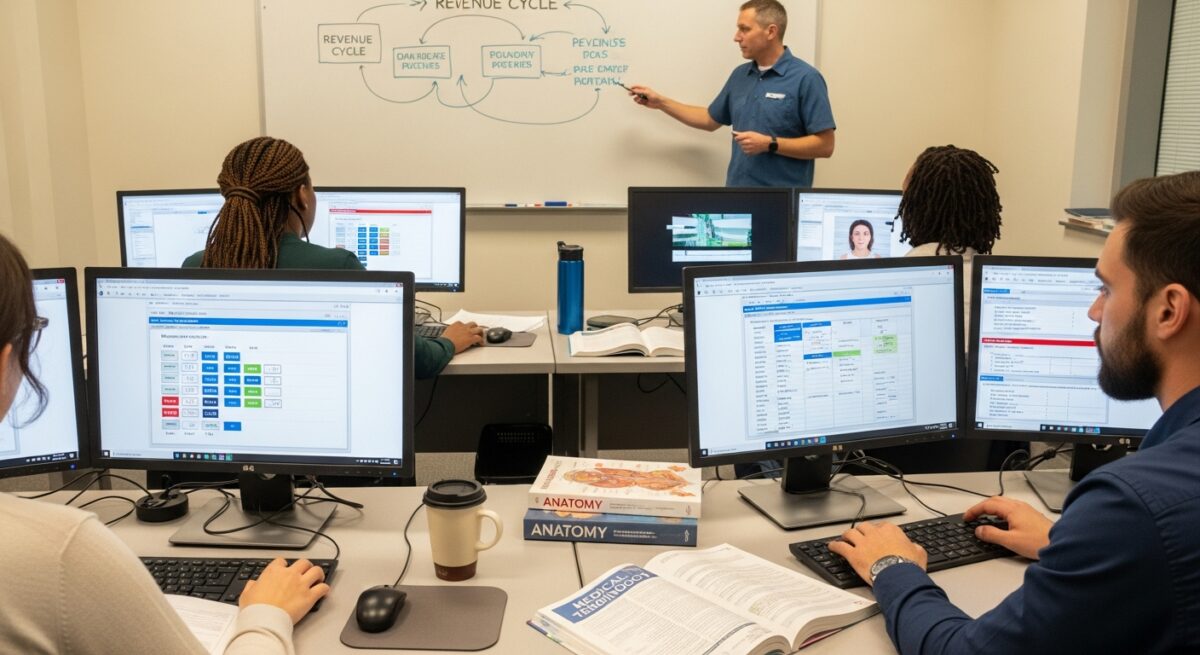
If you are looking for a stable healthcare career that does not require years of medical school or direct patient contact, medical coding might be the right path for you. Medical coding professionals translate patient diagnoses, treatments, and procedures into standardized alphanumeric codes used for billing, insurance claims, and health records. This role is critical to the healthcare revenue cycle, and demand for trained coders continues to grow. Medical Coding Diploma Programs Explained in this article will help you understand what these programs offer, how they differ from degrees, what you will learn, and how to choose the right one for your career goals.
Unlike a full associate or bachelor’s degree, a diploma program focuses exclusively on the skills you need to begin working as a medical coder. Most programs can be completed in less than one year, making them an attractive option for career changers, working adults, and anyone seeking a fast track into healthcare administration. The curriculum typically covers medical terminology, anatomy and physiology, coding systems such as ICD-10-CM, CPT, and HCPCS Level II, as well as reimbursement methodologies and healthcare law. By the end of the program, you will be prepared to sit for nationally recognized certification exams like the Certified Professional Coder (CPC) exam offered by the American Academy of Professional Coders (AAPC) or the Certified Coding Associate (CCA) exam from the American Health Information Management Association (AHIMA).
In our guide on Medical Coding Associate Degree Career Guide 2026, we explain how an associate degree compares to a diploma. The key difference is that diploma programs are shorter and more focused, while degree programs include general education courses that can open doors to management roles later. For someone who wants to enter the workforce quickly, a diploma is often the most efficient route. However, both paths lead to the same entry-level coding positions, and many employers value certification more than the type of credential.
What Is a Medical Coding Diploma Program?
A medical coding diploma program is a postsecondary training program that typically lasts between 9 and 12 months. It is offered by community colleges, vocational schools, and online institutions. Unlike an associate degree, which usually requires 60 credit hours and includes subjects like English composition and math, a diploma program concentrates on coding-specific coursework. You will spend most of your time learning how to assign codes to diagnoses and procedures, understand medical records, and comply with insurance and regulatory requirements.
Most programs require a high school diploma or GED for admission. Some also ask for basic computer skills and a typing speed of at least 30 words per minute. Because medical coding is detail-oriented, programs often include a capstone project or a practicum where you code real-world medical records under supervision. This hands-on experience is invaluable when you start applying for jobs.
Graduates of medical coding diploma programs are eligible to sit for entry-level certification exams. Many employers prefer or require certification, so this is a crucial step. The diploma itself demonstrates that you have completed formal training, but certification proves you have passed a standardized test and meet national competency standards. Together, a diploma and certification make you a competitive candidate in the job market.
Core Subjects You Will Study
The curriculum in a medical coding diploma program is designed to build both foundational knowledge and practical coding skills. Here are the main subject areas you can expect:
- Medical Terminology: You will learn the roots, prefixes, and suffixes used in medical language. This is essential for understanding physician notes and selecting the correct codes.
- Anatomy and Physiology: A basic understanding of body systems, organs, and disease processes helps you code accurately. You do not need to be a doctor, but you need to know where the spleen is and what pneumonia means.
- ICD-10-CM Coding: This is the system used for diagnosis coding. You will learn how to read diagnostic statements and assign the correct code from the International Classification of Diseases, 10th Revision, Clinical Modification.
- CPT and HCPCS Level II Coding: Current Procedural Terminology (CPT) codes are used for procedures and services. HCPCS Level II codes cover supplies, equipment, and some services not included in CPT. You will practice coding surgeries, office visits, lab tests, and more.
- Healthcare Reimbursement and Compliance: This covers how insurance companies pay claims, the role of medical necessity, and laws like HIPAA that protect patient privacy. Understanding the revenue cycle is key to becoming a valuable employee.
Most programs also teach you how to use electronic health record (EHR) software and coding encoders. These tools help you look up codes quickly and reduce errors. By the time you graduate, you will have practiced on software that is similar to what you will use in a hospital, clinic, or billing company.
Diploma vs. Certificate vs. Associate Degree: What Is the Difference?
Prospective students often confuse diplomas with certificates and degrees. While all three can lead to a career in medical coding, they differ in length, depth, and academic requirements. A certificate program is usually the shortest option, sometimes lasting only a few months, and it focuses narrowly on coding skills without much background science. A diploma program is longer and includes more foundational coursework like anatomy and medical terminology. An associate degree takes two years and includes general education classes.
Employers generally view diplomas and associate degrees as more rigorous than short certificates. However, certification from AAPC or AHIMA often matters more than the type of academic credential. Many diploma programs are designed to align with the content of certification exams, making them a smart choice if your goal is to pass the CPC or CCA on your first attempt.
Another important factor is cost. Diploma programs are typically less expensive than associate degrees because they have fewer credit hours. They also take less time, which means you can start earning a salary sooner. If you are on a tight budget or need to enter the workforce quickly, a diploma program offers the best balance of cost, time, and job readiness.
Online vs. On-Campus Medical Coding Diploma Programs
Many accredited schools offer medical coding diploma programs entirely online. This flexibility is ideal for students who work full-time, have family obligations, or live far from a campus. Online programs use video lectures, interactive coding exercises, and virtual labs to teach the same material as in-person classes. You will still have access to instructors through email, discussion boards, or live office hours.
On-campus programs provide a structured schedule and face-to-face interaction with instructors and classmates. Some students prefer this environment because it keeps them accountable and allows for immediate questions. If you learn best in a classroom setting, an on-campus program might be a better fit. However, many employers and certification bodies do not distinguish between online and on-campus graduates as long as the school is properly accredited.
When choosing between online and on-campus, consider your learning style, schedule, and access to technology. Online programs require self-discipline and reliable internet. On-campus programs require commuting or relocating. Both options can lead to the same career outcomes, so the choice comes down to personal preference.
Accreditation Matters: Why It Is Important
Accreditation is a quality assurance process that ensures a school or program meets certain educational standards. For medical coding diploma programs, accreditation from organizations like the Commission on Accreditation for Health Informatics and Information Management Education (CAHIIM) or the Accrediting Bureau of Health Education Schools (ABHES) is a strong indicator of program quality. Graduating from an accredited program may also be required to sit for certain certification exams.
If you enroll in a non-accredited program, you risk wasting time and money. Your diploma may not be recognized by employers, and you might not be eligible to take the CPC or CCA exam. Always verify a school’s accreditation status before applying. You can check the U.S. Department of Education’s database of accredited postsecondary institutions to confirm.
Accreditation also affects your ability to transfer credits if you later decide to pursue an associate or bachelor’s degree. If you complete a diploma at an accredited school, some of those credits may count toward a degree program later. This gives you flexibility to advance your education without starting over.
Career Outlook and Salary Expectations
The U.S. Bureau of Labor Statistics projects that employment for medical records specialists, which includes medical coders, will grow faster than the average for all occupations over the next decade. An aging population and the continued shift to electronic health records drive this demand. Hospitals, physician offices, outpatient clinics, insurance companies, and consulting firms all need skilled coders.
Entry-level medical coders with a diploma and certification can expect to earn between $35,000 and $45,000 per year, depending on location and employer. With a few years of experience, salaries often rise to $50,000 to $65,000. Coders who specialize in areas like outpatient surgery, emergency medicine, or risk adjustment coding can earn even more. Remote work is also common in this field, which adds flexibility for many professionals.
For those who want to advance, a diploma can be a stepping stone to roles like coding auditor, compliance officer, or health information manager. Many of these positions require an associate or bachelor’s degree, but your diploma gives you a head start. Some employers offer tuition reimbursement to help you continue your education while you work.
Frequently Asked Questions
How long does it take to complete a medical coding diploma program?
Most programs take 9 to 12 months of full-time study. Part-time options may take 18 to 24 months. Online programs often allow you to work at your own pace, which can shorten or lengthen the timeline.
Do I need certification after earning a diploma?
While not always required, certification is strongly recommended. Most employers prefer or require a credential like the CPC or CCA. A diploma alone may limit your job opportunities and earning potential.
Can I work from home as a medical coder?
Yes, many medical coding jobs are remote. After gaining some experience and proving your accuracy, many coders transition to work-from-home positions. Some employers offer remote training for new graduates as well.
What is the difference between medical coding and medical billing?
Medical coding focuses on assigning codes to diagnoses and procedures. Medical billing uses those codes to submit claims to insurance companies and follow up on payments. Some roles combine both tasks, and many diploma programs cover both topics. You can also find specialized medical billing and coding specialist courses that blend the two skills.
Are medical coding diploma programs expensive?
Costs vary widely. Public community colleges may charge $2,000 to $5,000 for a diploma program. Private vocational schools can cost $10,000 to $20,000. Online programs often fall in the middle. Financial aid, scholarships, and payment plans are available at many schools.
How to Choose the Right Program for You
Choosing a medical coding diploma program requires research. Start by looking for programs accredited by CAHIIM or ABHES. Next, compare the curriculum to the content of certification exams to ensure the program covers what you need. Read reviews from alumni and check job placement rates. Some schools publish the percentage of graduates who pass certification exams on their first attempt, which is a useful metric.
Consider the format that fits your life. If you need to keep working while you study, an online program with asynchronous classes may be best. If you thrive in a classroom environment, look for a local community college with evening or weekend options. Many schools also offer career services, such as resume writing help and job placement assistance, which can make a big difference after graduation.
Finally, think about your long-term goals. If you eventually want to earn a degree, choose a diploma program that has articulation agreements with associate or bachelor’s degree programs. This way, your diploma credits will not be wasted. A well-chosen program can serve as a foundation for a lifelong career in healthcare administration.
Medical coding is a rewarding field that combines analytical thinking with healthcare knowledge. A diploma program offers the fastest route to entry, but it requires dedication and attention to detail. If you are ready to start a career that offers stability, growth, and the option to work remotely, a medical coding diploma is a smart investment in your future.
To explore accredited medical coding diploma programs and connect with schools that match your needs, visit CollegeDegree.school for personalized matching and program comparisons. Taking the first step toward your new career is easier than you think.